
1 min walk · Paris 9e Arrondissement
Sainte-Rita Chapel
- High
- Place of worship
Language · 11 published
Art and culture venue · Paris 18e Arrondissement, Paris
Reviewed by Elena Voss · Roavina Travel Editor
| Monday | 20:00 – 23:30 |
|---|---|
| Tuesday | 20:00 – 23:30 |
| Wednesday | 20:00 – 23:30 |
| Thursday | 20:00 – 23:30 |
| Friday | 20:00 – 23:30 |
| Saturday | 20:00 – 23:30 |
| Sunday | 20:00 – 23:30 |
Checked 2026-08-24 · Source
This place is a Theatre. It opened in 1889.
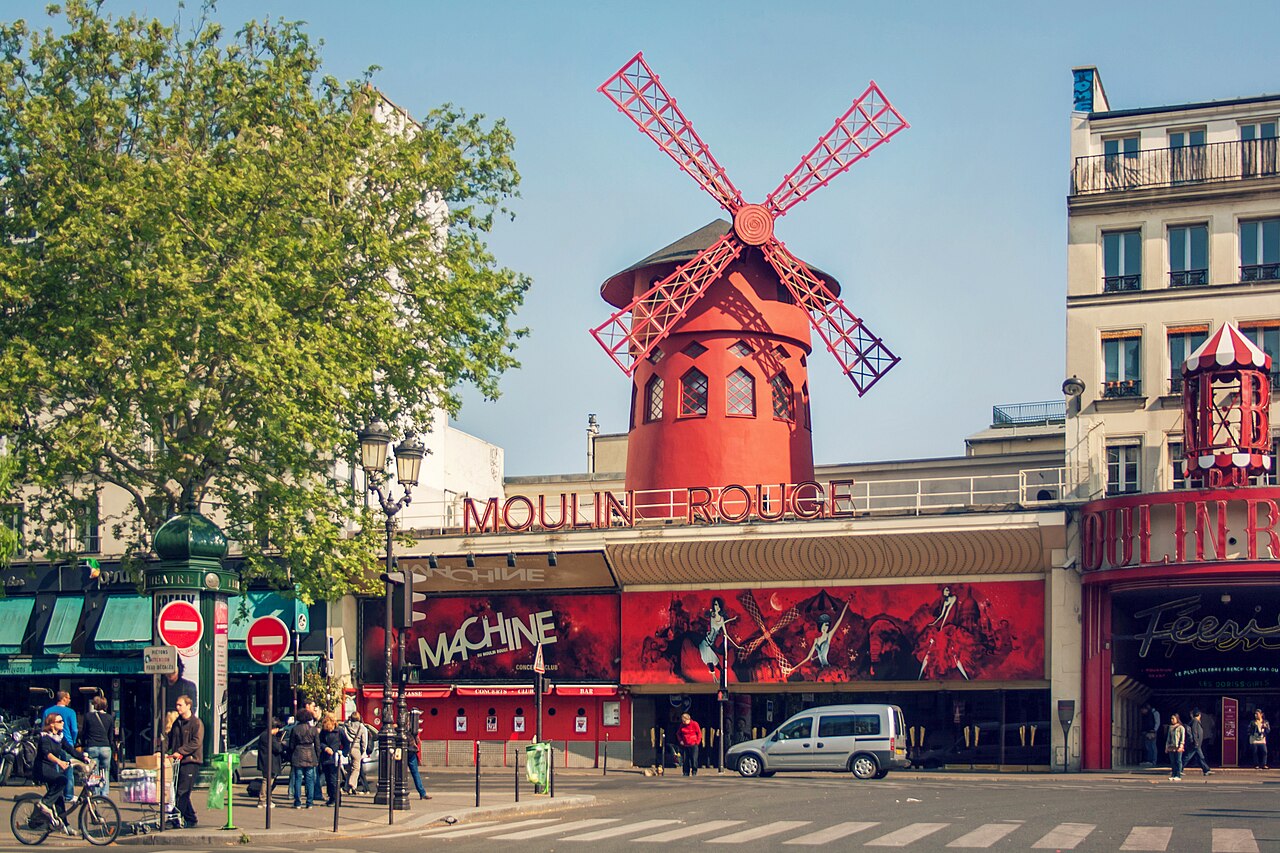
Moulin Rouge is the famous cabaret on Boulevard de Clichy in Pigalle, at the southern foot of Montmartre. Its illuminated red windmill marks a venue closely associated with the French cancan and Parisian nightlife. Joseph Oller and Charles Zidler opened it on 6 October 1889, the same year the Eiffel Tower was completed. Henri de Toulouse-Lautrec helped make its performers and atmosphere internationally recognisable through his posters and lithographs. Today, the Moulin Rouge remains a seated cabaret theatre built around a choreographed revue, music, costumes and the cancan. A red windmill on a Pigalle façade marks the cabaret that turned the French cancan into a Paris export. Joseph Oller and Charles Zidler opened the Moulin Rouge on 6 October 1889, at the foot of Montmartre, the same year the Eiffel Tower went up across the city for the World's Fair.
Checked 2026-08-24 · Source
The Moulin Rouge presents a staged revue rather than a museum-style tour or casual entertainment space. The current show is Féerie, a sequence of themed numbers accompanied by a live orchestra. Elaborate costumes, choreography and the cancan form the centre of the experience, with guests seated at tables throughout the performance. Dinner-and-show and champagne-show formats shape the evening differently, but both are designed as complete productions. The façade's red windmill is the most recognisable exterior feature, while the interior belongs to a working theatre whose layout is experienced through a booked performance.
Checked 2026-08-24 · Source
Allow around two hours for the show itself. A dinner-and-show booking requires a longer evening because the meal is served before the revue begins. The experience follows a fixed performance schedule, so it is better suited to a planned evening than to an open-ended sightseeing stop. Arrive with enough time to enter, settle at the assigned table and complete any included dining service before the curtain. Leaving partway through would interrupt a continuous theatrical performance and is not the natural way to experience the venue.
Checked 2026-08-24 · Source
Choose the performance that fits the rest of your Paris plans, then leave time for arrival and seating before the stated start. Earlier and later evening performances both attract visitors, so the best choice depends on whether you want dinner afterwards or a later night in Pigalle. The venue is especially easy to combine with a walk around Montmartre or the neighbouring streets before the show.
Checked 2026-08-24 · Source
Entry is through a booked performance. The venue offers champagne-show and dinner-and-show formats, with different seating categories and positions relative to the stage. Select the format that matches the kind of evening you want: champagne keeps the focus on the revue, while dinner makes the visit a longer combined meal and theatre experience. Use the venue's own booking page for the available performance and seating choices. The Moulin Rouge is not a drop-in attraction where visitors enter simply to see the windmill or interior.
Checked 2026-08-24 · Source
Moulin Rouge stands on Boulevard de Clichy in Pigalle, in Paris's 18th arrondissement. Blanche station on Métro line 2 is directly outside the venue. Pigalle station, served by lines 2 and 12, is a short walk east along the boulevard. The location works well as part of a wider Montmartre evening because the theatre sits at the hill's southern foot, close to the lively streets of Pigalle. Plan the route around the booked show time rather than treating the venue as an unscheduled stop.
Checked 2026-08-24 · Source
Shows follow a strict schedule and seating is assigned, so arriving late can mean missing part of the performance rather than joining whenever convenient. The atmosphere is theatrical and the venue suits visitors seeking a formal night out more than casual sightseeing. Smart clothing fits the setting, particularly for dinner bookings and closer seating. Pigalle is busy and strongly associated with nightlife, so expect a lively streetscape when walking to and from a late performance. Keep the evening's return route in mind before the show begins.
Checked 2026-08-24 · Source
The illuminated red windmill on the façade is the strongest photograph associated with Moulin Rouge. Stand across Boulevard de Clichy to include the full sign and the entrance, especially around dusk when the red neon contrasts with the remaining daylight. Inside the theatre, the performance is the subject of the visit rather than a photographic opportunity, and photography or filming during the show is generally restricted. Concentrate on the exterior before entering, then put the camera away and experience the revue from the table.
Checked 2026-08-24 · Source
It is on Boulevard de Clichy in Pigalle, at the southern foot of Montmartre in Paris's 18th arrondissement.
Joseph Oller and Charles Zidler opened it on 6 October 1889, the same year the Eiffel Tower was completed.
The current revue is Féerie, built around live orchestra music, elaborate costumes, choreography and the cancan.
Allow around two hours for the show itself, or longer when the booking includes dinner before the performance.
Blanche station on Métro line 2 is directly outside the venue. Pigalle station on lines 2 and 12 is also nearby.
The Moulin Rouge made the cancan its signature act after opening in 1889, helping turn the dance into an internationally recognised symbol of Parisian cabaret.
Loading the interactive map…
The interactive map could not be loaded.
Last updated:
Source: OpenStreetMap contributors, Wikidata ·