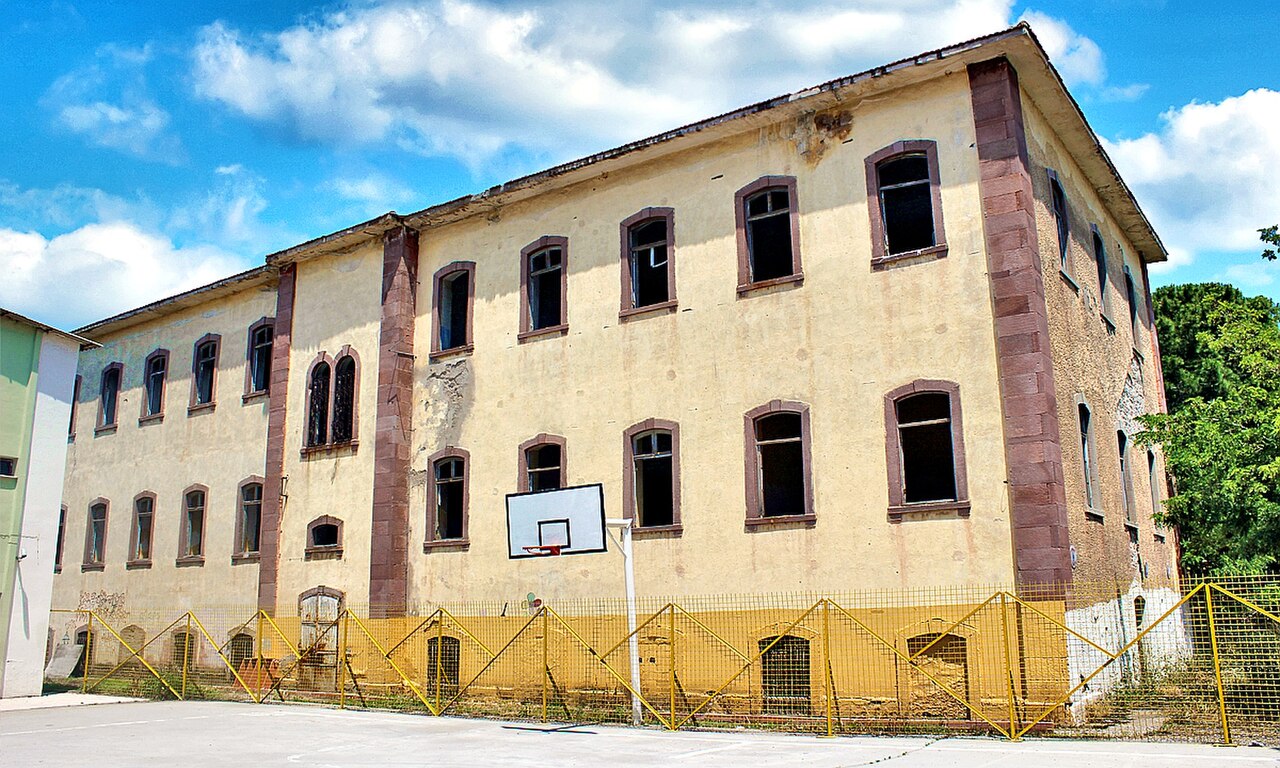
145 min walk · Akhisar
Or Yehuda Agriculture School
- Must see
- Historic monument
Language · 11 published
Historic monument · Saruhanlı, Manisa
Reviewed by Elena Voss · Roavina Travel Editor
Jupiter Launch Base 5 is the mapped location of a former Turkish launch position associated with the United States Jupiter intermediate-range ballistic-missile deployment. It was the fifth of five positions established in Turkey near İzmir during the Cold War. The launch position was completed in February 1962 and formed part of a wider military system rather than a public attraction. Today, the node identifies an outdoor historic military site in rural Akhisar district, not an operating museum, memorial, or visitor attraction with staff and interpretive displays. Its value is historical and geographical: the location helps explain how Cold War missile infrastructure was distributed beyond the better-known bases and diplomatic centres of the period.
Checked 2026-09-02 · Source
There is no visitor centre, ticket office, staffed entrance, exhibition room, or maintained tourist route at Launch Base 5. What remains to see is the setting and any surviving outdoor evidence of the former launch position, approached as a historic landscape rather than a conventional attraction. Each of Turkey’s five launch positions was assigned three Jupiter missiles. Çiğli Air Base near İzmir served as the supporting base for the Turkish Jupiter squadron. Expect no labelled rooms, reconstructed launch equipment, interpretation panels, shop, café, or museum collection on site. Historical references are therefore essential to understanding what the rural location represented during its short operational life.
Checked 2026-09-02 · Source
Allow about 30 to 60 minutes for a respectful roadside or rural-site visit, including time to orient yourself, inspect what can be seen without entering restricted land, and read background material before or after arrival. The actual viewing time may be shorter because this is an unstaffed former military position with no formal route or collection. Build extra time into the journey if you are studying the surrounding landscape or comparing the location with historical maps. Do not extend the visit by crossing fences, fields, or uncertain ground. A short visit is appropriate because the place is a site marker and historical setting, not a full museum experience.
Checked 2026-09-02 · Source
There is no published visiting timetable because the former launch position has no public opening schedule or visitor facility. Daylight is the practical time for locating and understanding an outdoor rural site, especially where paths, boundaries, and remains may be difficult to distinguish. Weather can change ground conditions and visibility, so dry conditions are preferable for an approach over uneven ground. The Jupiter positions in Turkey were withdrawn and deactivated in 1963, making this a historical location rather than a functioning military installation open for tours.
Checked 2026-09-02 · Source
No admission ticket is identified for the outdoor historic remains, and there is no staffed public entrance collecting a fee. Treat the location as free to view from any lawful public approach, not as a guaranteed right to enter every part of the former military site. Because the node is not a visitor attraction with ticketing infrastructure, there are no timed admissions, guided-tour prices, group rates, or on-site services to arrange. Free access does not remove the need to respect private property, agricultural land, military restrictions, or local instructions. The practical cost is transport to a rural position, not an entrance charge.
Checked 2026-09-02 · Source
The mapped position lies in rural Akhisar district in Manisa Province. Plan to reach it by private vehicle using local rural roads and navigation, checking the approach on arrival rather than assuming that a marked tourist entrance exists. No named bus stop or visitor shuttle is identified at the node. Kayışlar railway station is the nearest named rail arrival point identified in the surrounding OpenStreetMap area, but onward travel still requires a separate local connection. Download or prepare directions before leaving built-up areas, allow for limited roadside facilities, and carry water because the site itself has no visitor services. A vehicle with clearance suited to local rural roads may be more practical than relying on a standard attraction transfer.
Checked 2026-09-02 · Source
This is an unstaffed outdoor former military position, not a prepared archaeological park. The mapped point does not identify a public toilet, visitor centre, accessible path, or step-free visitor route. Rural ground, uneven surfaces, vegetation, weather, and unclear boundaries may make access difficult. Visitors should also avoid blocking farm access, climbing remnants, moving stones or metal, and treating any unverified feature as an authenticated launch structure.
Checked 2026-09-02 · Source
Photography is most useful here as documentary recording of a historic landscape: photograph from a lawful public position, include the surrounding rural setting, and avoid treating uncertain remnants as confirmed structures. Do not photograph people, active security arrangements, or restricted installations without permission. A wide view can communicate why the location mattered strategically, while historical references provide the context that the unstaffed site itself cannot supply. Leave the ground exactly as you found it, and avoid moving through crops or private land to improve a composition. If no clearly identifiable remains are visible, photograph the setting honestly rather than inventing a stronger visual story.
Checked 2026-09-02 · Source
It was the fifth Turkish launch position in the United States Jupiter intermediate-range ballistic-missile deployment near İzmir.
Each of Turkey’s five launch positions was assigned three Jupiter missiles.
The fifth and final Turkish launch position was completed in February 1962.
The missiles were deployed in Turkey from 1961 until their withdrawal and deactivation in 1963.
Çiğli Air Base near İzmir served as the supporting base for the Turkish Jupiter squadron.
The Turkish Jupiter deployment formed part of the Cold War missile confrontation that preceded the Cuban Missile Crisis.
Loading the interactive map…
The interactive map could not be loaded.
Last updated:
Source: OpenStreetMap contributors ·