
1 min walk
Khan el-Khalili
- Must see
- Historic monument
Language · 11 published
Historic monument · Cairo
Reviewed by Elena Voss · Roavina Travel Editor
| Monday | 09:00 – 17:00 |
|---|---|
| Tuesday | 09:00 – 17:00 |
| Wednesday | 09:00 – 17:00 |
| Thursday | 09:00 – 17:00 |
| Friday | 09:00 – 17:00 |
| Saturday | 09:00 – 17:00 |
| Sunday | 09:00 – 17:00 |
Checked 2026-08-31 · Source
Read from the OpenStreetMap access tags; anything not listed has no tag recorded.
Set the group type to family in the planner and the day window contracts to about three quarters of a solo day.
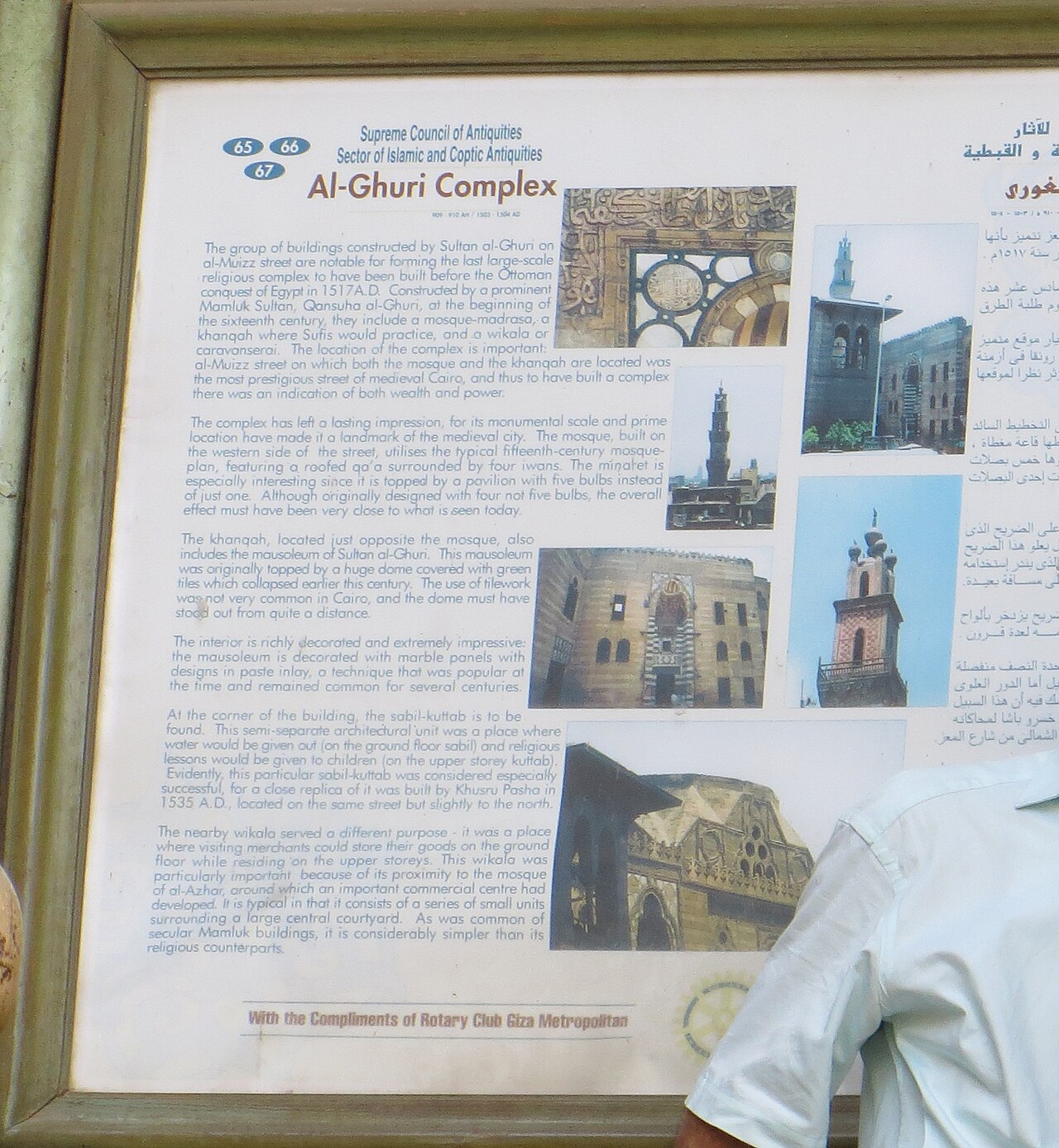
The Al-Ghuri Complex is a Mamluk-era architectural ensemble in Islamic Cairo, commissioned by Sultan al-Ashraf Qansuh al-Ghuri, the penultimate Mamluk sultan of Egypt. The complex comprises two distinct buildings facing each other across a thoroughfare: a religious structure with mosque and mausoleum, and a secular building containing a sabil-kuttab and a wikala. Constructed during the final flourishing of Mamluk architecture before Ottoman conquest, it represents the transitional style between late Mamluk and early Ottoman periods. Daily 09:00–17:00. The Ministry lists identical hours from Sunday through Saturday, with no weekly closure day.
Checked 2026-08-31 · Source
The mosque and mausoleum building features a hypostyle prayer hall with marble flooring, a central dome, and a minaret displaying the characteristic late Mamluk twin-shaft design. The mausoleum was intended for the sultan though he was not interred there. Opposite stands the sabil-kuttab, a charitable foundation providing water to passersby and Quranic education to children above. The wikala served as a commercial inn for merchants with storage and lodging. The Ministry lists identical hours from Sunday through Saturday, with no weekly closure day. Foreign adult: EGP 150. Egyptian adult: EGP 10.
Checked 2026-08-31 · Source
Visitors typically allocate between forty-five minutes and ninety minutes for the Al-Ghuri Complex, depending on architectural interest and photography pace. The two main structures require separate visits across the dividing street. The mosque interior merits careful examination of marble paneling and ceiling ornamentation. The sabil-kuttab and wikala offer contrasting spatial experiences. Those with particular interest in Mamluk architectural evolution may extend their stay. Foreign adult: EGP 150. Egyptian adult: EGP 10. The mosque’s main doorway is reached by several steps. The complex includes ground-floor spaces and upper-floor rooms, so the complete visitor route is not step-free.
Checked 2026-08-31 · Source
Visitors should verify current opening schedules through official channels before planning their visit. The complex occupies a central position in Islamic Cairo with substantial pedestrian traffic throughout daylight hours. Friday prayer periods may affect access to the mosque portion. The winter months of December through February generally offer more temperate conditions. Daily 09:00–17:00. Take Cairo Metro Line 3 to Bab El Shaaria, which Cairo Governorate identifies as the closest station to the northern side of Islamic Cairo. Continue to the junction of Al-Muizz Street and Al-Azhar Street; the complex occupies buildings on both sides of Al-Muizz Street.
Checked 2026-08-31 · Source
Entrance fee structures for heritage monuments in Egypt have undergone periodic revisions, with separate ticketing sometimes implemented for Egyptian nationals and foreign visitors. Some religious structures maintain no admission charge while associated secular monuments may require tickets. Photography permits, if mandated, may constitute additional costs. Foreign adult: EGP 150. Egyptian adult: EGP 10. The mosque’s main doorway is reached by several steps. The complex includes ground-floor spaces and upper-floor rooms, so the complete visitor route is not step-free. The complex was constructed in 909–910 AH, corresponding to 1503–1504 CE. Mamluk sultan Qansuh al-Ghuri commissioned the complex; he ruled from 1501 until 1516.
Checked 2026-08-31 · Source
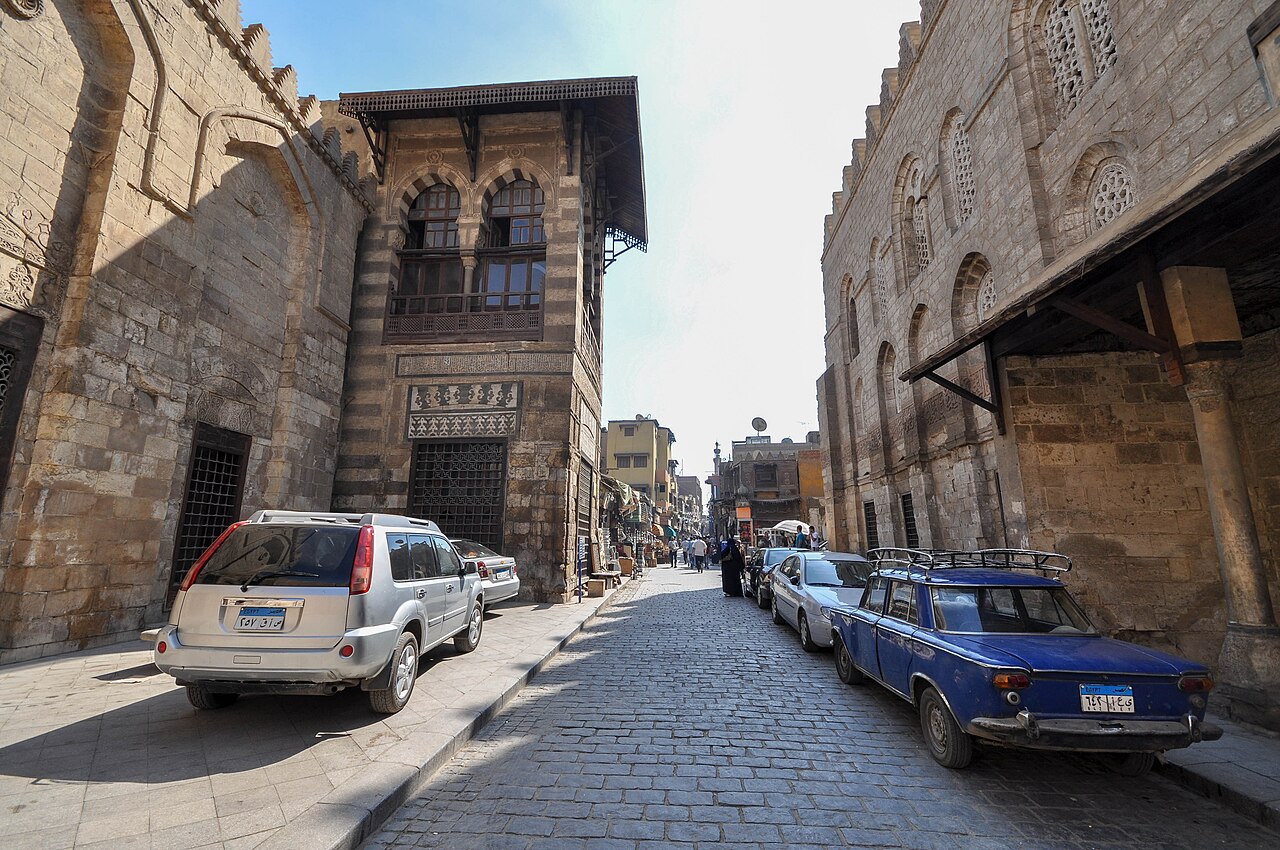
The Al-Ghuri Complex occupies a prominent position on Al-Azhar Street in Islamic Cairo, near the intersection with Al-Muizz li-Din Allah Street. The site lies within the dense historic core where vehicular access is restricted. Al-Azhar Mosque and Khan el-Khalili constitute recognizable nearby landmarks. Take Cairo Metro Line 3 to Bab El Shaaria, which Cairo Governorate identifies as the closest station to the northern side of Islamic Cairo. Continue to the junction of Al-Muizz Street and Al-Azhar Street; the complex occupies buildings on both sides of Al-Muizz Street. The complex includes ground-floor spaces and upper-floor rooms, so the complete visitor route is not step-free.
Checked 2026-08-31 · Source
The street separating the two buildings carries active vehicle and pedestrian traffic requiring caution when crossing. The historic quarter presents uneven paving, steps without railings, and dim interior lighting in some areas. Structural conservation work may restrict access to portions of either building without advance notification. The surrounding commercial district attracts persistent vendor attention. The mosque’s main doorway is reached by several steps. The complex was constructed in 909–910 AH, corresponding to 1503–1504 CE. Mamluk sultan Qansuh al-Ghuri commissioned the complex; he ruled from 1501 until 1516. The complex combines a mosque and madrasa with a mausoleum, khanqah, sabil, kuttab and residential accommodation.
Checked 2026-08-31 · Source
The architectural details of both structures offer substantial photographic subject matter including stone carving, wooden screens, and ceiling decoration. Natural light varies significantly between the prayer hall, mausoleum chamber, and sabil interior spaces. Tripod use may be restricted without prior arrangement. The twin minaret against sky provides an exterior composition opportunity from the opposing building. The street-level perspective captures the unusual bifurcated complex arrangement. Interior photography should respect active worshippers when present. Flash photography may be prohibited in sensitive areas. Mamluk sultan Qansuh al-Ghuri commissioned the complex; he ruled from 1501 until 1516.
Checked 2026-08-31 · Source
The complex was constructed in 909–910 AH, corresponding to 1503–1504 CE.
Mamluk sultan Qansuh al-Ghuri commissioned the complex; he ruled from 1501 until 1516.
The complex combines a mosque and madrasa with a mausoleum, khanqah, sabil, kuttab and residential accommodation.
The mosque and madrasa stand on the western side, while the mausoleum, khanqah and sabil-kuttab stand opposite on the eastern side.
No. He died during the 1516 Battle of Marj Dabiq in northern Syria, and his body was never recovered.
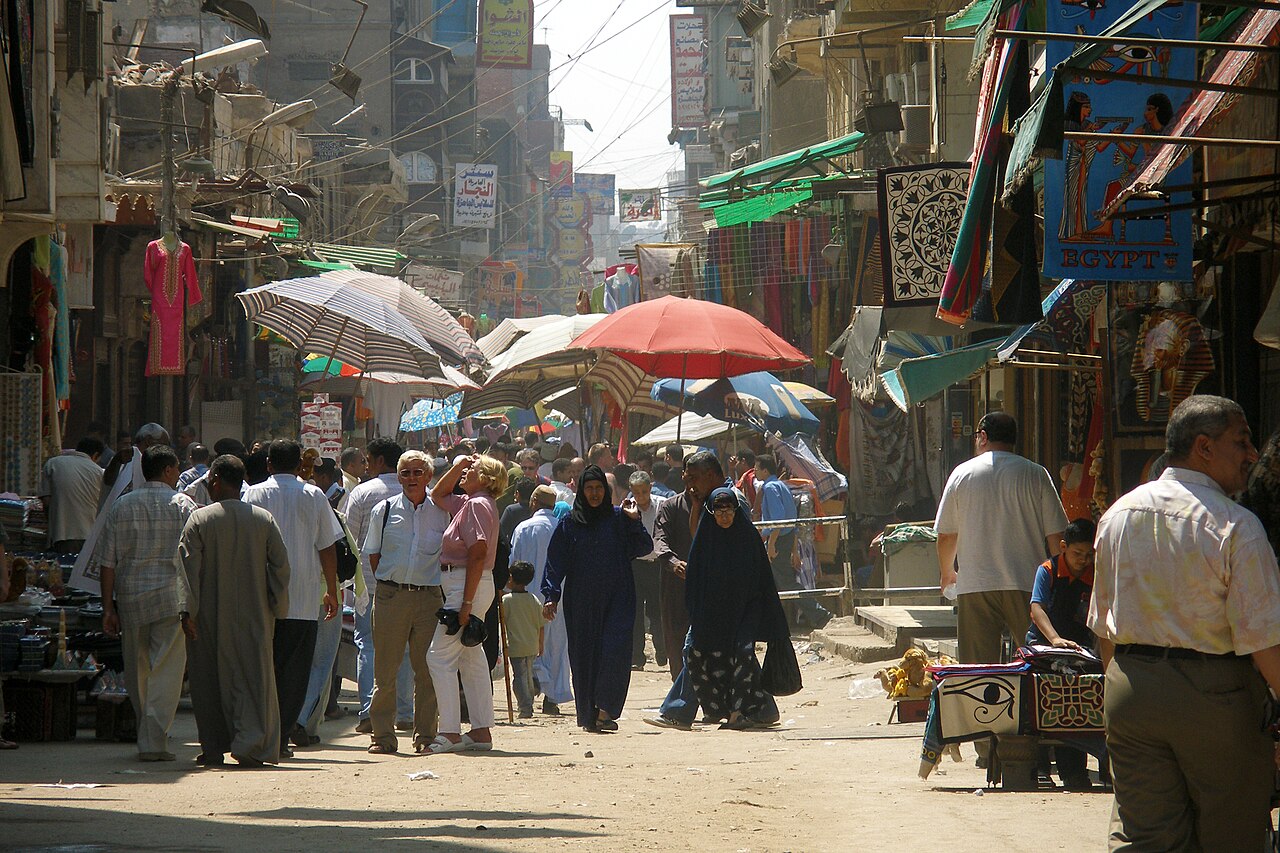
A wooden roof spans the street between the two halves and shelters the textile and clothing market below.
Loading the interactive map…
The interactive map could not be loaded.
Last updated:
Source: OpenStreetMap contributors ·