
1 min walk
Ancient ruins
- High
- Historic monument
Language · 11 published
Historic monument · Athens
Ωδείο Ηρώδου Αττικού
Reviewed by Elena Voss · Roavina Travel Editor
Read from the OpenStreetMap access tags; anything not listed has no tag recorded.
Set the group type to family in the planner and the day window contracts to about three quarters of a solo day.
This place is a Attraction. It opened in 161. It was built in the ancient Roman architecture style. It is built of marble. It carries the archaeological site in Greece heritage designation.
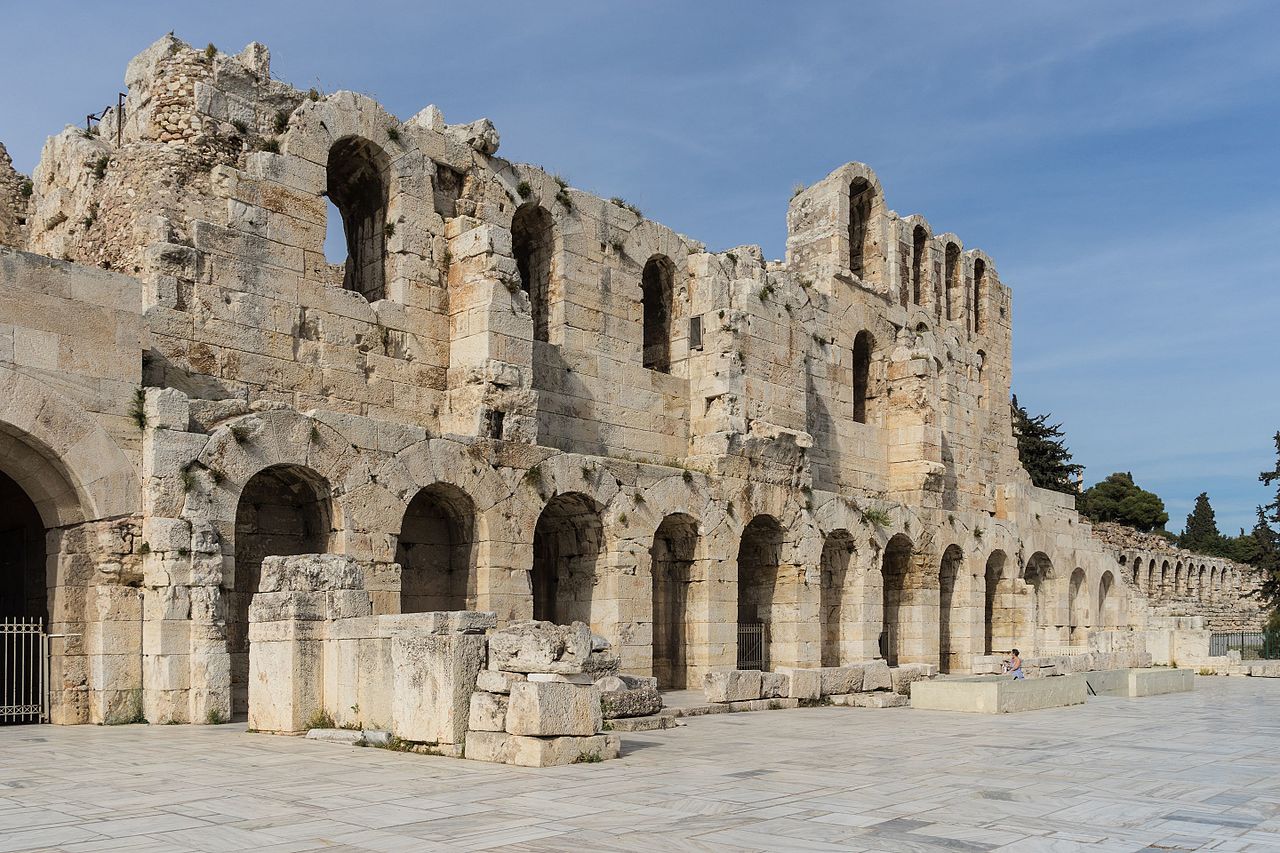
The Odeon of Herodes Atticus is a stone Roman theatre structure on the southwest slope of the Acropolis in Athens, Greece. Built in 161 AD by the Athenian magnate Herodes Atticus in memory of his wife, it was constructed as a steep-sloped amphitheatre with a three-story stone front wall and a wooden roof. The structure was restored in the 1950s and now serves as a venue for performances. Monday–Sunday: Closed. The venue opened only for the June 2026 Farewell Celebrations and then closed for a multiyear restoration. The Ministry of Culture states that the closure will last at least three years from the start of work.
Checked 2026-08-31 · Source
The monument consists of a semicircular orchestra and a cavea with thirty-two rows of seats for approximately five thousand spectators. The facade wall rises to a notable height behind the stage structure. The seating area and architectural framework are composed primarily of stone. Visitors observe the preserved seating tiers, the stage building foundations, and the overall structural shell. The site contains no interior enclosed spaces in the conventional sense; it is an open-air ruin adapted for modern use.
Checked 2026-08-31 · Source
A visit to the Odeon of Herodes Atticus typically requires between thirty minutes and one hour for casual observation of the structure from accessible viewpoints. Visitors attending a performance should allocate additional time for entry procedures and seating. The duration depends on individual interest in architectural examination and whether the visit coincides with a scheduled event. The site is generally viewed in conjunction with adjacent Acropolis monuments rather than as an isolated destination. Photography and contemplation of the setting extend time spent. No general admission is available while the monument is closed for restoration; there are no current visitor or performance tickets.
Checked 2026-08-31 · Source
The optimal period for visiting Athens generally falls outside the peak summer months when temperatures are elevated and tourist density increases. The Odeon presents different experiential qualities across seasons, with evening conditions offering atmospheric lighting on the stone surfaces. Performance events occur during the annual Athens and Epidaurus Festival primarily, though specific scheduling varies annually. Monday–Sunday: Closed. The entrance is on the pedestrianised Dionysiou Areopagitou Street on the Acropolis’s southern slope. The named Metro arrival point is Acropolis station on Line 2. By bus, use the Erechtheiou stop or the Afetiria terminus, both served by route 230.
Checked 2026-08-31 · Source
Access arrangements for the Odeon of Herodes Atticus depend on whether visiting for general monument viewing or attending a ticketed performance. The structure is visible from exterior pathways without charge. Performance admission requires purchase through designated channels for festival events. Combined ticketing with other archaeological sites may be available. No general admission is available while the monument is closed for restoration; there are no current visitor or performance tickets. When the venue is operating, a wooden non-slip ramp connects the stage door with the adapted A1 section of the lower tier.
Checked 2026-08-31 · Source
The Odeon of Herodes Atticus occupies the southwestern approach to the Acropolis, accessible from Dionysiou Areopagitou pedestrian street and surrounding pathways in the Makrygianni district. The Athens Metro serves the vicinity through Acropolis station on Line 2. Multiple bus routes operate in the surrounding area. The entrance is on the pedestrianised Dionysiou Areopagitou Street on the Acropolis’s southern slope. The named Metro arrival point is Acropolis station on Line 2. By bus, use the Erechtheiou stop or the Afetiria terminus, both served by route 230. The adapted A1 section has eight wheelchair spaces; each wheelchair user may bring one companion seated directly behind in A2.
Checked 2026-08-31 · Source
The stone surfaces throughout the monument and approaches become slippery when wet and retain heat during sunny conditions. Footwear with adequate grip is advisable. Seating rows are steep and lack modern safety barriers in many sections. The open-air structure offers minimal protection from weather elements. Crowding occurs during performance events and peak tourist periods. Visitors should secure personal belongings in dense conditions. When the venue is operating, a wooden non-slip ramp connects the stage door with the adapted A1 section of the lower tier. An adapted toilet with a marble access ramp is located at the entrance.
Checked 2026-08-31 · Source
The Odeon of Herodes Atticus presents substantial photographic interest due to its architectural scale, Acropolis backdrop, and dramatic stone textures. Daylight hours reveal structural detail; evening conditions during events offer artificial lighting effects. Tripod use may be restricted during performances or require advance arrangement. The exterior facade is photographable from public thoroughfares without site entry. Interior photography during events may be constrained by performance etiquette and venue policies. The surrounding pedestrian zone provides contextual shots of the monument within its urban landscape. Wheelchair users may receive vehicular access to the square in front of the Odeon.
Checked 2026-08-31 · Source
No. Its one-month June 2026 programme was presented as a farewell before the monument closed for a multiyear restoration.
No current admission is offered because the monument is closed for restoration.
Access is limited: during operation, a non-slip ramp reaches eight wheelchair spaces in lower-tier section A1, and an adapted toilet is available at the entrance.
Acropolis station on Metro Line 2 is the named Metro stop; route 230 serves the Erechtheiou and Afetiria bus stops.
Herodes Atticus built it between 160 and 174 AD in memory of his wife, Regilla.
Children under six are not admitted, heels are prohibited, and late entry is allowed only during an interval.
Loading the interactive map…
The interactive map could not be loaded.

Last updated:
Source: OpenStreetMap contributors, Wikidata ·