
35 min walk
Agung Rai Museum of Art
- Must see
- Museum
Language · 11 published
Historic monument · Denpasar
Reviewed by Elena Voss · Roavina Travel Editor
| Monday | 08:00 – 17:00 |
|---|---|
| Tuesday | 08:00 – 17:00 |
| Wednesday | 08:00 – 17:00 |
| Thursday | 08:00 – 17:00 |
| Friday | 08:00 – 17:00 |
| Saturday | 08:00 – 17:00 |
| Sunday | 08:00 – 17:00 |
Checked 2026-08-31 · Source
Read from the OpenStreetMap access tags; anything not listed has no tag recorded.
Set the group type to family in the planner and the day window contracts to about three quarters of a solo day.
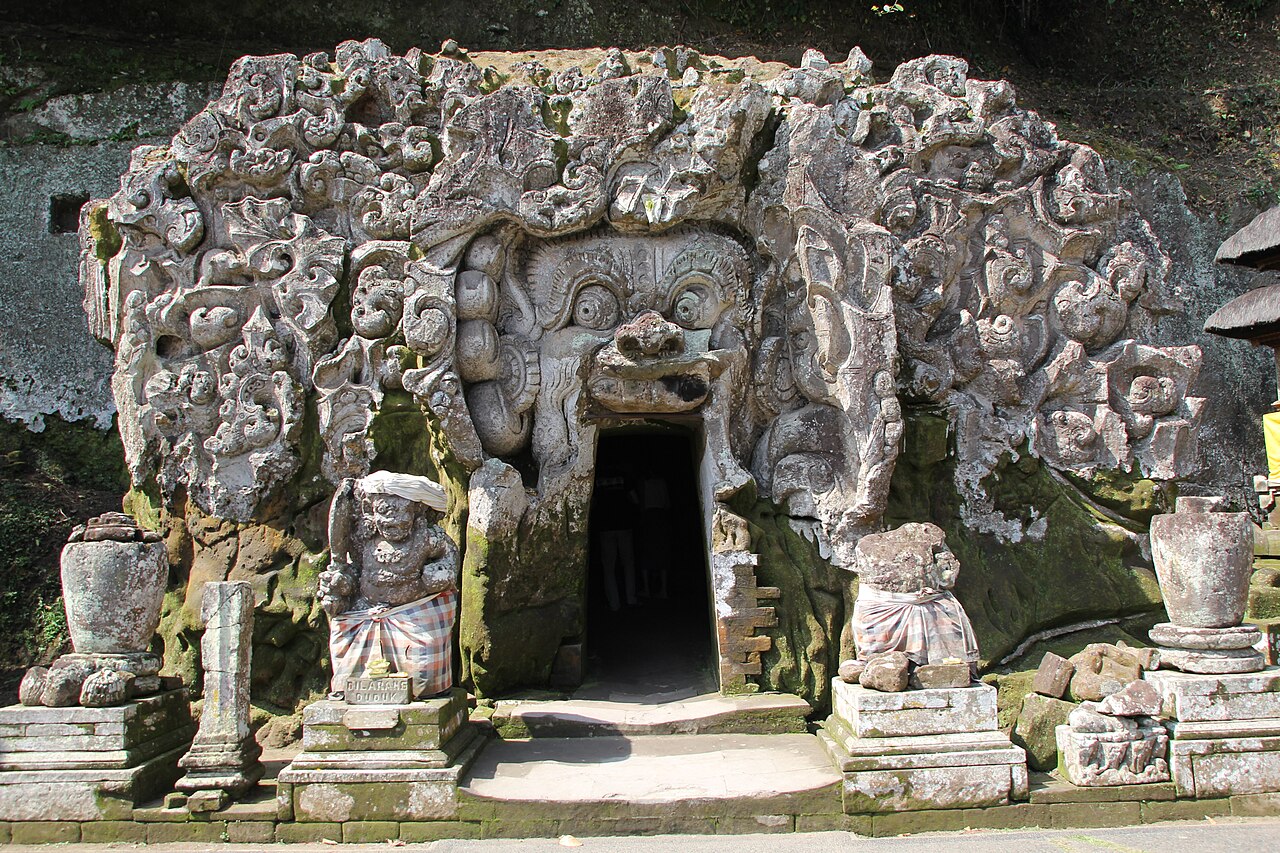
Goa Gajah, also known as the Elephant Cave, is an archaeological site of significant historical importance located near Ubud in the Gianyar Regency area, commonly associated with greater Denpasar visits. The site dates to at least the 9th century and features a cave entrance carved with menacing faces, thought to ward off evil spirits. It was listed as a tentative UNESCO World Heritage Site. The complex includes Hindu and Buddhist elements, reflecting Indonesia's religious transitions over centuries of cultural development. Daily 08:00–17:00 WITA. No regular closure day; the responsible public-body source lists the site as open every day.
Checked 2026-08-31 · Source
The main attraction is the cave itself, with its demon-shaped entrance. Inside are T-shaped niches that may have served meditation purposes. Outside lies a bathing pool with carved stone figures holding water spouts, discovered in the 1950s. The surrounding area contains stone fragments, a Buddhist stupa site, and various carved relics. The complex blends sacred Hindu lingam and yoni symbols with Buddhist imagery, demonstrating the syncretic religious practices that characterized early Balinese spiritual life before institutional separation. No regular closure day; the responsible public-body source lists the site as open every day.
Checked 2026-08-31 · Source
Visitors typically spend approximately one to two hours exploring Goa Gajah thoroughly. This duration allows adequate time to examine the cave interior, circumambulate the bathing pools, observe the scattered stone relics throughout the grounds, and appreciate the surrounding gardens and rice-field vistas. The compact nature of the archaeological site means extensive hiking is unnecessary. Those with deep interest in Hindu-Buddhist iconography or photography may wish to extend their visit. Combine with nearby attractions for a fuller day itinerary in the region. Adult admission: IDR 50,000 for foreign nationals and IDR 30,000 for Indonesian nationals.
Checked 2026-08-31 · Source
Visitors should verify current opening schedules independently before planning their trip. Early morning arrivals generally offer cooler temperatures and reduced crowding at popular Balinese cultural sites. The rainy season from approximately November through March may create slippery conditions on stone walkways and steps. Daily 08:00–17:00 WITA. The complete visitor route is not step-free: each of the three bathing pools is reached by stairs. The south and north pools each have 11 steps; the middle pool has 13 steps. The wider complex includes the lower Tukad Pangkung valley, so visitors with limited mobility should expect changes of level.
Checked 2026-08-31 · Source
Visitors should expect to pay a modest admission fee consistent with Indonesian archaeological site standards, with possible additional charges for parking or camera use. Foreign nationals typically pay higher rates than Indonesian citizens at government-managed heritage locations. Carry sufficient Indonesian rupiah in small denominations, as electronic payment acceptance at rural cultural sites remains inconsistent. Adult admission: IDR 50,000 for foreign nationals and IDR 30,000 for Indonesian nationals. The complete visitor route is not step-free: each of the three bathing pools is reached by stairs. The south and north pools each have 11 steps; the middle pool has 13 steps.
Checked 2026-08-31 · Source
Goa Gajah lies approximately six kilometers northeast of central Ubud, accessible via Jalan Raya Goa Gajah. Visitors staying in Denpasar proper should anticipate roughly thirty to sixty minutes travel time depending on traffic conditions, which worsen during morning and evening peak periods. Goa Gajah is in Bedulu, Blahbatuh, Gianyar, about 5 km from Ubud and 27 km east of Denpasar. Indonesia’s Ministry of Tourism describes the journey from central Ubud as about 15 minutes by motorbike, rental car, or organized tour. Trans Metro Dewata Route 4 is the named public-transport corridor serving central Ubud; onward road transport is needed for the Bedulu site.
Checked 2026-08-31 · Source
Modest dress is required; shoulders and knees must be covered, with sarongs available for rent or loan at the entrance. The cave interior is dark and uneven underfoot; appropriate footwear with grip is essential. Steep stone steps descend to the bathing pool area, demanding caution particularly when wet. Persistent vendors operate near the parking area. The complete visitor route is not step-free: each of the three bathing pools is reached by stairs. The wider complex includes the lower Tukad Pangkung valley, so visitors with limited mobility should expect changes of level.
Checked 2026-08-31 · Source
The carved cave entrance provides the most iconic photographic subject, best captured in soft morning light when shadows accentuate the demonic facial features. The bathing pools offer reflective water compositions with sculptural elements. Tripod use may attract scrutiny or require special permission. Flash photography inside the cave is discouraged to preserve atmosphere and protect any residual pigmentation. Respect worshippers by refraining from intrusive documentation of prayer activities. Goa Gajah is in Banjar Goa, Bedulu village, Blahbatuh district, Gianyar Regency, approximately 5 km from Ubud and 27 km east of Denpasar.
Checked 2026-08-31 · Source
Goa Gajah is in Banjar Goa, Bedulu village, Blahbatuh district, Gianyar Regency, approximately 5 km from Ubud and 27 km east of Denpasar.
Pura Goa Gajah Zone I is a nationally ranked cultural-heritage site, designated under decree 131/M/1998 on 16 June 1998.
The northern complex preserves Shaivite remains, including a Ganesha statue and the Tri Lingga inside the cave, and remains an active Hindu place of worship.
The Tukad Pangkung area contains Buddhist remains, including a carved thirteen-tiered stupa and a three-branched stupa.
L. C. Heyting reported the Ganesha, Tri Lingga and Hariti finds in 1923; further research began in 1925, and excavations conducted from 1954 to 1979 uncovered the bathing pool with six fountain statues.
Visitors must wear a sarong and sash; the Ministry of Tourism states that both can be rented on site.
Loading the interactive map…
The interactive map could not be loaded.
Last updated:
Source: OpenStreetMap contributors, Wikidata ·