6 min walk
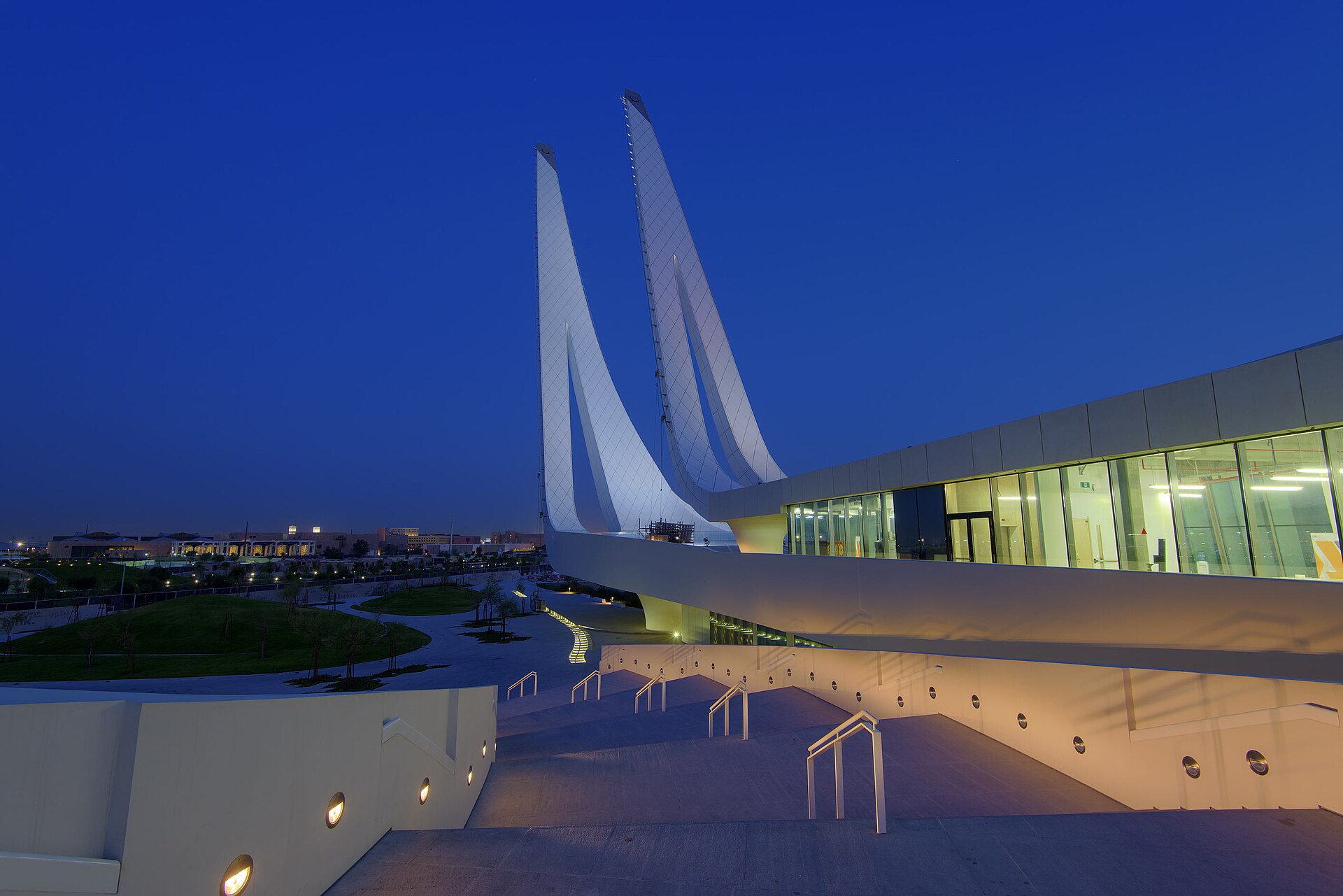
Education City Mosque
- Must see
- Place of worship
Language · 11 published
Historic monument · Doha
Reviewed by Elena Voss · Roavina Travel Editor
This place is a Attraction.
The Miraculous Journey is Damien Hirst’s fourteen-part public-art installation outside Sidra Medicine in Doha’s Education City. It follows human development from conception to birth, ending with a monumental 14-metre baby boy. The outdoor institutional setting makes the work unusual: a sequence usually encountered in a gallery is placed along a walkway. Approach it as contemporary art about the human body rather than as a conventional monument. Its location also makes it a natural companion to a wider visit around Education City. The Miraculous Journey is a public-art installation by British artist Damien Hirst comprising fourteen monumental bronze sculptures. Commissioned for Sidra Medicine, a women's and children's hospital in Doha's Education City, the sequence depicts the gestation of a human being from conception to birth. The works range from a tiny fertilised egg to a 14-metre anatomically correct baby boy. Unveiled in 2013 after initial hesitation regarding their explicit nature, the sculptures represent Qatar's ambitious investment in internationally significant contemporary art and its willingness to host culturally challenging works in public space.
Checked 2026-08-26 · Source
Fourteen bronze sculptures form a chronological walk. The early stages refer to the union of sperm and egg, then move through embryo and foetal development before reaching the newborn. Several pieces use strong vermillion and gold colouring, while the scale shifts from microscopic beginnings to a 14-metre final figure. The changing size is part of the experience: visitors move from intimate biological imagery to a work that dominates the surrounding space. The final baby is the visual climax, but the earlier stages give the sequence its narrative structure.
Checked 2026-08-26 · Source
Allow about 20 to 40 minutes for the sculpture sequence, depending on how closely you study each stage and how long you spend photographing the bronze surfaces. The outdoor arrangement lets visitors set their own pace. If you are already visiting Education City, combine the installation with another destination in the district and plan a longer half-day outing. The artwork itself is a focused stop rather than a full-day attraction, and its impact comes from seeing the stages in order.
Checked 2026-08-26 · Source
Choose the cooler part of the day because the installation is entirely outdoors. In Doha, early morning and late afternoon reduce exposure to the strongest midday heat and can give the bronze figures more directional light. November through March is generally more comfortable for spending time outside than the hottest summer months. The exposed setting makes shade, water and sun protection important parts of planning even a short visit.
Checked 2026-08-26 · Source
The installation is publicly accessible without an admission charge. Treat it as a free outdoor art stop rather than a ticketed museum visit: there is no ticket sequence or timed-entry arrangement described for the sculptures. Visitors can fit it into a wider Education City route without reserving a separate entry slot. The visit is self-directed, so the value lies in walking the complete fourteen-stage sequence and considering the contrast between the smallest biological beginnings and the enormous final baby.
Checked 2026-08-26 · Source
Sidra Medicine is in Education City, about 13 kilometres west of Doha’s central business district. The Doha Metro Gold Line serves Education City, and Qatar National Library station is the nearest named rail access; from there, continue on foot or by local ground transport. Taxis and ride-hailing services can take visitors into the district. Have the precise map location ready before leaving the station or requesting a drop-off, because the artwork stands beside an operating medical campus.
Checked 2026-08-26 · Source
The sculptures show explicit anatomical stages, including foetal development and birth. This can be confronting for sensitive viewers, and families should decide in advance whether the subject suits the children travelling with them. The path is outdoors, so Doha’s heat and strong sun can become the practical challenge; carry water and use sun protection. Stay aware of traffic around the medical campus, keep to visitor-appropriate areas, and remember that this is an operating healthcare setting as well as an art location.
Checked 2026-08-26 · Source
Photograph the installation as a progression rather than treating the final baby as the only subject. Wide views show the contrast between the figures and Education City, while closer images bring out the bronze modelling and vermillion or gold surfaces. Early and late daylight can create stronger shadows than midday light. The explicit content deserves discretion when sharing images, especially around families and the medical campus. Keep people and institutional activity out of the frame where possible, and do not use a drone without required permissions.
Checked 2026-08-26 · Source
It depicts fourteen stages of human development, beginning with conception and ending with a 14-metre newborn baby boy.
The installation contains fourteen monumental bronze sculptures arranged as a sequence.
It stands outside Sidra Medicine in Education City, approximately 13 kilometres west of Doha’s central business district.
Plan roughly 20 to 40 minutes for the sequence, with extra time if you photograph each sculpture.
Yes. It is an outdoor installation arranged along a walkway beside Sidra Medicine.
The subject includes explicit anatomical images of foetal development and birth, so sensitive viewers and families should consider that content before visiting.
Loading the interactive map…
The interactive map could not be loaded.

Last updated:
Source: OpenStreetMap contributors ·