.jpg)
3 min walk
State Library Victoria
- Must see
- Art and culture venue
Language · 11 published
Historic monument · Melbourne
Reviewed by Elena Voss · Roavina Travel Editor
| Monday | 10:00 – 17:00 |
|---|---|
| Tuesday | 10:00 – 17:00 |
| Wednesday | 10:00 – 17:00 |
| Thursday | 10:00 – 17:00 |
| Friday | 10:00 – 17:00 |
| Saturday | 10:00 – 17:00 |
| Sunday | 10:00 – 17:00 |
Checked 2026-08-31 · Source
Read from the OpenStreetMap access tags; anything not listed has no tag recorded.
Set the group type to family in the planner and the day window contracts to about three quarters of a solo day.
This place is a Attraction. It opened in 1845. It is built of bluestone. It carries the listed on the Victorian Heritage Register heritage designation. It is run by National Trust of Australia.
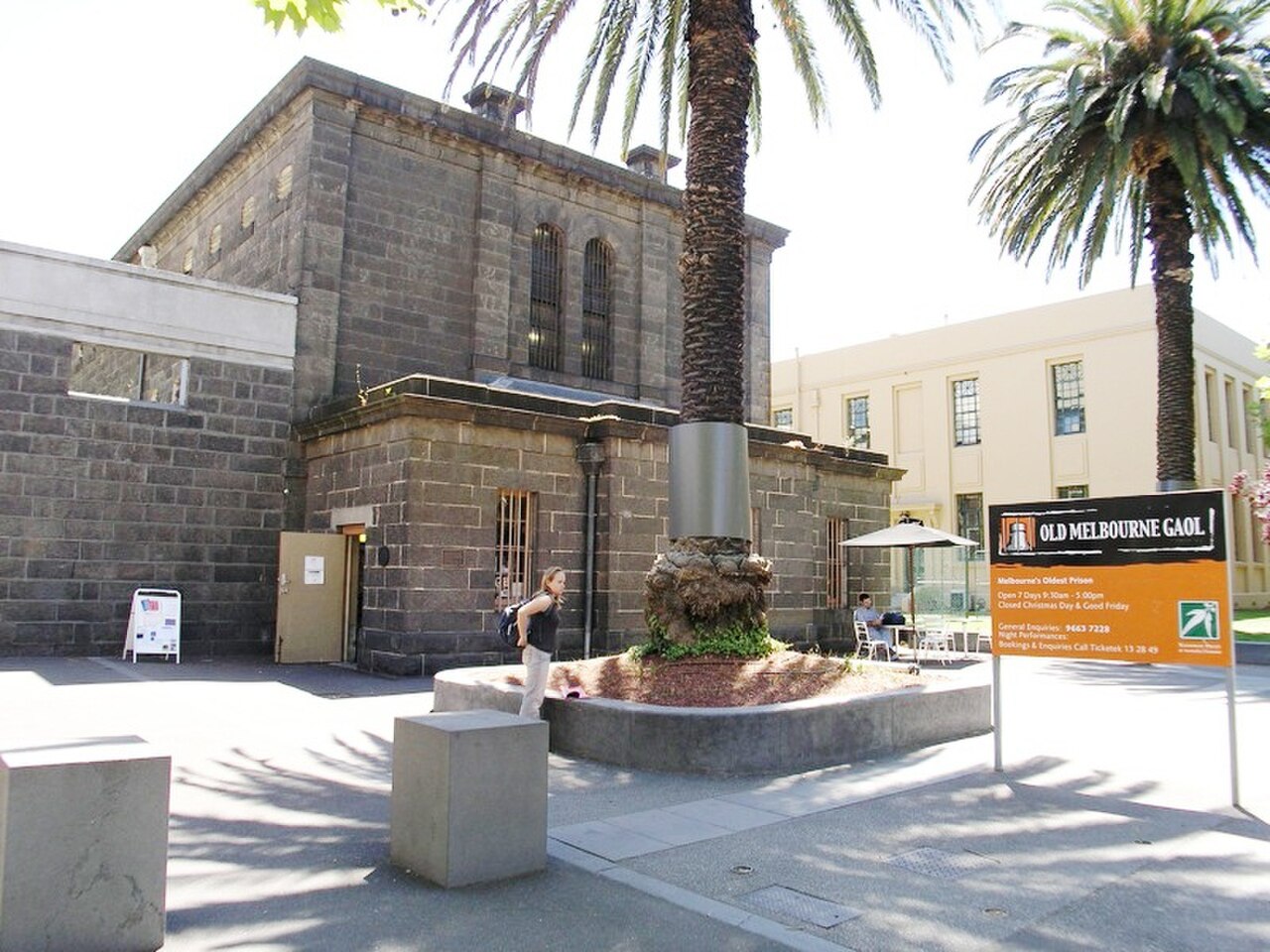
Old Melbourne Gaol is a preserved former prison in central Melbourne where the building carries as much meaning as the displays. Its narrow cells, austere corridors and controlled circulation make the site a direct encounter with the physical conditions of confinement. The visit is especially distinctive because the architecture is not reconstructed as a neutral museum setting: surviving institutional spaces shape how you move, look and understand the gaol. It suits travelers interested in Melbourne’s justice history, historic buildings and places where the atmosphere comes from original fabric. Allow time to notice the relationship between public areas and spaces designed for supervision and restriction.
Checked 2026-09-02 · Source
Inside, the experience combines former prison spaces with interpretation about the gaol’s operation and Melbourne’s justice history. Read the displays alongside the layout: cells, corridors, hard surfaces and confined-feeling areas show how movement and supervision were organised. Look for the details that make the institution legible, including the proportions of the rooms, boundaries between areas and the durable materials that still define the interior. A focused visit can follow the principal route and pause at the spaces that best explain prison life. With more time, compare public-facing areas with controlled circulation and consider how the building guided both staff and prisoners through the complex.
Checked 2026-09-02 · Source
Plan about 90 to 120 minutes for a focused visit, depending on queues, reading pace, walking speed and accessibility needs. Leave a little time before entry to find the visitor entrance, complete admission or screening and orient yourself within the complex. A shorter stop can work if Old Melbourne Gaol is one of several central Melbourne sights, but rushing through the cells and interpretation weakens the sense of how the prison operated. Travelers who enjoy architectural details or read every label will benefit from the longer end of the range. If you add a separate special experience, treat its duration as additional time rather than assuming it fits inside an ordinary museum stop.
Checked 2026-09-02 · Source
The regular recorded schedule is 10:00 to 17:00 every day. Arrive with enough time to complete admission and the main route before closing, rather than treating 17:00 as time guaranteed for a final room. An early start leaves more space for reading the interpretation and observing the building without end-of-day pressure. The operator’s visit information also identifies special night tours as separate experiences with separate times, so they should be planned independently from the daytime visit. During the visit, follow any instructions governing movement through particular rooms or heritage areas and keep your schedule flexible around the experience you have selected.
Checked 2026-09-02 · Source
Standard admission is recorded as AUD 0 per person, so the ordinary admission charge is free. That does not make every Old Melbourne Gaol experience free: the operator distinguishes special tours, exhibitions and activities as products that may require separate tickets or additional charges. Decide first whether you want the standard visit or a particular timed or night experience, then use the operator’s visit information for that product. Keeping those options separate prevents a free ordinary admission from being mistaken for an all-inclusive ticket.
Checked 2026-09-02 · Source
The operator names Melbourne Central station and tram routes on La Trobe and Russell streets as public-transport references. Melbourne Central is a large interchange with multiple exits, so allow time to choose the right exit, walk through the station and make the final street approach to the named visitor entrance. Tram users can use the La Trobe or Russell Street references when planning their route. Build in a buffer for orientation, admission or screening queues, then follow staff directions through the complex once you arrive.
Checked 2026-09-02 · Source
The complete route is not step-free. Step-free access, accessible toilets and pushchair access are recorded as limited, while toilets are recorded as available. This matters in a former prison where heritage fabric, stairs, cobbles and narrow circulation can shape the visit. If your plans depend on reaching a particular level or facility, use the operator’s accessibility information and speak with staff on arrival. Keep bags and pushchairs clear of confined paths, wear secure footwear on historic surfaces and follow directions when queues, maintenance, events or security arrangements alter ordinary movement.
Checked 2026-09-02 · Source
Photographs are most effective when they show how the preserved prison architecture controls scale and movement. Start with an establishing view from a permitted public area, then look for details such as narrow circulation, cell-like spaces, heavy materials and institutional geometry. Keep entrances, stairs, queues and walkways clear, especially where the route is confined. Follow staff directions if a room, object, event or performance has different photography rules, and avoid photographing people without consent. A quiet architectural frame can communicate the gaol’s character better than a crowded record of every display.
Checked 2026-09-02 · Source
The regular recorded schedule is daily from 10:00 to 17:00. Arrive early enough to complete admission and the main route before closing. Special night tours are separate experiences with separate times.
Yes. Standard admission is recorded as AUD 0 per person, so ordinary entry is free. Special tours, exhibitions and activities may require separate tickets or additional charges.
No. The complete route is not step-free. Step-free access, accessible toilets and pushchair access are recorded as limited, while toilets are recorded as available.
The operator names Melbourne Central station and tram routes on La Trobe and Russell streets. Allow time for the correct station exit, the final walk, orientation and any admission or screening queue.
Yes. Events, maintenance, weather and security arrangements may change ordinary access. Follow the operator’s current visit information and staff directions, particularly for timed or special experiences.
No. Special tours, exhibitions and activities may use separate tickets or additional charges. Plan the ordinary visit and any night or premium experience as distinct products.
Loading the interactive map…
The interactive map could not be loaded.
Last updated:
Source: OpenStreetMap contributors, Wikidata ·