.jpg)

3 min walk
Yasso
- Notable
- Market
Language · 11 published
Place of worship · Cairo
الجامع الأزهر
Reviewed by Elena Voss · Roavina Travel Editor

Read from the OpenStreetMap access tags; anything not listed has no tag recorded.
Set the group type to family in the planner and the day window contracts to about three quarters of a solo day.
This place is a Attraction. It was established in 971. It was built in the Islamic architecture style. It carries the part of UNESCO World Heritage Site heritage designation.
Al-Azhar Mosque is a Fatimid-era congregational mosque and one of the oldest universities in the world, founded in 970 CE. It stands in Islamic Cairo, a UNESCO World Heritage site. The institution has served as a premier centre of Sunni Islamic scholarship for over a millennium. Its architectural complex expanded across centuries, reflecting multiple Islamic styles. The mosque remains an active place of worship and study, with the associated Al-Azhar University continuing its educational mission. Open for visits daily; visiting times follow Al-Azhar Mosque management’s operating schedule rather than fixed clock hours published by the Ministry of Tourism and Antiquities.
Checked 2026-08-31 · Source
The mosque contains multiple prayer halls, courtyards, and minarets from different periods. Notable architectural elements include Mamluk-era additions and later Ottoman modifications. The central courtyard provides open space for worshippers. Decorative features encompass carved stonework, woodwork, and ornamental details reflecting various Islamic artistic traditions. The library houses important religious manuscripts. Multiple madrasas historically functioned within the complex. The mashrabiya screens and marble flooring represent craftsmanship from diverse eras. The responsible ministry lists the mosque among sites open to visitors and designates no weekly closure day.
Checked 2026-08-31 · Source
Visitors should allocate approximately one to two hours for meaningful exploration of the mosque complex. This duration permits observation of architectural details across courtyards and prayer spaces. Those with particular interest in Islamic art history may prefer extended visits. The surrounding neighbourhood merits additional time, as the mosque anchors a dense historic district with markets and monuments. Friday prayers draw substantial congregations, affecting visitor movement. Academic researchers or those seeking to comprehend the institution's educational role might extend their stay. Free general entry; the responsible bodies present Al-Azhar as an active mosque receiving worshippers and visitors and publish no admission tariff for it.
Checked 2026-08-31 · Source
Visitors should verify current opening times through official channels before planning. The mosque functions as an active religious institution, so prayer times significantly affect accessibility for non-worshippers. Early morning or late afternoon potentially offer calmer conditions for observation, though this varies daily. Ramadan and religious holidays bring special patterns of activity. Open for visits daily; visiting times follow Al-Azhar Mosque management’s operating schedule rather than fixed clock hours published by the Ministry of Tourism and Antiquities. The central courtyard and principal prayer arcades are on the main visitor level.
Checked 2026-08-31 · Source
The mosque traditionally does not charge entry fees for Muslim worshippers. Non-Muslim visitor policies regarding access and any associated costs remain subject to current administrative decisions. Visitors should carry modest identification and be prepared for possible donation requests or guided tour arrangements through unofficial channels. Budget considerations should include transportation to Islamic Cairo and potential gratuities. Free general entry; the responsible bodies present Al-Azhar as an active mosque receiving worshippers and visitors and publish no admission tariff for it. The central courtyard and principal prayer arcades are on the main visitor level.
Checked 2026-08-31 · Source
The mosque occupies a central position in Islamic Cairo, accessible from multiple directions. Public transportation options include Cairo Metro, with stations requiring subsequent walking through dense urban fabric. Taxis and ride-hailing services serve the general district, though final approaches navigate narrow streets. Traffic congestion characterises peak periods. The mosque is on Al-Azhar Street in Al-Darb Al-Ahmar. Cairo Public Transport Authority bus route 7 runs along Al-Azhar Street between Omrania and Ataba Garage. Metro Line 3 serves Bab El Shaaria; Cairo’s official transport guide identifies that station with northern Islamic Cairo, from where the mosque lies farther south in the historic district.
Checked 2026-08-31 · Source
Visitors must dress modestly, covering shoulders and legs; women should cover hair. Remove shoes before entering prayer areas. Active worship demands respectful silence and behaviour. Photography restrictions apply in certain zones. Unofficial guides may approach with unsolicited services; establish terms clearly if engaging. The surrounding streets present intense commercial activity and potential crowding. Petty attention to belongings warranted in busy areas. The central courtyard and principal prayer arcades are on the main visitor level. Al-Azhar provides disability-focused educational activities and sign-language religious sessions, but its published visitor information does not identify a continuous wheelchair route or lifts.
Checked 2026-08-31 · Source
Photography policies vary across the complex and may change without notice. Some interior spaces prohibit all imaging. Where permitted, avoid photographing worshippers without explicit consent, particularly during prayer. Flash photography generally inappropriate in dim interior spaces containing sensitive materials. Tripods and professional equipment may attract scrutiny or require special permission. Courtyard photography typically more permissible than within prayer halls. Respect immediate cessation if requested by staff or worshippers. The architectural details and minarets offer exterior photographic subjects. Construction began in 359 AH/970 CE and was completed in 361 AH/972 CE.
Checked 2026-08-31 · Source
Construction began in 359 AH/970 CE and was completed in 361 AH/972 CE.
Fatimid caliph Al-Muizz li-Din Allah ordered its construction, and commander Jawhar al-Siqilli carried out the work.
It was founded as Cairo’s congregational mosque and as an institution for teaching the Fatimid state’s Ismaili Shi'a doctrine.
The complex includes the Taybarsiyya, Aqbughawiyya and Gawhariyya madrasas.
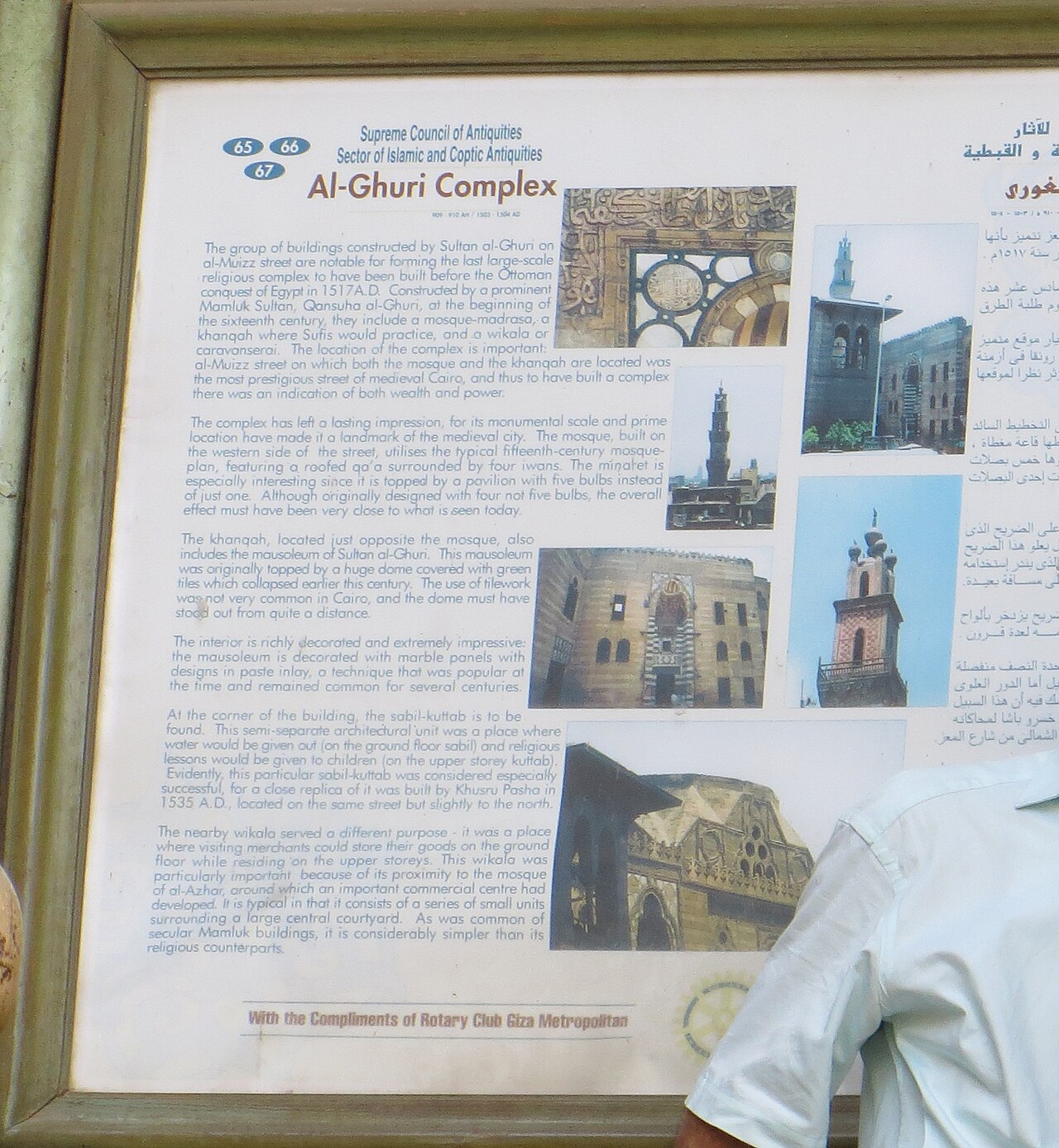
Sultan Qaitbay built the western gate and adjacent three-tiered minaret in 1468; Sultan Qansuh al-Ghuri added the double-headed minaret in 1510.
Yes. It remains an active mosque and hosts prayers, Qur'an recitation circles, lessons and other Al-Azhar scholarly programs.
Loading the interactive map…
The interactive map could not be loaded.

Last updated:
Source: OpenStreetMap contributors, Wikidata ·