

3 min walk
DenkStätte Weiße Rose
- Notable
- Museum
Language · 11 published
Historic monument · Munich
Reviewed by Elena Voss · Roavina Travel Editor
| Monday | 00:00 – 23:59 |
|---|---|
| Tuesday | 00:00 – 23:59 |
| Wednesday | 00:00 – 23:59 |
| Thursday | 00:00 – 23:59 |
| Friday | 00:00 – 23:59 |
| Saturday | 00:00 – 23:59 |
| Sunday | 00:00 – 23:59 |
Checked 2026-08-31 · Source
Read from the OpenStreetMap access tags; anything not listed has no tag recorded.
Set the group type to family in the planner and the day window contracts to about three quarters of a solo day.
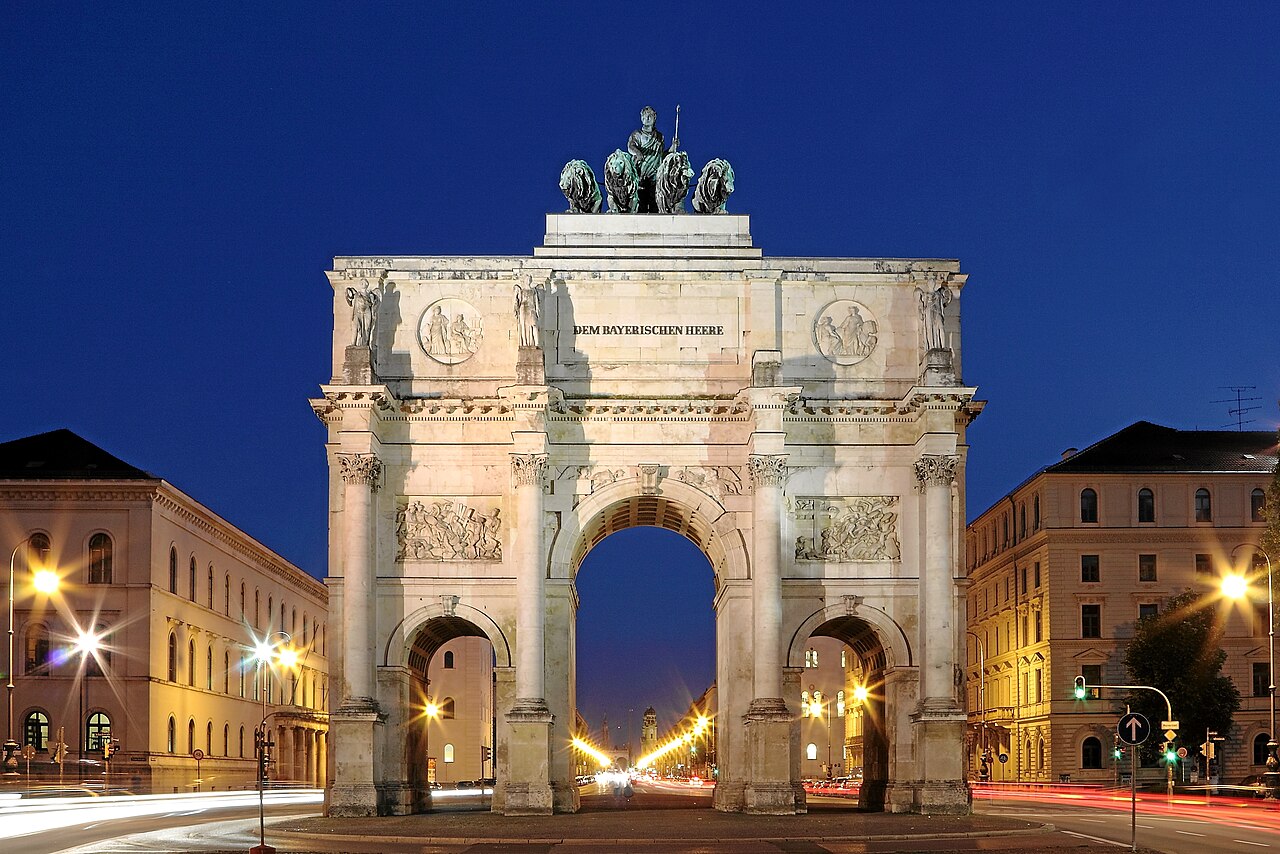
This place is a Attraction. It was built in the Neoclassical architecture style. It was designed by Friedrich von Gärtner. It carries the architectural heritage monument in Bavaria heritage designation.
Siegestor is a nineteenth-century triumphal arch at the northern end of Ludwigstraße, where the avenue becomes Leopoldstraße in Munich. King Ludwig I commissioned the monument to commemorate Bavarian military achievements, and Friedrich von Gärtner designed it. Completed in 1852, the arch combines Corinthian columns, classical stonework, and sculptural decoration. War damage led to reconstruction, after which a peace-related inscription gave the monument an additional meaning. Siegestor is best understood as an urban landmark encountered during a walk through Maxvorstadt, rather than as a secluded museum or enclosed attraction. The Siegestor is a triumphal arch standing at the northern end of Ludwigstraße in Munich's Maxvorstadt district. King Ludwig I commissioned the monument in the early nineteenth century to commemorate Bavarian military achievements. No. The Siegestor does not offer visitor access to upper levels or rooftop positions. It functions as a traffic archway without interior staircases or viewing platforms.
Checked 2026-08-26 · Source
There is no visitor interior inside Siegestor. The monument is a single archway carrying road traffic through its central opening, with pedestrians viewing the structure from the surrounding pavements and crossings. At the upper level, sculptural decoration represents Bavaria and related allegorical themes. Walk around the base to compare the columns, stone surfaces, and inscriptions from different angles. The setting is an active city junction, so the experience centres on exterior architecture, public space, and the relationship between the arch and Ludwigstraße rather than rooms or exhibitions.
Checked 2026-08-26 · Source
Allow about fifteen minutes for a focused visit to Siegestor. That gives enough time to approach from a designated crossing, walk around the visible sides, read the inscriptions, and photograph the arch. A shorter stop works when Siegestor is one landmark on a longer city walk. Travellers interested in nineteenth-century architecture or Bavarian commemorative monuments may linger longer to study the sculptural programme and the views along Leopoldstraße. The arch combines naturally with an exploration of Maxvorstadt and Ludwigstraße.
Checked 2026-08-26 · Source
Siegestor is an outdoor monument in a public urban setting, so daylight gives the clearest view of the stonework and sculpture. Morning and late-afternoon light can create stronger modelling across the façade and may make photography more comfortable. The arch has no enclosed visitor areas, making rain, cold, and strong sun part of the experience. The junction is used by commuters, students, pedestrians, cyclists, and vehicles throughout the day. Oktoberfest does not define this landmark, but busy city periods can make the surrounding streets more crowded.
Checked 2026-08-26 · Source
Viewing Siegestor from the public streets is free because the monument is part of Munich’s open urban landscape. There is no ticketed interior, exhibition route, or admission checkpoint at the arch itself. Travellers can include the monument in a walking itinerary without reserving a time slot. The most useful visit is an exterior stop: approach safely, examine the architectural details, and continue along Ludwigstraße or Leopoldstraße. Any separate walking tour in the district would be a different experience from visiting the monument.
Checked 2026-08-26 · Source
Siegestor stands where Ludwigstraße meets Leopoldstraße, making it easy to identify during a walk through northern Maxvorstadt. Universität underground station, served by the U3 and U6 lines, is nearby. Tram services also run along Ludwigstraße in the surrounding area. The monument’s position on a major thoroughfare makes it a practical meeting point and a clear landmark when walking between central Munich and the university district. Cyclists should remain attentive around the traffic junction, and pedestrians should use marked crossings when approaching the arch.
Checked 2026-08-26 · Source
Traffic is the main consideration at Siegestor. Vehicles pass through the central opening, and the surrounding junction carries regular movement, so the roadway is not a place for standing or crossing informally. Use designated pedestrian crossings and keep clear of the kerb while composing photographs. The monument is fully exposed to weather, with no visitor shelter. Wet stone can be slippery near the base. Commuter and student foot traffic can also be heavy, particularly around the nearby university streets.
Checked 2026-08-26 · Source
Siegestor works well in both wide architectural views and close studies of its columns and sculptures. A wide lens can show the full arch and its position at the end of Ludwigstraße, while a longer lens helps isolate details on the upper level. Morning or late-afternoon light can reveal texture across the stone. The opening frames Leopoldstraße toward Schwabing. Photograph from pavements and safe public viewpoints, and keep equipment clear of crossings, cycle routes, and traffic. Evening views offer a different atmosphere when the surrounding city is lit.
Checked 2026-08-26 · Source
No. Siegestor has no visitor route to upper levels, rooftop, or viewing platform. The monument is experienced from the surrounding public streets.
No. Siegestor is in Munich, while the Brandenburg Gate is in Berlin. Both are triumphal arches, but they are separate monuments in different cities.
Visitors can see the Corinthian columns, the central traffic opening, the upper sculptural decoration, the inscriptions, and the arch’s position between Ludwigstraße and Leopoldstraße.
No. Siegestor is an exterior monument. There are no museum rooms or enclosed exhibition spaces for visitors inside the arch.
Yes. The central opening carries vehicular traffic along Leopoldstraße, which is why visitors need to remain on the surrounding pedestrian areas.
Siegestor is at the northern end of Ludwigstraße, where Ludwigstraße becomes Leopoldstraße in the Maxvorstadt area, near Universität underground station.
Loading the interactive map…
The interactive map could not be loaded.
Last updated:
Source: OpenStreetMap contributors, Wikidata ·