
6 min walk
Embassy Theater
- Notable
- Art and culture venue
Language · 11 published
Viewpoint · Athens
Λυκαβηττός
Reviewed by Elena Voss · Roavina Travel Editor
Read from the OpenStreetMap access tags; anything not listed has no tag recorded.
Set the group type to family in the planner and the day window contracts to about three quarters of a solo day.
This place is a Peak.
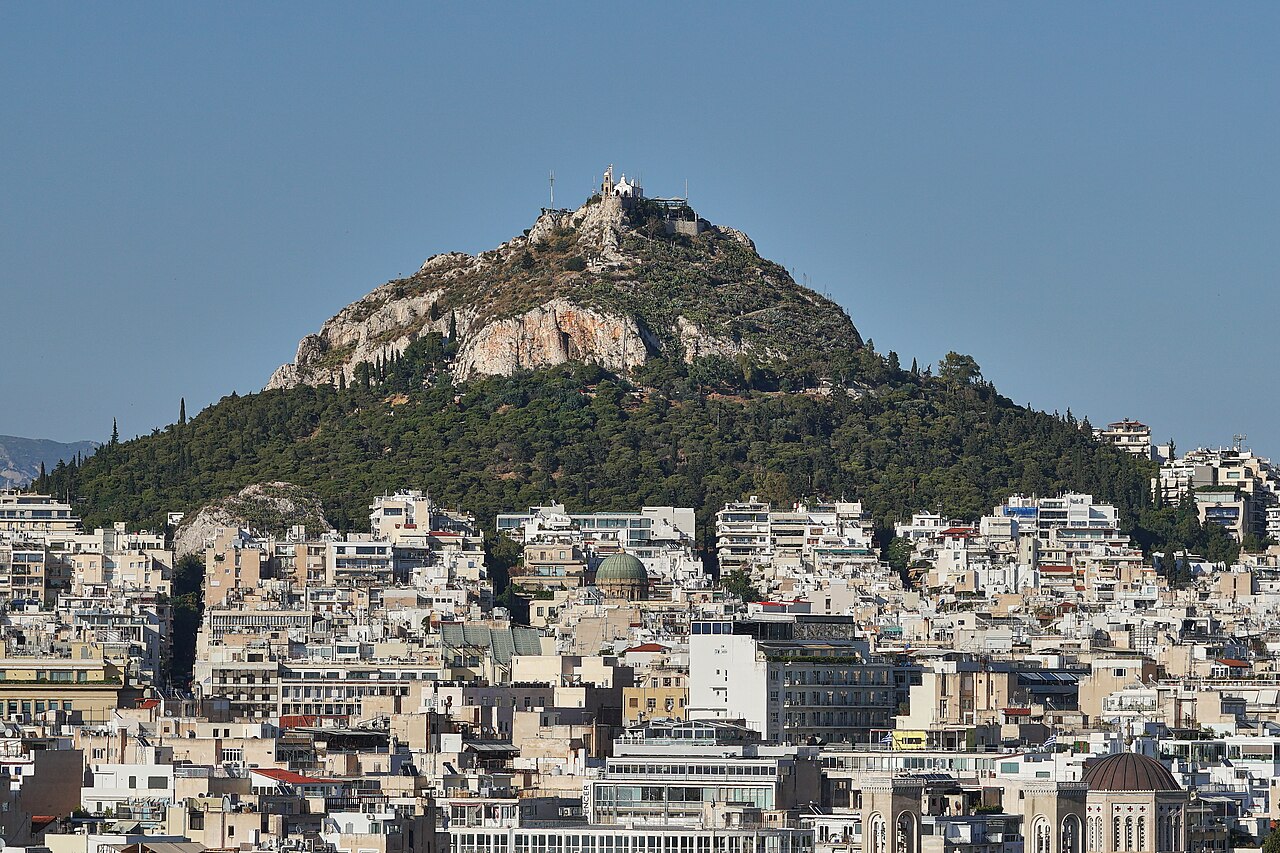
Mount Lycabettus is a limestone cone rising to 277 metres above the Kolonaki district, and it is the high point of central Athens. The official Athens city guide is careful about the superlative: it calls the summit the second highest viewpoint in the wider city, behind Tourkovounia, which is the honest way to put it. What the hill has that Tourkovounia does not is position. The name is less settled. Open to the public; the current City of Athens notice sets no daily opening hours or regular weekly closure.
Checked 2026-08-31 · Source
The summit is small and holds three things worth naming. The whitewashed chapel of Agios Georgios sits at the very top, built in the eighteenth century on a site that had already carried a Byzantine church and, before that, traces of a temple to Zeus. Its bell tower went up in 1902 on a donation from Nicholas Thon, a landowner in King Othon's court, and the large bell inside was cast in Russia and given by Queen Amalia. The latest municipal notice reopened the hill from midnight on 14 August 2026. Temporary full closures may be imposed by municipal civil-protection order during severe wildfire danger.
Checked 2026-08-31 · Source
Ninety minutes covers the hill properly from the street and back to it, and that is the figure this guide plans against. The summit itself is compact: the chapel, the terrace, the parapet and the view take perhaps thirty to forty minutes at an unhurried pace, longer if the light is changing and you keep waiting for it. The rest of the ninety goes on getting up and down, and that is the part visitors underestimate. Free admission to the hill and viewpoint. The optional funicular is separately charged.
Checked 2026-08-31 · Source
Late afternoon into dusk is the reason most people come, and it is the right instinct. Arrive an hour before sunset if you want a place at the parapet rather than a place behind three rows of people at it. Two dates change the character of the hill entirely. Open to the public; the current City of Athens notice sets no daily opening hours or regular weekly closure. City documentation identifies a 200-metre accessible route from a vehicle stopping point towards the Stone Pavilion; it does not describe a continuous step-free route to the summit.
Checked 2026-08-31 · Source
There is no ticket for Mount Lycabettus. The hill is open ground, the summit terrace is open ground, and the chapel of Agios Georgios is a working church that charges nothing. The only thing you pay for is the ride. The one-way fare is worth thinking about rather than defaulting to the return. Free admission to the hill and viewpoint. The optional funicular is separately charged. City documentation identifies a 200-metre accessible route from a vehicle stopping point towards the Stone Pavilion; it does not describe a continuous step-free route to the summit.
Checked 2026-08-31 · Source
No car is needed, and on many nights a car is a liability. The funicular's lower station is at Aristippou 1 in Kolonaki, where Aristippou meets the top of Ploutarchou, and the line runs in a tunnel through the hill to the summit. Everyone else walks. OASA identifies bus 060 from Panepistimio Metro station as the public-transport route for Lycabettus Hill, leaving approximately 140 metres to the listed access point. Alternatively, the funicular's lower station is at Ploutarchou and Aristippou streets; Evangelismos is the nearest Metro station, about 600 metres away along a steep uphill approach.
Checked 2026-08-31 · Source
The operator's own website disagrees with itself about the funicular's hours, and this is the trap worth knowing before you plan an evening around it. The access page states services from 09:00 to 02:30, every thirty minutes and every ten at peak. The operator's page about the hill says that the funicular runs until midnight during the summer months to serve visitors. City documentation identifies a 200-metre accessible route from a vehicle stopping point towards the Stone Pavilion; it does not describe a continuous step-free route to the summit.
Checked 2026-08-31 · Source
The picture almost everyone comes for is southwest: the Acropolis on its rock in the middle distance, the low sprawl of the city around it, Piraeus and the Saronic Gulf behind, and Aegina on the horizon when the air is clean enough. That composition wants a moderate telephoto rather than a wide lens, because the Acropolis is small at this distance and a wide frame turns it into a detail. Two practical warnings. Yes. The City of Athens reopened the hill to the public from midnight on 14 August 2026, and no later closure notice was published by 31 August 2026.
Checked 2026-08-31 · Source
Yes. The City of Athens reopened the hill to the public from midnight on 14 August 2026, and no later closure notice was published by 31 August 2026.
No regular weekly closure is specified. The City may temporarily prohibit entry and vehicle passage during severe wildfire danger, as it did in July and August 2026.
Yes. Access to the hill and viewpoint is free; the funicular is an optional, separately charged service.
The operator's current information box gives 09:00–02:30, with service every 30 minutes and intervals of 10, 15 or 20 minutes at peak times. Adult fares are €10 one way or €13 round trip.
The 210-metre journey runs entirely through a tunnel and takes about three minutes.
The Official Athens Guide recommends one to two hours for the hill route; the summit includes the Church of Agios Georgios, a café, a restaurant and views from 277 metres.
Loading the interactive map…
The interactive map could not be loaded.
Last updated:
Source: OpenStreetMap contributors, Wikidata ·