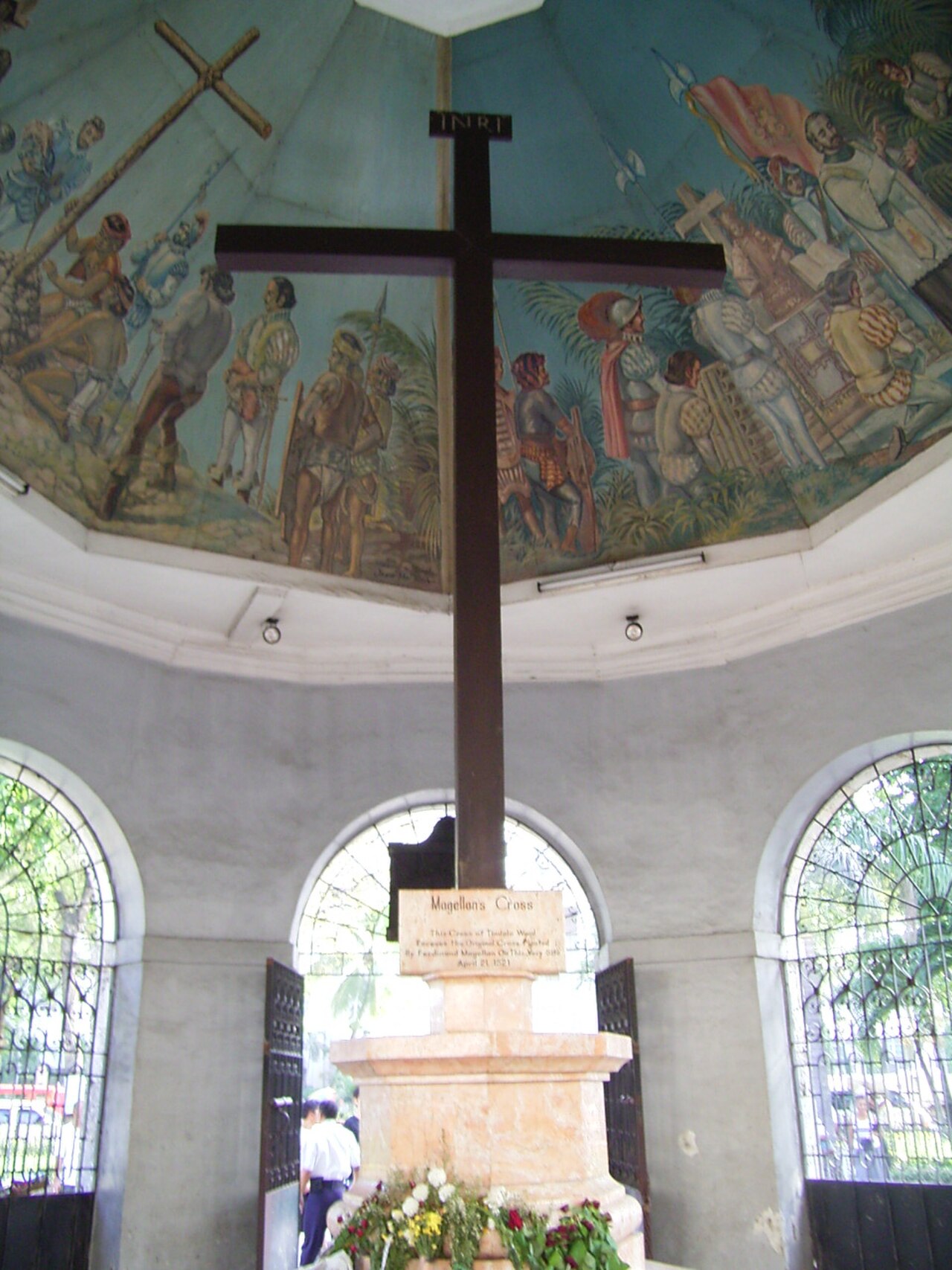
Magellan's Cross is a historical landmark in Cebu City housed within a small chapel near the Basilica Minore del Santo Niño. The site commemorates the arrival of Ferdinand Magellan in 1521 and the subsequent planting of a cross, symbolizing the introduction of Christianity to the Philippines. The current structure protects what is claimed to be remnants of the original cross. Daily 08:00–18:00. No regular weekly closure day. Access may be temporarily controlled during major Basilica events such as Fiesta Señor. Free general admission; no entrance ticket is required.
Visitors encounter a hexagonal pavilion with a painted ceiling depicting the baptism of Humabon, Cebu's ruler, and his queen. The central feature is the encased cross, visible through a grilled enclosure. The surrounding area includes devotional candles and religious items available from nearby vendors. The adjacent Basilica Minore del Santo Niño contains additional ecclesiastical artifacts and worship spaces. No regular weekly closure day. Access may be temporarily controlled during major Basilica events such as Fiesta Señor. Free general admission; no entrance ticket is required.
Most visitors allocate fifteen to thirty minutes for the cross pavilion itself, given its compact dimensions and singular focal point. The experience typically extends when combined with adjacent religious sites, particularly the basilica. Devotional activities such as candle lighting may add time. Travel media consistently list this among essential Cebu stops, suggesting integration into broader itineraries rather than isolated destination status. Free general admission; no entrance ticket is required. The Basilica’s crowd-management plan assigns visitors with disabilities to the P. Burgos Gate rather than the Magellan’s Cross Kiosk Gate. The Basilica site map identifies a dedicated Senior Citizens and PWD area.
Morning visits may offer reduced crowding before pilgrimage and tour groups arrive. Sunday masses and religious observances significantly increase foot traffic. Seasonal variations including Sinulog Festival in January create exceptional congestion. Wikipedia's Cebu City entry confirms the site's enduring prominence without specifying temporal parameters. Daily 08:00–18:00. Use the Plaza Sugbo stop on P. Burgos Street for the Cebu City Hall–IT Park BEEP modern-jeep route. The pavilion is in Plaza Sugbo, beside Basilica Minore del Santo Niño and directly opposite Cebu City Hall; its visitor address is P. Burgos Street.
The site's religious character and public accessibility suggest no admission charge, consistent with comparable Philippine heritage chapels, though this remains unverified through authoritative sources. Candle purchases and devotional offerings involve voluntary contributions. No ticketing infrastructure is evident from available documentation. The National Museum of the Philippines Cebu maintains separate admission policies. Free general admission; no entrance ticket is required. The Basilica’s crowd-management plan assigns visitors with disabilities to the P. Burgos Gate rather than the Magellan’s Cross Kiosk Gate. The Basilica site map identifies a dedicated Senior Citizens and PWD area.
The monument occupies central Cebu City within the Santo Niño precinct, accessible from major thoroughfares including Osmeña Boulevard. Public utility vehicles including jeepneys serve surrounding routes with signage indicating basilica proximity. Taxis and ride-hailing applications provide direct access with minimal navigation complexity given the landmark's established recognition. Use the Plaza Sugbo stop on P. Burgos Street for the Cebu City Hall–IT Park BEEP modern-jeep route. The pavilion is in Plaza Sugbo, beside Basilica Minore del Santo Niño and directly opposite Cebu City Hall; its visitor address is P. Burgos Street.
Persistent candle vendors and informal guides operate in immediate surroundings, requiring visitors to exercise discernment regarding unsolicited services and transactions. The compact pavilion generates congestion during peak pilgrimage periods, demanding patience and personal space awareness. Religious sensitivity remains essential given active worship context; photography restrictions may apply during services despite general permissiveness. Nearby pedestrian traffic includes vehicular intersections with inconsistent crossing infrastructure. The Basilica’s crowd-management plan assigns visitors with disabilities to the P. Burgos Gate rather than the Magellan’s Cross Kiosk Gate. No wheelchair-accessible toilet is identified at the pavilion itself.
The cross enclosure permits visual documentation through protective grating, though angles remain restricted by architectural constraints. Ceiling frescoes reward upward camera orientation with adequate lighting conditions. Flash usage may disturb devotional visitors and should be employed judiciously. The surrounding plaza and basilica exterior provide alternative compositional opportunities with reduced spatial compression. Morning illumination enhances exterior photography before harsh midday tropical contrast develops. No. The Basilica says the survival of Magellan’s original cross remains debated; the securely documented later cross was erected by Augustinians at the traditional site in 1565.
Is the displayed cross certainly the one erected in 1521?
No. The Basilica says the survival of Magellan’s original cross remains debated; the securely documented later cross was erected by Augustinians at the traditional site in 1565.
Why is the cross enclosed in another wooden structure?
By the 1730s it had been covered with nailed wooden boards to stop devotees removing fragments as religious mementos.
When was the present pavilion built?
Bishop Santos Gómez Marañón ordered and funded the present octagonal coral-stone gazebo in 1834.
What does the ceiling mural depict?
It depicts Father Pedro Valderrama baptizing Rajah Humabon and his household and Ferdinand Magellan planting a wooden cross.
Who painted the ceiling mural?
The artists’ names inscribed on the ceiling are Jess Roa and Serry M. Josol.
What heritage protection does the pavilion have?
The Magellan’s Cross Pavilion and Basilica complex were declared National Cultural Treasures on 14 April 2021.
Nothing non-essential is set before you choose, in regions where consent is required. If you decline, ads still appear and analytics is switched off entirely.