
2 min walk
Plaza de Roma
- Must see
- Nature site
Language · 11 published
Place of worship · Manila
Reviewed by Elena Voss · Roavina Travel Editor

Read from the OpenStreetMap access tags; anything not listed has no tag recorded.
Set the group type to family in the planner and the day window contracts to about three quarters of a solo day.
This place is a Place of worship. It was established in 1958. It was built in the Gothic Revival style. It was designed by Fernando H. Ocampo.
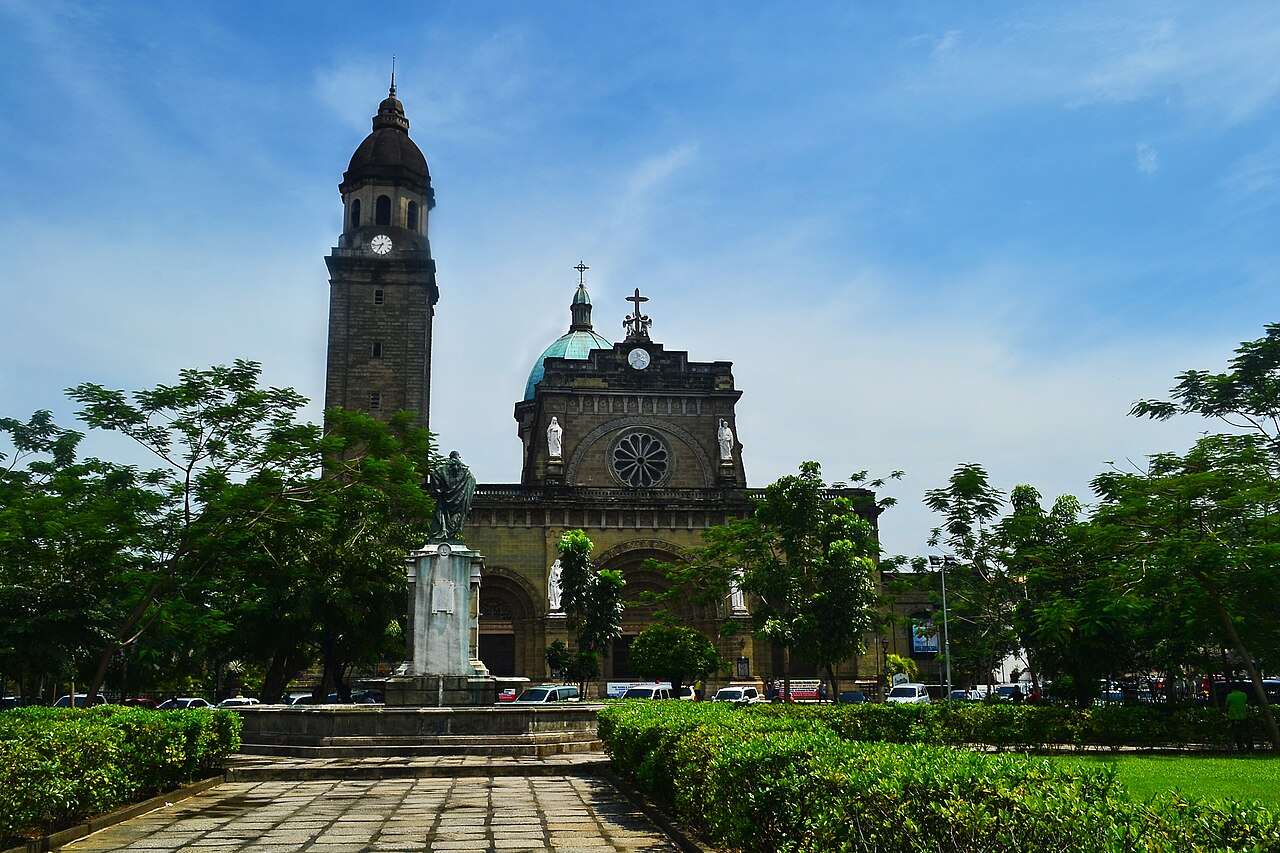
Manila Cathedral is the principal church of the Roman Catholic Archdiocese of Manila and a Minor Basilica in Intramuros. Facing Plaza de Roma, it forms one of the walled district’s most recognizable landmarks. The present building is the result of repeated reconstruction after earthquakes, fires, and wartime destruction, giving the site both religious importance and a layered architectural history. Manila Cathedral, formally the Minor Basilica and Metropolitan Cathedral of the Immaculate Conception, serves as the principal church of the Roman Catholic Archdiocese of Manila. Located within the historic walled district of Intramuros, it stands as a significant religious and architectural landmark. The current structure represents multiple reconstructions following destruction from earthquakes, fires, and wartime bombing throughout its history. The cathedral occupies a prominent position facing Plaza de Roma, contributing to the colonial-era urban plan of the fortified city. Its status as a minor basilica reflects its importance in Philippine Catholic institutional hierarchy. The cathedral functions as an active place of worship. Visitors should verify current accessibility directly with official sources.
Checked 2026-08-26 · Source
Inside, look for neoclassical and Romanesque Revival details, ornate altars, stained-glass windows, devotional statues, and side chapels. Pew rows and confessionals make its continuing role as a working church immediately clear. The crypts contain the remains of former archbishops of Manila. Allow time to notice how decorative stonework, concrete, and later rebuilding coexist within one sacred interior. The cathedral interior features neoclassical and Romanesque revival elements, with ornate altars, stained glass windows, and religious statuary. The main altar and side chapels contain devotional objects and imagery central to Catholic worship. Crypts below the church house the remains of former archbishops of Manila. The structure incorporates stone and concrete construction with decorative detailing. Visitors will observe pews arranged for congregational worship, confessionals, and spaces for liturgical functions. The overall spatial experience reflects centuries of ecclesiastical architectural evolution adapted to Philippine conditions and materials available during successive reconstruction periods.
Checked 2026-08-26 · Source
A focused visit usually takes about twenty minutes to one hour. Use the shorter end for a quiet look at the facade and interior, or stay longer for prayer, architectural details, and the chapels. Religious services add their own duration. Because Manila Cathedral stands inside Intramuros, it fits naturally into a longer heritage walk alongside nearby churches, plazas, and defensive walls. Visitor duration depends on individual purposes including prayer, architectural observation, or general tourism. Casual visitors typically spend between twenty minutes to one hour inside the cathedral. Those attending Mass or participating in religious services will require additional time corresponding to liturgical schedules. Photography and detailed examination of interior features may extend visits.
Checked 2026-08-26 · Source
Manila Cathedral is an active place of worship, so religious observances shape the visitor experience. Weekday mornings can feel more peaceful, while weekends and holy days bring larger congregations. Christmas and Holy Week are especially significant periods for Catholic worship in the Philippines. Visiting earlier in the day also makes an Intramuros walk more comfortable before heat and crowds build.
Checked 2026-08-26 · Source
Manila Cathedral is a functioning church rather than a conventional ticketed museum. Visitors enter for worship, prayer, or respectful sightseeing, and donations may be welcomed for church care. The cathedral’s religious purpose remains central throughout the visit. Treat any contribution as voluntary and bring modest Philippine pesos if you wish to support the building or its activities.
Checked 2026-08-26 · Source
The cathedral is in Intramuros, near Plaza de Roma and the district’s historic gates. Jeepneys, buses, taxis, and ride-hailing services reach the surrounding Manila streets, while the LRT-1 Central Terminal provides a nearby rail approach followed by a walk. Once inside Intramuros, expect pedestrian movement over cobblestones and uneven surfaces, with the cathedral easiest to reach on foot.
Checked 2026-08-26 · Source
Dress modestly, covering shoulders and knees, and keep voices low in prayer areas. Services take priority over sightseeing, and staff or clergy directions should guide where you stand and when you photograph. Intramuros can be hot, bright, and busy, with uneven streets underfoot. Carry water, protect valuables in crowds, and leave generous space for worshippers entering or leaving.
Checked 2026-08-26 · Source
The facade and Plaza de Roma provide strong exterior views of Manila Cathedral, including its broad front and architectural details. Inside, photograph quietly and without interrupting prayer or services. Avoid flash unless church staff permit it, and keep equipment compact in crowded areas. The most rewarding images often combine the cathedral’s rebuilt details with the surrounding streetscape of Intramuros.
Checked 2026-08-26 · Source
It is the principal church of the Roman Catholic Archdiocese of Manila, a Minor Basilica, and a major landmark facing Plaza de Roma in Intramuros.
The interior includes ornate altars, stained glass, religious statuary, side chapels, pews, confessionals, and crypts containing former Manila archbishops’ remains.
It stands within Intramuros in central Manila, directly associated with Plaza de Roma and the historic walled-city streets.
Plan roughly twenty minutes to one hour for sightseeing, with additional time if you attend a religious service or spend time in prayer.
Choose modest clothing that covers the shoulders and knees, and behave quietly because the cathedral remains an active place of worship.
Its Intramuros location makes it easy to combine with Plaza de Roma, nearby historic churches, defensive walls, and other heritage sites in the walled district.
Loading the interactive map…
The interactive map could not be loaded.

Last updated:
Source: OpenStreetMap contributors, Wikidata ·