

3061 min walk
Mälaren
- Must see
- Nature site
Language · 11 published
Art and culture venue · Stockholm
Reviewed by Elena Voss · Roavina Travel Editor
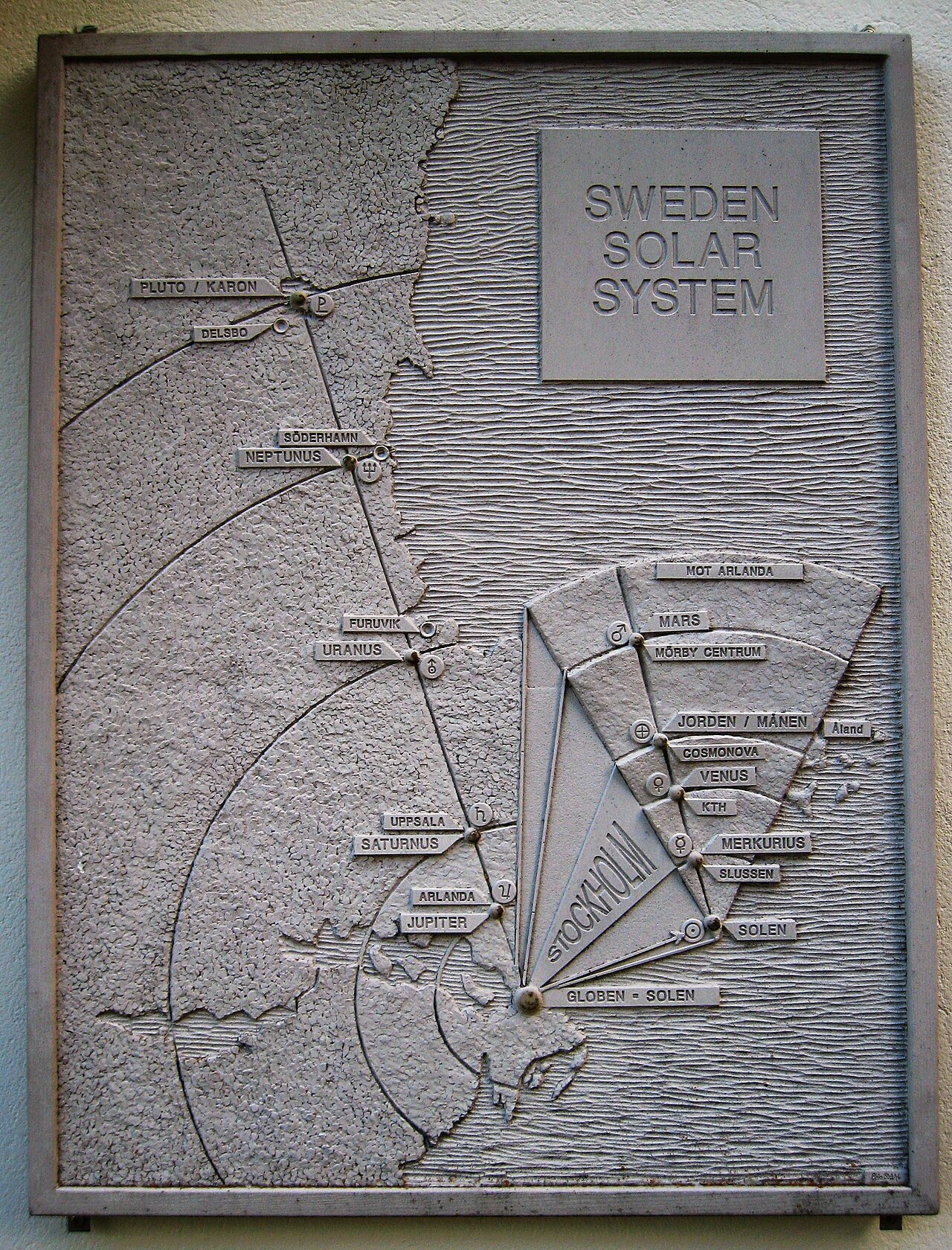
This place is a Artwork.
Sweden Solar System is a large-scale model of the solar system spread across Sweden, with Stockholm serving as the central reference point. Celestial bodies are represented by spherical installations placed at scaled distances. The concept turns astronomical distance into a geographical journey: instead of seeing every planet in one room, travellers encounter separate components across the country. It is both an educational model and an invitation to think about scale through travel. Sweden Solar System is a large-scale model of the solar system distributed across Sweden, with Stockholm serving as a central reference point. The model uses spherical representations of celestial bodies placed at scaled distances from one another. The Sun is represented at a prominent location, with planets positioned throughout the country at distances proportional to their actual astronomical separation. This educational installation allows visitors to comprehend the vast scale of planetary orbits through physical travel between model components. No. Only the Sun representation is situated in Stockholm. The planets are distributed across Sweden at scaled distances, requiring substantial travel to experience multiple components.
Checked 2026-08-26 · Source
The installation includes a representation of the Sun in Stockholm and planetary representations distributed across Sweden. Each sphere expresses the relative scale of the solar system through physical size and distance. The experience is therefore outdoors and geographically dispersed rather than contained inside a conventional exhibition hall. Visit one component as a brief sight, or combine several components with a broader Swedish journey to make the model’s enormous scale easier to understand. The installation comprises representations of the Sun and multiple planets, each constructed as a spherical object with dimensions scaled to maintain proportional relationships. The Sun represents the largest component, with subsequent planets decreasing in relative size. Some models incorporate additional features such as information plaques or artistic elements. The distributed nature means visitors encounter individual components rather than a contained exhibition.
Checked 2026-08-26 · Source
A single component can be viewed quickly, but experiencing the full Sweden Solar System requires substantial travel between different parts of Sweden and may take several days. In Stockholm, treat the Sun representation as a short educational stop that can fit into a city itinerary. A wider tour needs realistic time for rail, road or other intercity journeys. The travel between spheres is not incidental; it is the central way the model communicates astronomical distance.
Checked 2026-08-26 · Source
Outdoor components can be approached throughout the year, but Swedish weather and daylight strongly affect comfort and visibility. Summer offers long daylight for finding and viewing installations, while winter may bring cold, snow or difficult road conditions, especially away from Stockholm. For a multi-stop journey, choose a season that suits the distances you intend to cover. For the Stockholm component alone, the best time is simply when it fits your city route and outdoor plans.
Checked 2026-08-26 · Source
Sweden Solar System is encountered as separate outdoor installations rather than a single ticketed museum. In Stockholm, the Sun representation can be treated as a brief public-art and science stop. A complete solar-system journey is therefore shaped more by geography and travel planning than by entrance fees.
Checked 2026-08-26 · Source
The Stockholm component is reached through the capital’s urban transport network and can be combined with other city sightseeing. Other planetary installations require intercity travel across Sweden by train, car or another suitable connection. The national railway network and regional operators serve many Swedish destinations, but the correct route depends on the particular sphere you want to see. Build the trip around selected components and their distances, rather than expecting the full model to fit into one Stockholm excursion.
Checked 2026-08-26 · Source
The model’s distributed design makes distance the main practical challenge. Do not plan to walk between planets: the installations are separated across Sweden. Rural or remote components can involve long journeys, variable road conditions and fewer services than central Stockholm. Wear clothing suited to the season, allow generous travel time, and avoid turning a distant sphere into a rushed detour. When photographing near roads, keep a safe distance from traffic and remain aware of changing outdoor conditions.
Checked 2026-08-26 · Source
Each sphere offers a different photographic setting, from Stockholm’s urban environment to installations surrounded by other Swedish landscapes. Use the surrounding space to show the contrast between a small model object and the large geography it represents. Seasonal light varies greatly across Sweden, especially between southern and northern locations. Keep clear of roads, respect the places where installations stand, and avoid treating a photograph of one sphere as a substitute for the wider journey between components.
Checked 2026-08-26 · Source
No. Stockholm contains the Sun representation, while the planetary components are distributed across Sweden at scaled distances.
No. The components are spread across Sweden, so travelling between them requires intercity transport rather than walking.
The Stockholm component represents the Sun, serving as the central reference point for the scaled model across Sweden.
Seeing the whole model requires substantial travel across Sweden and may take several days, depending on how many components you include.
No. It is a geographically distributed outdoor installation made up of separate spherical representations across Sweden.
Individual component viewing is described as free of admission charges; the main practical costs come from travelling between installations.
Loading the interactive map…
The interactive map could not be loaded.
Last updated:
Source: OpenStreetMap contributors, Wikidata ·