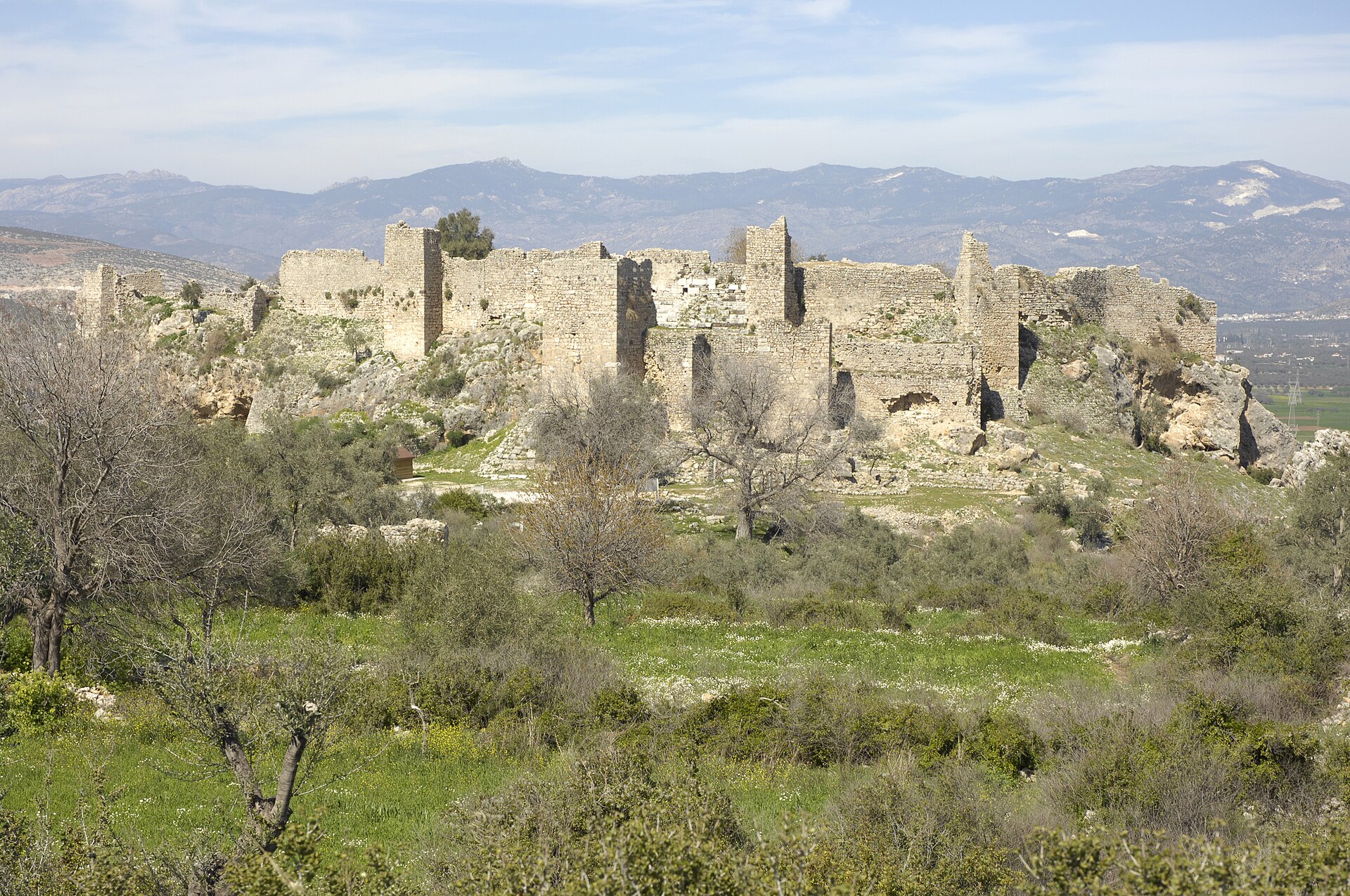
191 min walk
Beçin Castle
- Must see
- Historic monument
Language · 11 published
Historic monument · Muğla
Hydisos
Reviewed by Elena Voss · Roavina Travel Editor
This place is a Attraction.
Hydissus is an ancient settlement in Caria, the region of southwestern Anatolia that gives this place its historical setting. It is identified with a polis, or city-state, rather than a modern museum complex or a preserved urban centre with a visitor reception building. The site is associated with the ancient community known by the forms Hydissus, Hydissos, Hydisus, Hydisos and Hydissa. Its significance lies in reading a lesser-known Carian place within the wider political and cultural landscape of the Aegean coast. Hydissus also helps connect the inland Milas area with the maritime political networks of the ancient Aegean. The site is modest in visitor infrastructure, but its historical identity is unusually specific.
Checked 2026-09-02 · Source
Hydissus is an open-air archaeological area in natural terrain, not a fully arranged ruin park with marked visitor facilities. Research for the site does not identify a walking platform, managed visitor route, or accessible circuit. Expect the remains and landscape to be encountered outdoors, with the character of an archaeological location rather than a sequence of reconstructed rooms, interpretive galleries or staffed exhibition spaces. The historical identity of the settlement is more certain than the extent of visible, visitor-ready remains on the ground. Visitors should therefore approach Hydissus as a landscape to understand, not as a compact collection whose principal features are guaranteed to be signposted.
Checked 2026-09-02 · Source
Allow time for the journey, locating the archaeological area and walking carefully over its natural ground rather than planning a fixed museum-style visit. A short exploratory stop may be enough for travellers already nearby, while visitors interested in landscape archaeology should leave more time to orient themselves and examine the setting without rushing across uneven terrain. Build flexibility into the day because finding the site and understanding the visible traces may take longer than the actual stop.
Checked 2026-09-02 · Source
Because Hydissus is not listed by the Ministry of Culture and Tourism among the arranged, visitable archaeological sites, no official opening hours or weekly closing day are published for it. The practical implication is that this is not a timed museum attraction with a reliable daily timetable. Daylight is the sensible condition for an outdoor visit, especially because the site is on natural ground and no managed route or visitor infrastructure is identified. Weather and ground conditions should shape the decision to go. Dry, bright conditions will generally make the terrain easier to negotiate and the archaeological setting easier to read, although no seasonal visiting rule is published for Hydissus.
Checked 2026-09-02 · Source
It should therefore be approached as a non-ticketed landscape site rather than as a staffed archaeological museum or regulated ören yeri entrance. No ticket-purchase process, ticket office, timed entry or official visitor tariff is identified in the operator or responsible public-body material supplied for this guide. There is consequently no researched adult, child or concession price to display. The absence of a tariff is part of the site’s practical character, not a reason to invent an equivalent museum ticket.
Checked 2026-09-02 · Source
Hydissus is near Karacahisar in Milas district, Muğla. The mapped location is approximately 37.13851°N, 27.81098°E, with Karacahisar and Çiftlikköy identified as the nearest settlements in the supplied map research. Access is described from the Karacahisar direction by private car. No dedicated public-transport line or stop is listed for the site, so drivers should treat the map position as an orientation aid and be prepared for the final approach to an undeveloped archaeological area. The coordinates are useful for orientation, but the last stretch should be approached cautiously.
Checked 2026-09-02 · Source
Plan for a place without the safeguards of a developed visitor attraction. Wear stable footwear, avoid crossing fragile-looking remains, and keep the visit to daylight so that uneven surfaces and the surrounding terrain are easier to read. Carry water and do not expect toilets, staffed assistance, explanatory displays or a formal entrance point unless current local conditions show otherwise. Archaeological remains should be left undisturbed. Pushchairs and wheelchairs may be unsuitable because no step-free route is identified.
Checked 2026-09-02 · Source
Hydissus is best photographed as a relationship between archaeological traces and the Carian landscape around them. Without a managed visitor circuit or published interpretation, wide views can help communicate why the settlement’s position matters, while closer images should be taken from stable ground without climbing on or touching remains. Morning or late-afternoon light can make low features and changes in the terrain easier to distinguish. Keep photography observational: the open setting is part of the experience, but it does not make the archaeology a backdrop for careless access. Photograph from existing ground wherever possible and avoid moving stones to improve a composition.
Checked 2026-09-02 · Source
Hydissus was a city in ancient Caria, the historical region of southwestern Anatolia.
Hydissus was located south of Mylassa, the ancient city associated with modern Milas.
Yes. Hydissus was a polis, meaning an ancient city-state.
Hydissus was among the members of the Delian League.
The archaeological area is near Karacahisar in Milas district, Muğla.
Hydissus is also known as Hydissos, Hydisus, Hydisos and Hydissa.
Loading the interactive map…
The interactive map could not be loaded.
Last updated:
Source: OpenStreetMap contributors, Wikidata ·