

3 min walk · London Borough of Tower Hamlets
Sky Garden
- Must see
- Viewpoint
Historic monument · London Borough of Southwark, London
The Monument to the Great Fire of London
Read from the OpenStreetMap access tags; anything not listed has no tag recorded.
Set the group type to family in the planner and the day window contracts to about three quarters of a solo day.
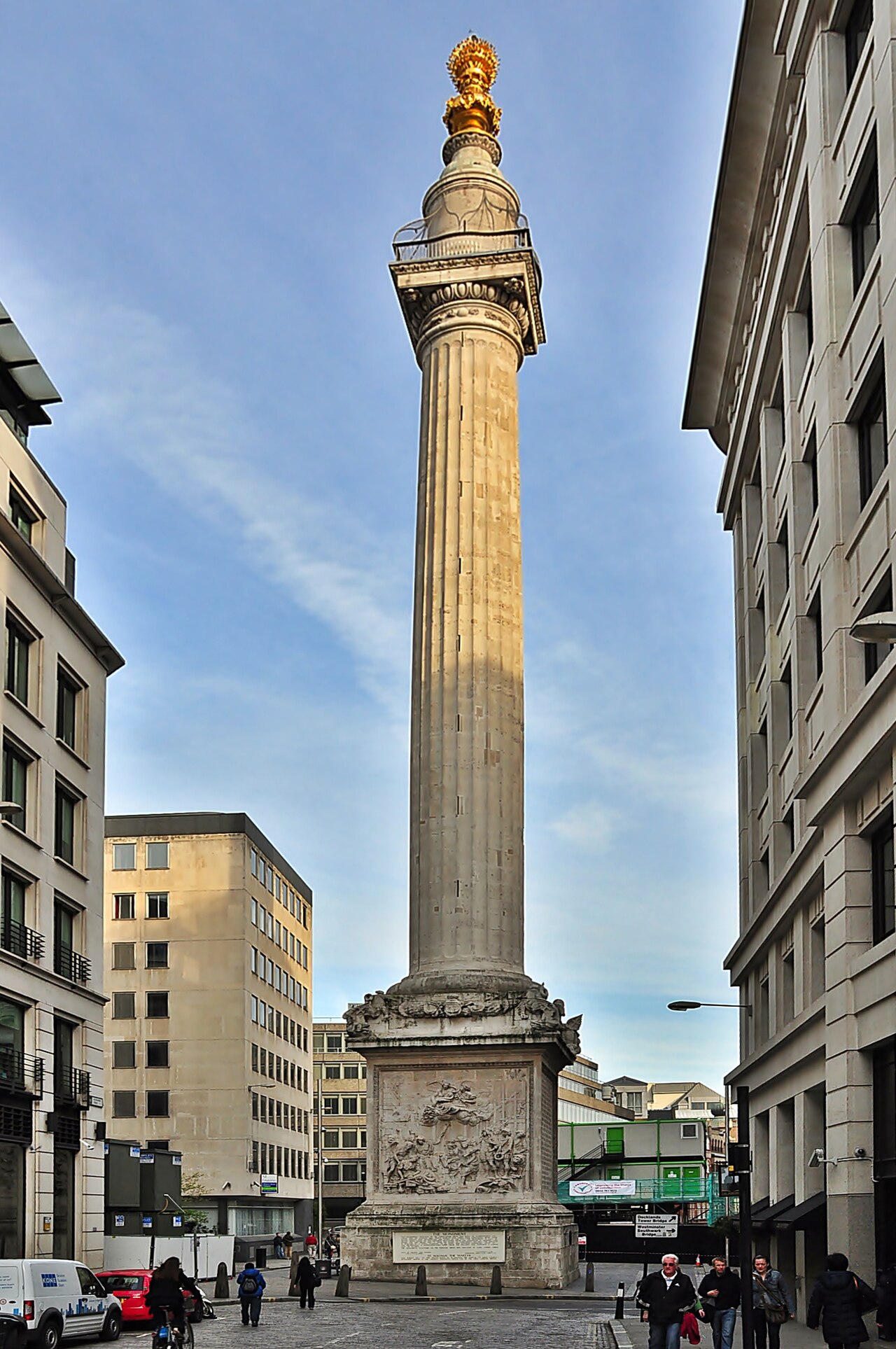
The Monument to the Great Fire of London is a Doric column near Pudding Lane in the City of London. Sir Christopher Wren and Robert Hooke designed it to commemorate the Great Fire of 1666 and the rebuilding that followed. A gilded urn of flames crowns the stone column, giving the landmark a distinctive profile among the surrounding streets. The structure combines a historical memorial with a climb to an exposed viewing platform. Its position near London Bridge, the Thames and the City’s older streets makes it a compact stop with strong historical and visual context.
Checked 2026-08-26 · Source
Inside the Monument, a narrow spiral staircase of 311 steps winds upwards through the largely hollow column. The climb ends at an open-air viewing platform with views across the City of London. At ground level, Latin inscriptions explain the fire, the rebuilding of the City and the purpose of the memorial. There are no additional chambers or galleries beyond the stairwell and platform, so the visit is focused: read the inscriptions, make the ascent, take in the elevated outlook and return through the same historic structure.
Checked 2026-08-26 · Source
The visit consists of the staircase ascent, time on the viewing platform and the descent. The 311 steps make physical effort the main factor in the duration. Visitors who move steadily can keep the stop compact, while those who pause for the inscriptions, skyline and photography will need longer. The staircase is narrow, so crowding can slow movement and make passing difficult. Plan the Monument as a focused historical and viewpoint experience rather than a large museum visit. The same staircase serves both directions, and the return journey is part of the physical commitment.
Checked 2026-08-26 · Source
The open-air platform is most rewarding on a clear day, when the City skyline and surrounding London landmarks stand out beyond the railings. Rain and strong winds can make the top unpleasant and may lead to temporary safety closures. The enclosed stairwell can feel warm during hot summer weather. Weekday mornings may offer a quieter climb than weekends, holidays and busy tourist periods. Weather matters more here than at an indoor attraction because the final viewpoint is exposed. The historical setting remains worthwhile in changing conditions, but the quality of the elevated panorama depends strongly on visibility.
Checked 2026-08-26 · Source
Climbing the Monument has historically required paid admission. The visit is separate from the surrounding public streets and from nearby attractions, so travellers should treat the staircase and viewing platform as a dedicated ticketed stop. Different admission categories may apply to adults, children or concessions. The compact structure has limited internal space, which makes entry arrangements relevant during busy periods. The value comes from combining a specific piece of Great Fire history with an elevated City view. The inscriptions at the base and the 311-step climb are part of the same experience, rather than separate exhibitions.
Checked 2026-08-26 · Source
The Monument stands on Fish Street Hill near the northern end of London Bridge. Monument Underground station, served by the Circle and District lines, is close to the column. Bank station provides further connections through the Central, Northern, District, Circle and Waterloo and City lines. Bus routes cover the surrounding streets, while the Thames Path offers a pedestrian approach along the river. The area connects naturally with London Bridge, Pudding Lane and the riverside. Weekday commuting traffic makes the streets busy, so walking from the station requires attention around crossings and crowded pavements.
Checked 2026-08-26 · Source
The staircase is steep, narrow and enclosed, with limited opportunities for people to pass. There is no lift, and wheelchair users cannot reach the viewing platform. The 311-step ascent and descent demand physical stamina, while the height and open platform may trouble visitors who dislike exposed places. Large bags are awkward in the tight stairwell. Children need careful supervision throughout the climb and at the top. The platform has protective railings but remains open to the weather. Around the base, traffic and pedestrians create a busy urban setting, especially during working hours.
Checked 2026-08-26 · Source
The viewing platform gives photographers an elevated position over the City, with changing views around the column and protective railings framing the skyline. The narrow staircase is not a practical place to stop for photographs because visitors move through it in limited space. From ground level, the full column is difficult to capture close up because surrounding buildings and the narrow streets restrict distance. The gilded flame urn benefits from a viewpoint farther away or from another elevation. Clear daylight brings detail to the City, while later light can emphasise the stone column and golden crown.
Checked 2026-08-26 · Source
The Monument’s narrow spiral staircase contains 311 steps leading to the open-air viewing platform.
It commemorates the Great Fire of London in 1666, the destruction it caused and the rebuilding of the City afterwards.
No. The Monument has no lift and the platform is reached only by the narrow 311-step spiral staircase.
The column stands on Fish Street Hill near the northern end of London Bridge, close to Pudding Lane in the City of London.
The staircase reaches an open-air viewing platform with views across the City of London and the surrounding skyline.
Sir Christopher Wren and Robert Hooke designed the Doric column, which was erected between 1671 and 1677.
Loading the interactive map…
The interactive map could not be loaded.
Last updated:
Source: OpenStreetMap contributors, Wikidata ·