

2 min walk
Jay Pritzker Pavilion
- High
- Art and culture venue
Language · 11 published
Activity · Chicago
Reviewed by Elena Voss · Roavina Travel Editor
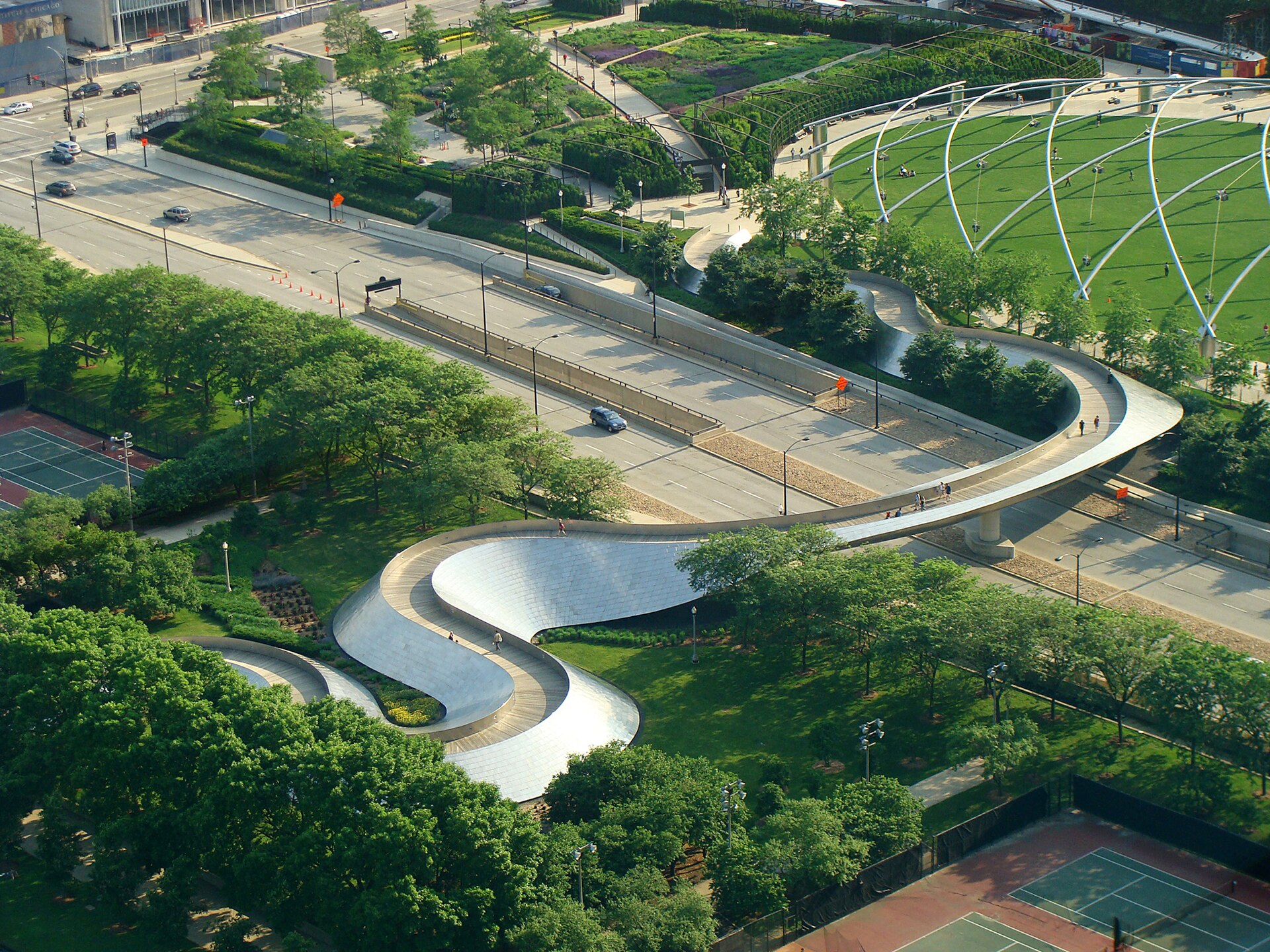
It opened in 2004. It was designed by Frank Gehry. It is built of stainless steel.
BP Pedestrian Bridge is a sculptural pedestrian crossing in Chicago’s Millennium Park, designed by architect Frank Gehry. The bridge spans Columbus Drive and links Millennium Park with Daley Bicentennial Plaza. Opened in 2004, the bridge functions as both public infrastructure and a piece of contemporary architecture. Its serpentine form, brushed stainless-steel surface, and elevated position make an ordinary crossing into a short city experience. The bridge is especially useful for travellers who want architecture, skyline views, and a connection between two downtown park spaces in one stop. The structure has no enclosed museum or gallery programme: its interest comes from the curve, surface, movement through space, and changing views over Chicago. The BP name reflects sponsorship by the energy company BP, but the visitor experience is defined by Gehry’s design and the bridge’s place within Millennium Park. Include it in a walking route rather than planning it as a standalone full-day attraction.
Checked 2026-08-26 · Source
There is no enclosed interior inside BP Pedestrian Bridge. Visitors walk across an open-air elevated deck with a wooden surface, stainless-steel cladding, and railings on both sides. The curved route frames Millennium Park, Daley Bicentennial Plaza, Columbus Drive, the Chicago skyline, and Lake Michigan. The bridge’s acoustic design helps reduce the impression of traffic noise from the road below, adding to the sense that the crossing has been shaped as an experience rather than as a straight utilitarian ramp. Benches are not integrated into the bridge, so the visit is based on walking, pausing, looking, and photographing rather than sitting for a long period. Because the deck is exposed, sky and weather remain part of what visitors encounter. The bridge’s changing reflections and sightlines reward movement: the view from the approach differs from the view at the middle and ends. Read the structure as a link between park landscapes as well as an architectural object.
Checked 2026-08-26 · Source
A direct crossing takes about five to ten minutes at a leisurely pace. Add more time if you want to pause for photographs, study the stainless-steel surface, or look toward the Chicago skyline and Lake Michigan. The bridge is most rewarding as part of a longer Millennium Park walk: travellers can cross between the park and Daley Bicentennial Plaza, then continue through the surrounding downtown spaces. Its short length makes the bridge easy to fit between larger attractions, meals, or architectural walks. Do not schedule it like a conventional museum with hours of galleries; the experience is the movement across the curved deck and the views that open around it. Crowds, events, and weather can slow the crossing, particularly when many visitors stop in the same narrow sections. A five-minute transit stop can be enough for the basic experience, while fifteen to twenty minutes gives a photographer or architecture enthusiast time to engage with the structure.
Checked 2026-08-26 · Source
BP Pedestrian Bridge is an outdoor park structure, so the best moment depends on daylight, weather, and the atmosphere in Millennium Park. Summer offers warm conditions and longer daylight, while winter can bring snow, ice, and a slippery walking surface. Morning and evening light change the way the stainless-steel cladding reflects the sky and nearby buildings, making different times of day useful for photography. Pleasant weather can also bring heavier pedestrian traffic, especially during major events and peak tourist periods. The bridge has no overhead shelter, so rain, snow, wind, and extreme temperatures are felt directly along the crossing. Include the bridge when the surrounding park route is comfortable, rather than making it the only outdoor activity of the day. A daytime crossing gives clear views across the park and skyline; an evening visit adds urban lighting when the surrounding park spaces remain accessible. Treat the bridge as part of Millennium Park’s public landscape.
Checked 2026-08-26 · Source
Crossing BP Pedestrian Bridge is free. The structure functions as public park infrastructure between Millennium Park and Daley Bicentennial Plaza, with no ticketing system at the bridge entrances. Travellers therefore need no admission budget for the crossing itself. Costs connected with the surrounding visit, such as parking, food, or paid attractions elsewhere in Millennium Park, are separate from bridge access. Guided walking tours may include the bridge as one stop, but the bridge remains a free public walkway when crossed independently. Its free access makes it useful in a Chicago itinerary that balances major ticketed attractions with open public spaces. Spend time on the bridge for its architecture and views, then continue into the park or across Columbus Drive without treating the crossing as a paid venue. The practical experience is simple: walk the curved deck, observe the city from above, and use the bridge to connect two downtown park areas.
Checked 2026-08-26 · Source
The bridge lies within Millennium Park in downtown Chicago and connects the park with Daley Bicentennial Plaza across Columbus Drive. Pedestrians can approach from Michigan Avenue, Columbus Drive, either connected park area, or nearby downtown streets. The Washington/Wabash and Adams/Wabash elevated-train stations serve the general area, and CTA bus and rail services connect Millennium Park with other parts of the city. Parking garages and street spaces exist nearby, but downtown availability and prices vary, making public transport and walking practical choices. Plan the bridge as a link in a route: enter Millennium Park, cross the curved deck, and continue into Daley Bicentennial Plaza or back toward the central park attractions. The bridge’s two ends are useful orientation points, while the elevated middle provides changing views over the road and park. Because this is an open pedestrian connection, the approach and crossing belong naturally within a walking day around Chicago’s Loop and lakefront edge.
Checked 2026-08-26 · Source
The wooden deck can become slippery when wet or icy, and the bridge has no roof or enclosed refuge from rain, snow, wind, or heat. Wear footwear suited to outdoor walking and leave room for changing conditions. Crowds can gather when visitors stop for photographs, during major events, or on pleasant summer days; keep to the pedestrian flow and avoid blocking the curved route. Bicycles are not permitted on the walkway, so cyclists must dismount and walk their bicycles when crossing. The serpentine form limits sightlines in places, and the bridge’s curves require attention to people approaching from the other direction. There is no permanent staff presence on the bridge and no restroom or seating provision on the structure itself. Use facilities in surrounding Millennium Park areas before beginning a longer walk. Keep bags secure in busy public spaces and remember that the bridge is a working pedestrian route as well as an architectural landmark.
Checked 2026-08-26 · Source
The BP Pedestrian Bridge is a strong photography stop because the bridge itself, Millennium Park, the Chicago skyline, and Lake Michigan can all enter the frame. Gehry’s curved form creates different compositions from the approaches, the middle of the crossing, and the connected park spaces. Stainless steel reflects changing light, clouds, buildings, and movement, so morning, midday, and evening produce different visual results. The bridge’s elevated position helps separate the deck from Columbus Drive while keeping the urban setting visible. Tripods must follow general park rules, and the supplied guide does not establish a special tripod or filming policy. Keep camera equipment out of the pedestrian path, especially when the bridge is crowded. Photograph the structure as part of its setting: one image can emphasise the serpentine silhouette, another the reflective cladding, and another the connection between Millennium Park and Daley Bicentennial Plaza. Weather is a creative element here, but it also changes footing and comfort.
Checked 2026-08-26 · Source
Yes. BP Pedestrian Bridge is a free public walkway connecting Millennium Park with Daley Bicentennial Plaza.
A leisurely crossing takes about five to ten minutes, with extra time useful for photographs and views.
It spans Columbus Drive and connects Millennium Park with Daley Bicentennial Plaza in downtown Chicago.
Architect Frank Gehry designed the bridge, which opened in 2004 with a distinctive serpentine form and stainless-steel surface.
Bicycles are not permitted on the pedestrian walkway; cyclists must dismount and walk their bicycles across.
The bridge offers views of Millennium Park, Daley Bicentennial Plaza, the Chicago skyline, Columbus Drive, and Lake Michigan.
Loading the interactive map…
The interactive map could not be loaded.
Last updated:
Source: OpenStreetMap contributors, Wikidata ·