
2 min walk
Gastown
- Must see
- Historic monument
Language · 11 published
Historic monument · Vancouver
Reviewed by Elena Voss · Roavina Travel Editor
| Monday | 00:00 – 23:59 |
|---|---|
| Tuesday | 00:00 – 23:59 |
| Wednesday | 00:00 – 23:59 |
| Thursday | 00:00 – 23:59 |
| Friday | 00:00 – 23:59 |
| Saturday | 00:00 – 23:59 |
| Sunday | 00:00 – 23:59 |
Checked 2026-08-31 · Source
Read from the OpenStreetMap access tags; anything not listed has no tag recorded.
Set the group type to family in the planner and the day window contracts to about three quarters of a solo day.
This place is a Attraction.
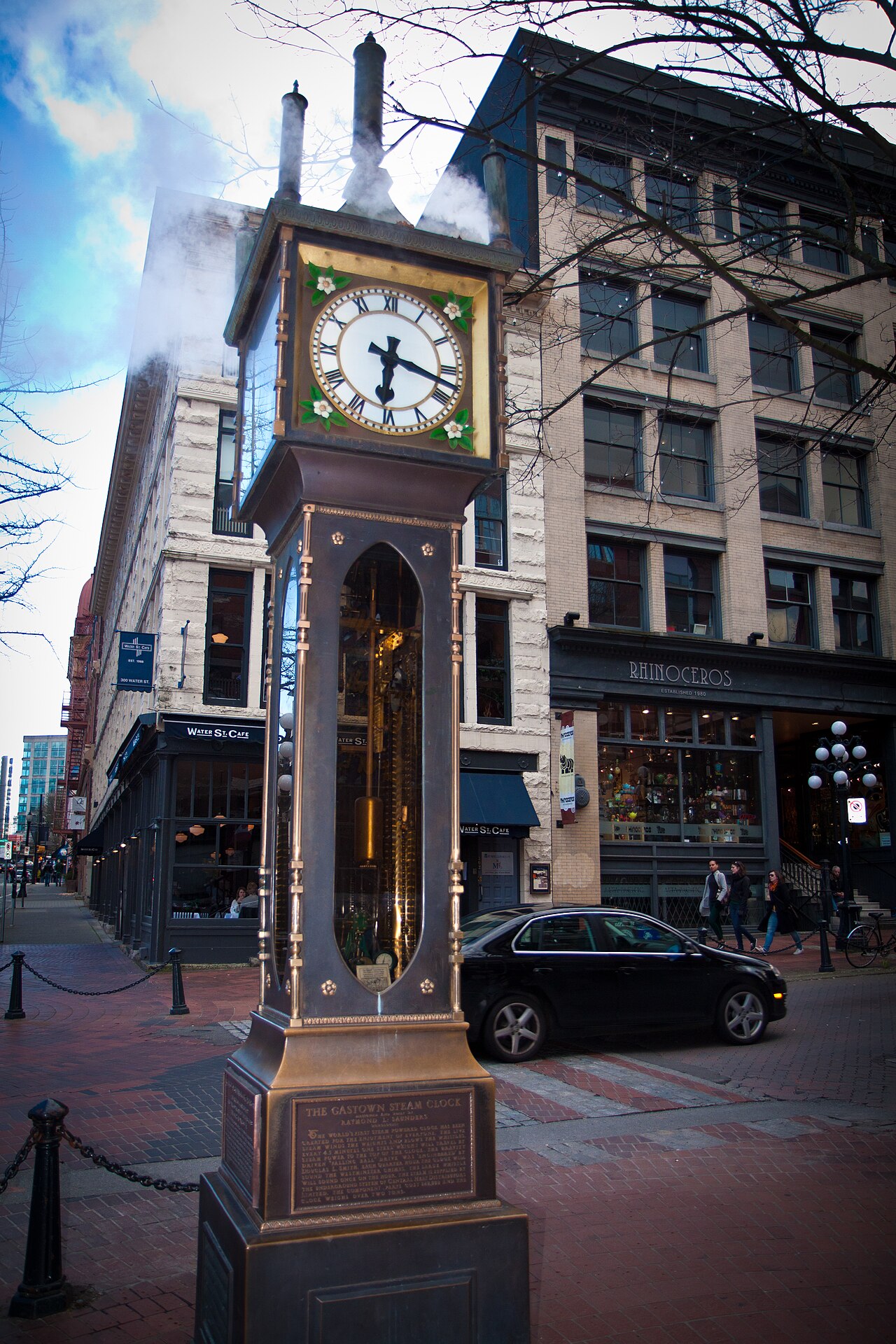
The Gastown Steam Clock is a public landmark on a sidewalk in Vancouver’s historic Gastown district. Installed in 1977 by clockmaker Raymond Saunders and metalwork specialist Doug Smith, it combines a working timepiece with visible steam effects and a whistle that chimes on the quarter hour. It is an outdoor street attraction rather than an enclosed museum or exhibition. The Gastown Steam Clock is a public timepiece and landmark in Vancouver's historic Gastown district. It stands on a sidewalk at a street corner, powered partly by steam. The clock was installed in 1977 by local clockmaker Raymond Saunders and metalwork specialist Doug Smith. It has become one of the most photographed attractions in the city, drawing visitors who gather to watch and hear its steam-driven whistle chime on the quarter hour. The clock combines functional horology with theatrical steam effects, making it a distinctive piece of street furniture rather than a building-based museum or gallery. No. The Gastown Steam Clock was built in 1977, though it stands in a historic district with older architecture.
Checked 2026-08-26 · Source
There is no interior visitor space. The clock stands in a tall metal-and-glass structure on a stone base, with clock faces on multiple sides and mechanical details visible through the glass. The surrounding experience comes from the street corner, nearby heritage buildings, cobblestone streets, shops, and restaurants of Gastown. Visitors come to observe the mechanism, hear the whistle, and photograph the landmark from outside. The Gastown Steam Clock is an exterior street object with no interior space for visitors to enter. Its mechanism is housed within a tall metal and glass column structure mounted on a stone base. Visitors can observe the external steam vents, clock faces on multiple sides, and the visible mechanical components through glass panels. There is no ticketed enclosure, exhibition hall, or staffed facility. The surrounding area consists of cobblestone streets, heritage buildings, shops, and restaurants that constitute the broader Gastown historic district.
Checked 2026-08-26 · Source
Set aside fifteen to thirty minutes for the clock itself. That is enough time to view its four-sided design, listen for the steam whistle, and take photographs from several angles. The stop naturally becomes longer when combined with a walk through Gastown, where heritage façades, shops, restaurants, and surrounding streets can fill one to two hours of an itinerary.
Checked 2026-08-26 · Source
The clock is an outdoor street landmark and can be viewed in any season. Daylight makes the steam and surrounding architecture easier to see, while evening brings illuminated clock faces and a different atmosphere in Gastown. Weather affects comfort but not the basic experience. If you want to hear the whistle, arrive with enough time to wait for a quarter-hour chime rather than treating the stop as an instant photograph.
Checked 2026-08-26 · Source
Viewing the Gastown Steam Clock from the public sidewalk is free. There is no entrance gate, ticket desk, reservation, or admission charge for the clock itself. Costs may arise from nearby restaurants, shops, parking, or a separate walking tour of Gastown, but the landmark remains a straightforward no-cost stop. Its position in the street makes it easy to add between other downtown Vancouver activities.
Checked 2026-08-26 · Source
The clock stands at the intersection of Water Street and Cambie Street in Gastown. It is walkable from downtown and close to Waterfront Station, which provides SkyTrain access. Local bus services also reach the surrounding district. Arrive on foot because the clock occupies a busy sidewalk corner rather than a separated attraction site. Gastown’s cobblestones, one-way streets, and active traffic require care while approaching and crossing nearby streets.
Checked 2026-08-26 · Source
The clock is positioned where pedestrians and street traffic meet, so stand clear of walking lines and watch the road when taking photographs. Its whistle can be unexpectedly loud, and steam vents release hot vapor; give the mechanism space and supervise children. Nearby cobblestones are uneven. Gastown can be busy and changeable, so keep personal belongings close and avoid stepping backward into the street while framing the clock.
Checked 2026-08-26 · Source
The clock’s four faces and glass-sided mechanism offer several angles, while Gastown’s heritage buildings provide useful context. Wait patiently for steam effects and the quarter-hour whistle if you want the landmark in action. Daylight reveals mechanical details; evening light emphasizes the illuminated faces. The sidewalk is narrow, so keep equipment compact and leave room for pedestrians. Personal photography from the public sidewalk is free and does not require a ticket.
Checked 2026-08-26 · Source
The clock was installed in 1977 by Raymond Saunders and Doug Smith.
No. It is an exterior street structure, and visitors experience it from the public sidewalk.
The steam whistle chimes on the quarter hour, so allow time to wait if hearing it is important to your visit.
It stands at the corner of Water Street and Cambie Street in Vancouver’s Gastown district.
Allow fifteen to thirty minutes for viewing, listening, and photographs; a broader Gastown walk can take one to two hours.
Yes. You can view and photograph it from the public sidewalk without an admission charge.
Loading the interactive map…
The interactive map could not be loaded.
Last updated:
Source: OpenStreetMap contributors, Wikidata ·