
6 min walk
Metro-City
- Notable
- Market
Language · 11 published
Place of worship · Shanghai
徐家汇圣依纳爵主教座堂
Reviewed by Elena Voss · Roavina Travel Editor
| Monday | Closed |
|---|---|
| Tuesday | 09:00 – 16:00 |
| Wednesday | 09:00 – 16:00 |
| Thursday | 09:00 – 16:00 |
| Friday | 09:00 – 16:00 |
| Saturday | 09:00 – 16:00 |
| Sunday | Closed |
Checked 2026-08-31 · Source
Read from the OpenStreetMap access tags; anything not listed has no tag recorded.
Set the group type to family in the planner and the day window contracts to about three quarters of a solo day.
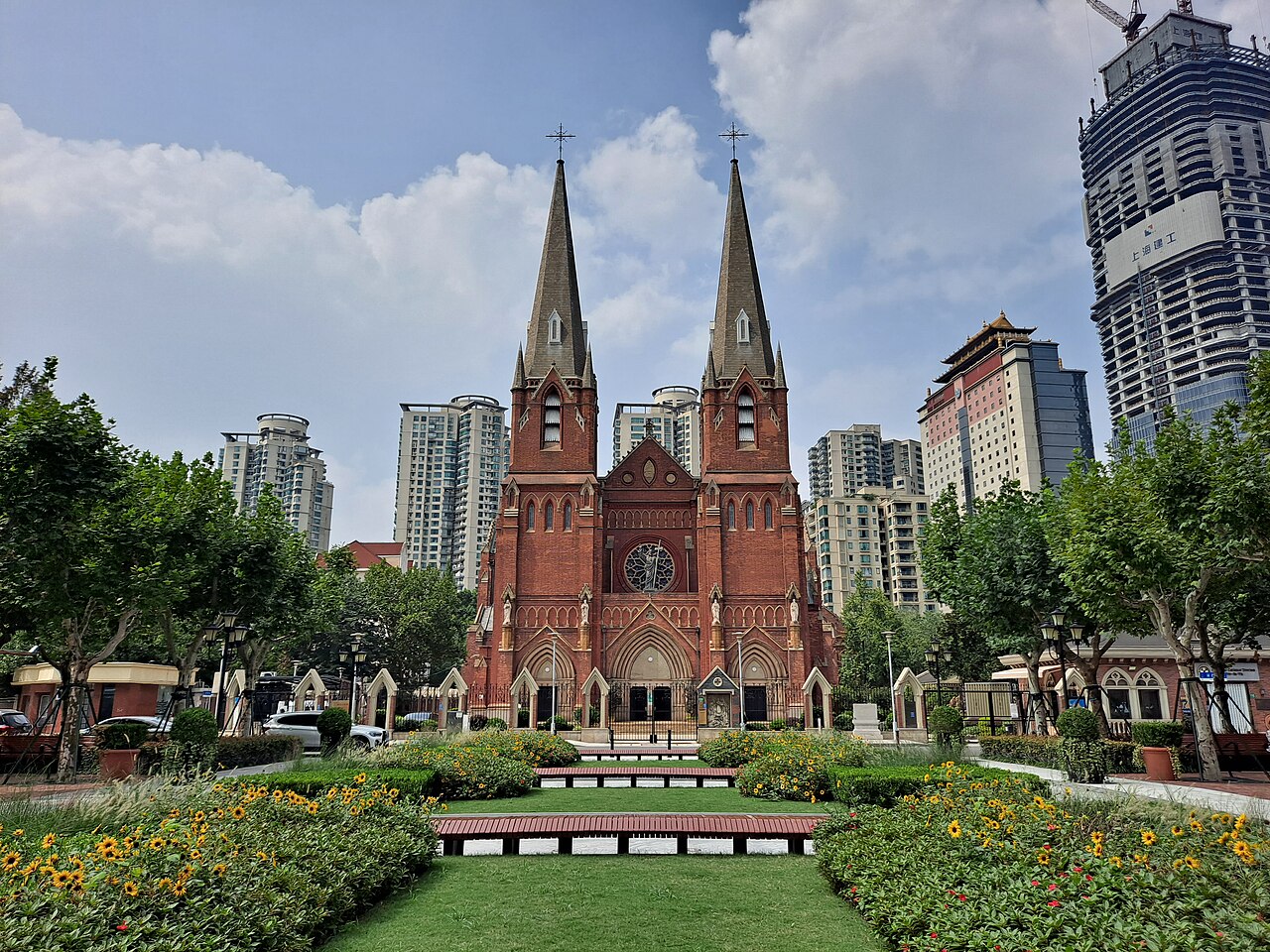
This place is a Place of worship. It was established in 1910. It was built in the Gothic Revival style. It was designed by William Dowdall. It is built of brick. It carries the Shanghai Cultural Relics Protection Unit heritage designation.
Saint Ignatius Cathedral, known locally as Xujiahui Catholic Church, stands as a prominent Catholic cathedral in Shanghai's Xujiahui district. The cathedral represents one of Shanghai's most recognizable religious landmarks and holds significance in the city's architectural and cultural heritage. Its Gothic Revival style distinguishes it within Shanghai's urban landscape. The structure serves as the cathedral church of the Roman Catholic Diocese of Shanghai and remains an active place of worship alongside its role as a visitor destination of note in the city's top tier of attractions.
Checked 2026-08-31 · Source
The interior of Saint Ignatius Cathedral features characteristic elements of Gothic Revival church architecture, including pointed arches, ribbed vaulting, and stained glass windows that filter colored light into the nave. The main altar and side chapels contain religious statuary and decorative elements typical of Catholic cathedral design. The spatial arrangement follows a traditional cruciform plan with a central nave flanked by aisles. Visitors should observe that active worship spaces maintain their sacred character, and interior access may be subject to religious service schedules and respectful conduct requirements.
Checked 2026-08-31 · Source
A visit to Saint Ignatius Cathedral typically requires between thirty minutes and one hour for exterior appreciation and brief interior observation. Those with particular interest in religious architecture, stained glass examination, or prayerful contemplation may extend their stay accordingly. The duration depends substantially on whether the interior is accessible at the time of visit and whether any religious services are in progress. Visitors should build flexibility into their scheduling, as unanticipated closures for private ceremonies or maintenance activities can affect the completeness of any planned visit.
Checked 2026-08-31 · Source
Tuesday–Saturday 09:00–16:00; last entry 15:30. On the first Friday of each month, public visiting begins at 13:00. Closed to public visits on Monday and Sunday, and during the morning of each month's first Friday. The cathedral remains an active place of worship; its responsible religious body reported a Mass held there on 2026-08-20. Seasonal variations in daylight affect the quality of stained glass viewing, with morning and late afternoon light producing notably different atmospheric effects. Religious holidays and Sunday masses may restrict visitor access or alter available visiting times. The surrounding Xujiahui district offers complementary attractions that can fill waiting periods if immediate cathedral access proves temporarily unavailable.
Checked 2026-08-31 · Source
General admission is free. Many historic religious buildings in Shanghai operate without admission charges, though voluntary donations may be solicited for maintenance purposes. Visitors should carry small denomination currency for contribution boxes if they wish to support preservation efforts. Any special exhibition or tower access would constitute a separate consideration. Group visits or photography permits may involve distinct arrangements requiring advance coordination with cathedral administrative staff rather than standard walk-in procedures.
Checked 2026-08-31 · Source
Take Shanghai Metro Line 1 to Xujiahui Station and use Exit 8. Public-body directions place the adjacent Xujiahui Academy about a five-minute walk along North Caoxi Road; the cathedral entrance is at 158 Puxi Road. This is the named approach for an independent visit. The cathedral occupies a position in Xujiahui, a major commercial and transportation hub in southwestern central Shanghai. Multiple metro lines converge at Xujiahui station, providing extensive network connectivity. Surface bus routes serve the surrounding street network with numerous options. The immediate area features dense pedestrian infrastructure including underground shopping passages and elevated walkways. Taxi and ride-hail services recognize Xujiahui as a standard destination. Visitors should consult current transit applications for real-time routing, as Shanghai's metro system undergoes continuous expansion and service adjustments.
Checked 2026-08-31 · Source
Accessibility support is documented at Xujiahui Origin scenic-area level rather than as a continuous step-free route through the cathedral. The scenic area provides wheelchairs and volunteer assistance at its visitor-service facilities. The access description applies to the documented visitor route. Visitors must respect active worship and refrain from disruptive behavior during religious services. Photography restrictions may apply in certain interior zones or during ceremonies; observe posted signage and staff direction. The surrounding Xujiahui district experiences heavy pedestrian and vehicular congestion, particularly during commercial peak hours and weekend shopping periods. Weather protection is advisable for queueing periods if exterior security screening is implemented. Appropriate attire covering shoulders and knees demonstrates cultural sensitivity in religious settings. Mobile telephones should be silenced upon interior entry.
Checked 2026-08-31 · Source
The Gothic Revival exterior of Saint Ignatius Cathedral presents substantial photographic interest, with twin spires and stone facade offering compositional possibilities from multiple surrounding vantage points. Interior photography requires careful attention to existing light levels and respect for worshippers' privacy and devotional focus. The stained glass windows present exposure challenges due to extreme dynamic range between illuminated glass and shadowed stonework. Early morning or late afternoon exterior lighting reduces harsh contrast and enhances three-dimensional architectural detail.
Checked 2026-08-31 · Source
It is the cathedral of the Catholic Diocese of Shanghai and is dedicated to Saint Ignatius of Loyola.
British architect William Dowdall designed it in 1904.
Construction began in 1906, and the building was completed on 22 October 1910.
It is a twin-towered Gothic church with a cruciform plan and a stone-column, brick-and-timber main structure.
The interior has 64 compound columns carved from Jinshan stone; the bell towers rise 57 metres, including 31-metre spires.
The main hall accommodates about 3,000 people. Shanghai designated the cathedral a municipal protected cultural site in 1989, and the State Council listed it as a Major Historical and Cultural Site Protected at the National Level in 2013.
Loading the interactive map…
The interactive map could not be loaded.
Last updated:
Source: OpenStreetMap contributors, Wikidata ·