

4 min walk
Deutsches Museum Verkehrszentrum
- High
- Museum
Language · 11 published
Historic monument · Munich
Reviewed by Elena Voss · Roavina Travel Editor
| Monday | 09:00 – 18:00 |
|---|---|
| Tuesday | 09:00 – 18:00 |
| Wednesday | 09:00 – 18:00 |
| Thursday | 09:00 – 18:00 |
| Friday | 09:00 – 18:00 |
| Saturday | 09:00 – 18:00 |
| Sunday | 09:00 – 18:00 |
Checked 2026-08-31 · Source
Read from the OpenStreetMap access tags; anything not listed has no tag recorded.
Set the group type to family in the planner and the day window contracts to about three quarters of a solo day.
This place is a Attraction. It opened in 1853. It was built in the Neoclassicism style. It was designed by Leo von Klenze. It carries the architectural heritage monument in Bavaria heritage designation.
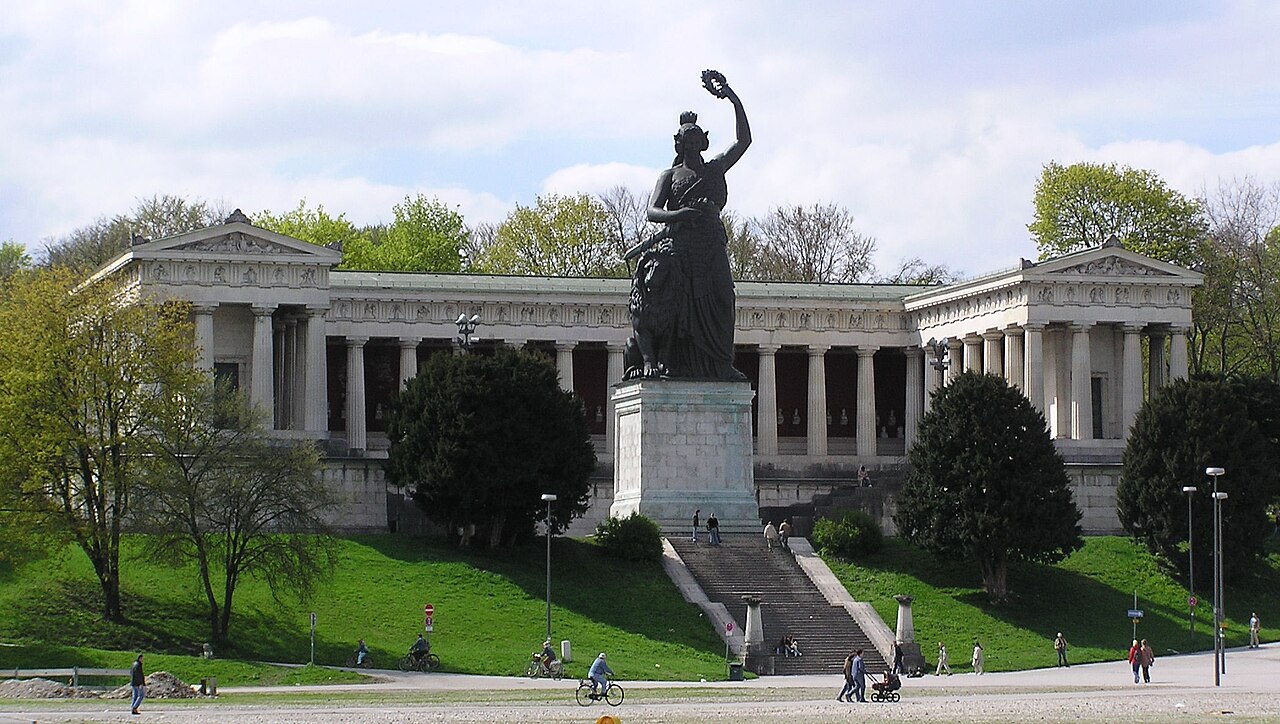
Ruhmeshalle is a sweeping nineteenth-century Doric colonnade on Munich’s Theresienwiese, the open grounds associated with Oktoberfest. Leo von Klenze designed the monument as a hall of fame for distinguished Bavarians. Its curved structure faces the city and forms an architectural ensemble with the Bavaria statue standing in front. The scale, repeated columns, and open position make Ruhmeshalle one of Munich’s clearest examples of Bavarian neoclassical monumental design. The site works especially well for travellers who want architecture, civic history, and broad urban views in one stop. The Ruhmeshalle is a monumental Doric colonnade on the edge of Munich's Theresienwiese, the vast open space best known as the Oktoberfest grounds. Designed by Leo von Klenze and completed in the mid-19th century, it forms a sweeping curved structure with a central pavilion. The building was conceived as a hall of fame to honour distinguished Bavarians. No. The Ruhmeshalle is the curved colonnade hall, while the Bavaria statue is the large bronze female figure standing in front of it. They are companion monuments designed as an ensemble but are distinct structures.
Checked 2026-08-26 · Source
The colonnade contains busts commemorating notable figures from Bavarian history. Scientists, artists, statesmen, and other personalities are represented across the memorial interior. Ruhmeshalle is not a conventional enclosed museum: much of the structure is open to the weather, and the colonnade also functions as a covered architectural passage. The central pavilion provides a more enclosed focus for the busts and their commemorative setting. Walk along the curve to see how the repeated columns frame the memorials and the view across Theresienwiese toward Bavaria.
Checked 2026-08-26 · Source
Allow twenty to forty minutes for Ruhmeshalle. That is enough time to walk the length of the colonnade, examine the busts, appreciate the Doric rhythm, and look across Theresienwiese toward the Bavaria statue. Combining both monuments creates a fuller stop of roughly one hour. Travellers with a strong interest in Bavarian history or neoclassical architecture may spend longer comparing the central pavilion, the curved wings, and the relationship between Ruhmeshalle and the open festival grounds.
Checked 2026-08-26 · Source
Ruhmeshalle is an open monument, so daylight offers the clearest view of the columns, busts, and Bavaria statue. Early morning and late afternoon can bring softer light and a calmer atmosphere. The exposed design provides little protection from wind, rain, or strong sun, conditions that are especially noticeable in winter. During Oktoberfest, Theresienwiese becomes extremely busy and event infrastructure can alter the surrounding space. Travellers seeking a quieter architectural visit will find the colonnade easier to appreciate outside major events.
Checked 2026-08-26 · Source
The Ruhmeshalle colonnade is a public monument without a standard admission checkpoint for viewing the architecture and busts. Travellers can treat the visit as a free outdoor stop while exploring Theresienwiese. No advance booking is needed for a casual walk around the monument. The open setting also makes it easy to combine Ruhmeshalle with the adjacent Bavaria statue in the same visit. Large events can change the character of the grounds, but the monument itself is experienced as part of Munich’s public space.
Checked 2026-08-26 · Source

Ruhmeshalle stands on Theresienwiese. U-Bahn lines U4 and U5 serve Theresienwiese station, placing the Oktoberfest grounds within easy reach of central Munich. Tram connections serve the broader area, and the site can also be reached on foot or by bicycle through Ludwigsvorstadt. The large Bavaria statue makes the monument easier to identify once on the grounds. During events, pedestrian routes and open spaces may feel very different from an ordinary day, so allow additional time to cross the area.
Checked 2026-08-26 · Source
Ruhmeshalle is exposed to weather and offers limited shelter. Wet stone can become slippery, while wind and strong sun can make a longer visit uncomfortable. Oktoberfest brings very heavy pedestrian traffic and event structures around Theresienwiese, which can restrict views or change access across the grounds. Some memorial details may be temporarily obscured during maintenance or events. Keep valuables secure in the open public setting, and give other visitors room in the narrow covered sections of the colonnade.
Checked 2026-08-26 · Source
Ruhmeshalle offers strong architectural compositions through its repeating Doric columns and curved plan. Use the arc of the colonnade as a leading line, then include the Bavaria statue for a wider ensemble view. Early morning and golden-hour light can emphasise the texture of the stone. The open structure gives photographers room to work, although the covered passage can narrow when busy. Close views of the busts benefit from careful framing and steady light. Keep tripods and bags clear of the walking route and respect people moving through the monument.
Checked 2026-08-26 · Source
No. Ruhmeshalle is the curved colonnade, while Bavaria is the large statue standing in front. They were designed as a companion ensemble but are separate monuments.
The monument stands on Theresienwiese, but Oktoberfest makes the surrounding grounds extremely crowded and can change pedestrian routes and views.
The colonnade contains busts commemorating notable figures from Bavarian history, including people associated with science, art, public life, and other fields.
No. Ruhmeshalle is an open colonnade with a more enclosed central section. Much of the visitor experience takes place in a covered but weather-exposed architectural space.
Allow twenty to forty minutes for the colonnade. Visiting Ruhmeshalle together with the Bavaria statue creates a combined stop of about one hour.
Ruhmeshalle is on Theresienwiese in Munich, near the grounds used for Oktoberfest and within reach of Theresienwiese underground station on the U4 and U5 lines.
Loading the interactive map…
The interactive map could not be loaded.

Last updated:
Source: OpenStreetMap contributors, Wikidata ·