
2 min walk
O'Connell Monument
- High
- Historic monument
Language · 11 published
Historic monument · Dublin
Sir John Gray Knt MD JP
Reviewed by Elena Voss · Roavina Travel Editor
This place is a Monument.
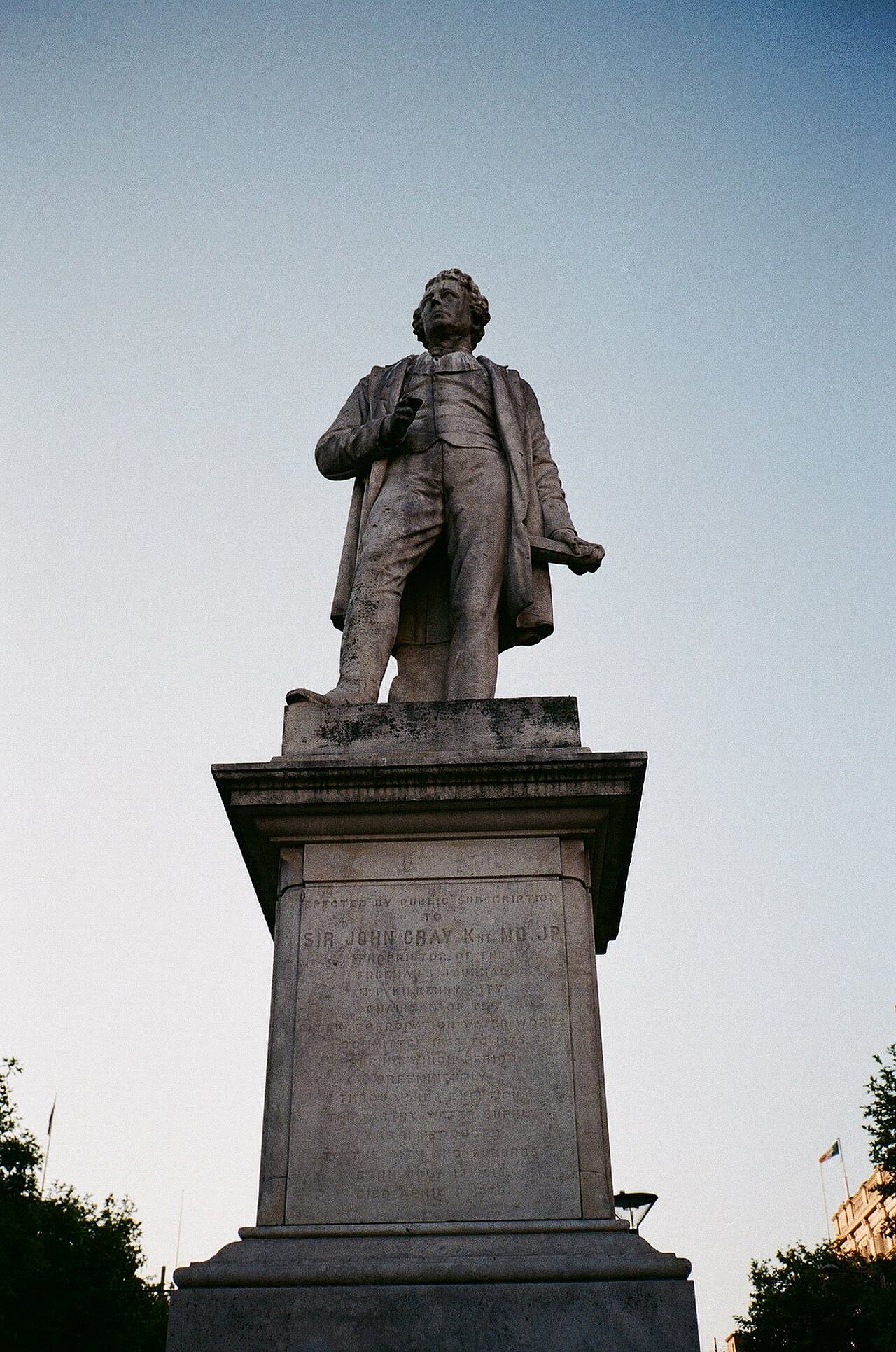
The Sir John Gray monument is Thomas Farrell’s 1879 memorial to the newspaper proprietor, parliamentarian and Dublin waterworks chairman. It stands on O’Connell Street Lower, the present name of the part of Sackville Street where Dublin Corporation granted a site in 1877. Dublin City Council records an overall height of 26 feet, including an 11-foot figure. The figure and its pedestal are Sicilian white marble, while the plinth is granite. Public subscriptions paid for the commission.
The council’s history places the statue within the nationalist sequence of monuments that reshaped the street in the nineteenth century. Gray had owned the Freeman’s Journal, represented Kilkenny City as an MP and chaired the Dublin Corporation Water Works Committee. The same account credits him with a key role in introducing the Vartry water supply from County Wicklow to Dublin in 1868. A committee was established soon after his death in 1875, the monument’s base was laid on 1 May 1879, and Archbishop John MacHale unveiled the completed statue on 24 June 1879. The monument therefore joins a precisely documented civic work, a named sculptor and a specific piece of Dublin’s municipal history rather than serving as an unidentified decorative statue.
Checked 2026-09-06 · Source
The monument is an open-air sculptural composition, not a building with rooms or an interior route. Its principal element is Farrell’s standing figure of Gray. Dublin City Council describes the pose as that of a Victorian gentleman: the coat is open, the stance confident and the expression serious but kindly. Below the figure, the inscription identifies Gray as a knight, doctor and justice of the peace, proprietor of the Freeman’s Journal, MP for Kilkenny City and chairman of the Dublin Corporation Water Works Committee from 1863 to 1875. It also connects his committee work with the introduction of the Vartry supply to Dublin and its suburbs.
The completed statue is simpler than the first design. The council’s history says the proposed pedestal was to include a representation of Ireland with a harp and broken fetters symbolising legislative and social wrongs from which the country had been rescued. A separate figure of patriotism was also planned. Those allegorical elements were not executed because the committee considered it necessary to erect the monument without delay; the finished composition presents Gray alone. Visitors should therefore examine the figure, materials and inscription that exist rather than look for the Ireland, harp, fetters or patriotism figures described only in the abandoned proposal.
Checked 2026-09-06 · Source
Dublin City Council publishes no recommended visit duration for the Sir John Gray monument, so a fixed five-to-fifteen-minute estimate would be unsupported. Plan the stop by deciding how much of the documented object and history you want to examine.
A direct inspection can distinguish the 11-foot marble figure from the pedestal and granite plinth, read the inscription, and compare Farrell’s open-coat pose with the council’s description. A more detailed examination can follow the inscription’s sequence from the Freeman’s Journal and Kilkenny parliamentary seat to the Water Works Committee and the Vartry supply. The abandoned design adds another layer: Ireland, a harp, broken fetters and a figure of patriotism were planned but are not present. The dated construction sequence may also matter: the base was laid on 1 May 1879 and the statue was unveiled on 24 June. The official dimensions establish the monument’s scale, but they do not dictate how long an individual needs to study it. Set your own duration around those concrete details and any wider interest in O’Connell Street’s memorial history.
Checked 2026-09-06 · Source
Dublin City Council’s monument history and protected-structure listing publish no visitor timetable, daily opening period, seasonal schedule, closure calendar or last-entry time for the Sir John Gray monument. Its classification as a monument on O’Connell Street Lower describes what and where it is; it does not amount to an official promise of continuous access or establish twenty-four-hour availability.
The council’s historical account records dates connected with the monument’s creation: Dublin Corporation granted the Sackville Street site in 1877, the base was laid on 1 May 1879, and Archbishop John MacHale unveiled the statue on 24 June 1879. Those are historical dates, not recurring visitor hours. The current Record of Protected Structures confirms the monument’s O’Connell Street Lower address but supplies no operating schedule. Choose a visit time according to conditions that can be verified when travelling, without treating the absence of published hours as proof that access is guaranteed at every hour. If the street or monument is temporarily affected, only a current council notice or information at the site can establish the immediate arrangement.
Checked 2026-09-06 · Source
Dublin City Council’s monument history and protected-structure listing specify no current admission charge, ticket requirement, reservation process or visitor entrance arrangement for the Sir John Gray monument. It would be equally unsupported to say that a ticket is required or that viewing is free. A street location by itself is not evidence for a formal admission policy, and the absence of a published price must not be converted into a zero price.
The council records that public subscriptions paid for the monument’s commission. That statement describes how the memorial was funded before its unveiling in 1879; it is not a statement about present-day admission. Likewise, inclusion in the Record of Protected Structures confirms the monument’s recognised address and protected status, not a visitor fee. The council pages name no box office, booking link, concession category, group rate or admission benefit. If a current access arrangement matters to a visit, rely on a current notice from Dublin City Council or information at the site. Until the responsible authority publishes a visitor policy, admission remains not recorded.
Checked 2026-09-06 · Source
Use O’Connell Street Lower, Dublin 1 as the exact destination for the Sir John Gray monument. Dublin City Council’s current Record of Protected Structures lists the monument at that address under reference 6104. The historical name in accounts of its erection is Sackville Street; the council explicitly identifies that street as today’s O’Connell Street. These are two names for the same siting context, not separate destinations.
Dublin Corporation granted the site in 1877 close to the Abbey Street offices of the Freeman’s Journal, the newspaper Gray owned. That Abbey Street reference explains why the committee selected this part of Sackville Street; it does not identify a visitor entrance or a second monument location. The statue was unveiled on the granted site in June 1879. Dublin City Council’s monument pages provide no monument-specific bus, tram, rail, cycle or walking directions, so the address is the reliable orientation point. Navigate to the complete council-recorded address rather than relying on the POI’s display name alone, and distinguish the Sir John Gray monument from the other named memorials recorded on O’Connell Street.
Checked 2026-09-06 · Source
Treat the Sir John Gray monument as a protected historic work made from two specifically recorded stone types. Dublin City Council identifies Sicilian white marble in the figure and pedestal and granite in the plinth. The current Record of Protected Structures separately lists the monument on O’Connell Street Lower. Do not climb on the work, attach objects or equipment to it, lean items against the carved surfaces, or otherwise physically interfere with the figure, pedestal, plinth or inscription.
After a public-sculpture survey and the redesigned O’Connell Street public realm, Dublin City Council commissioned condition reports for the street’s monuments and included Thomas Farrell’s Sir John Gray in its conservation programme. The programme identified atmospheric pollution, gypsum crusts, organic growth, grease and graffiti as prevailing conservation issues across the surveyed sculptures; it also found that inappropriate earlier cleaning methods had contributed to poor conditions in stone and brass elements. Cleaning trials were carried out on four stone types to prepare the conservation reports. These are programme-wide findings, not proof that every listed issue is present on every part of Gray’s monument today, and they do not provide a current damage diagnosis. Dublin City Council’s pages also establish no barrier arrangement, supervision level, crime condition or step-free route for this exact monument, so those details remain unrecorded.
Checked 2026-09-06 · Source
The most reliable photographic subjects are the details Dublin City Council documents: Farrell’s 11-foot figure, the open coat, confident stance and serious but kindly expression, the inscription of Gray’s titles and public work, the white marble figure and pedestal, and the contrasting granite plinth. A full-length composition can show how those elements form the recorded 26-foot total height. A closer frame can preserve the inscription’s connection between the Freeman’s Journal, Kilkenny City, the Water Works Committee and the Vartry supply.
The council’s history also clarifies what a photograph cannot show. The proposed figures of Ireland and patriotism, the harp and the broken fetters were omitted from the completed design, leaving Gray alone. Do not label an ordinary detail as one of those unrealised allegories. Dublin City Council publishes no monument-specific photography policy, flash rule, tripod rule, commercial-permit requirement, lighting advice or recommended time for pictures on these pages. That silence establishes neither permission nor prohibition. Follow any current instructions at the site, keep photographic equipment physically separate from the protected monument, and describe photographed materials, scale and sculptural details only as far as the council record supports them.
Checked 2026-09-06 · Source
It is an open-air monument on O’Connell Street Lower, not an indoor attraction. Dublin City Council describes a standing marble figure and pedestal on a granite plinth and records the work at an O’Connell Street address. The council does not describe rooms, galleries or an interior visitor route.
Dublin City Council publishes no visitor timetable for the monument. Its street location is not a twenty-four-hour access guarantee. Historical dates for the site grant, pedestal and unveiling are not opening hours, so check current conditions rather than assuming access at every hour.
Dublin City Council publishes no present admission arrangement or price for the monument. Public subscriptions paid for the nineteenth-century commission, but that historical funding record is not a visitor-fee policy. Do not interpret the absence of a listed charge as proof of free admission; the current amount is not recorded.
Dublin City Council gives no recommended duration, so there is no sourced five-to-fifteen-minute estimate. Set your own time according to whether you want only to identify the monument or also inspect the 11-foot figure, inscription, marble pedestal, granite plinth and the history of its unrealised allegorical design.
The inscription and Dublin City Council’s history identify Gray as proprietor of the Freeman’s Journal, MP for Kilkenny City and chairman of the Dublin Corporation Water Works Committee from 1863 to 1875. The council credits him with a key role in introducing the Vartry water supply from County Wicklow to Dublin in 1868. Thomas Farrell’s publicly subscribed monument commemorates those journalistic, parliamentary and municipal roles.
Dublin City Council’s current Record of Protected Structures lists it at O’Connell Street Lower, Dublin 1, under reference 6104. Historical accounts call the road Sackville Street and explain that the 1877 site was close to the Abbey Street offices of Gray’s Freeman’s Journal; that is historical context, not a second address.
Loading the interactive map…
The interactive map could not be loaded.
Last updated:
Source: OpenStreetMap contributors, Wikidata ·