
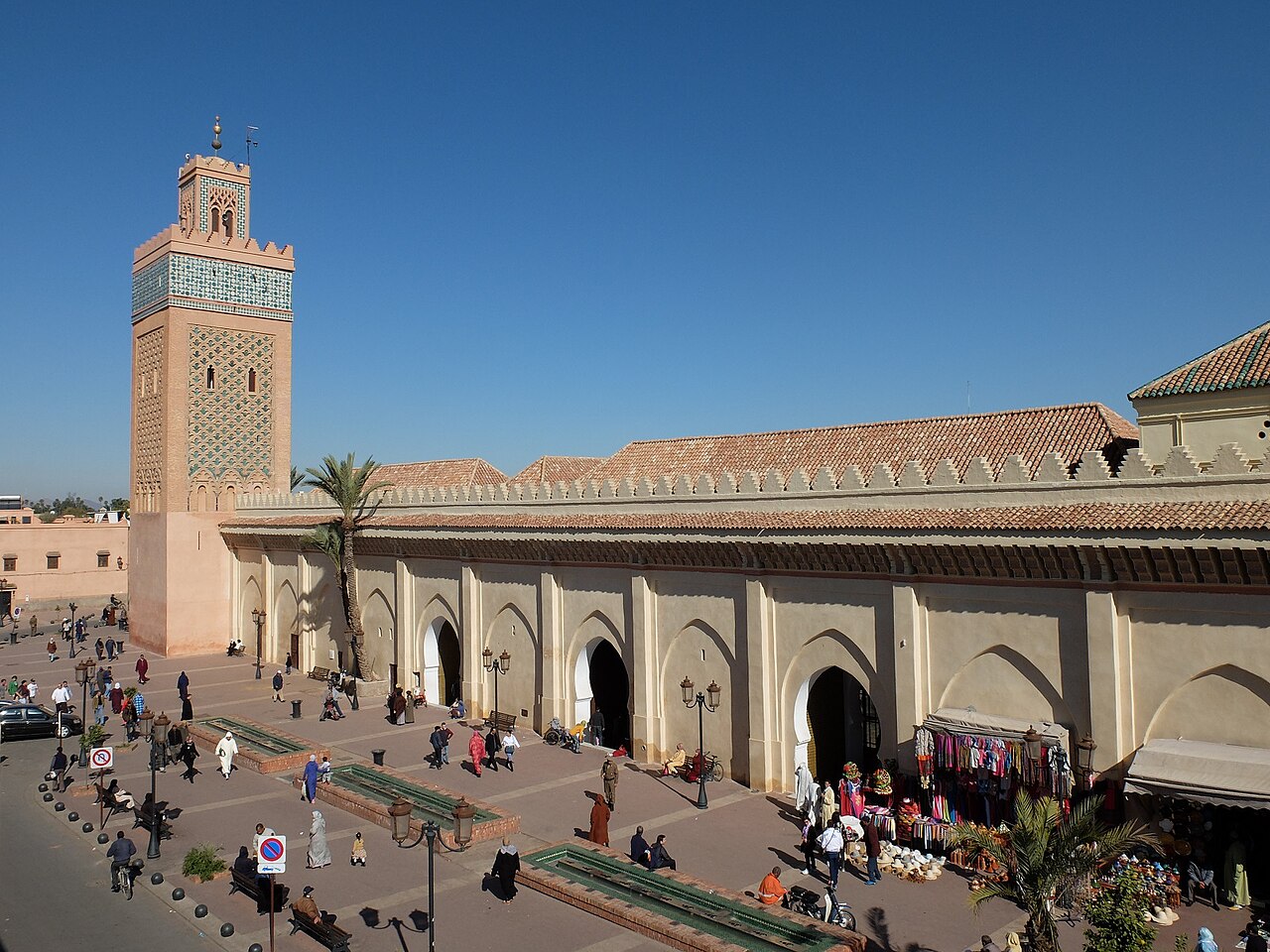
3 min walk
Al-Mansour Mosque
- Must see · Heritage site
- Place of worship
Language · 11 published
Historic monument · Marrakesh
Reviewed by Elena Voss · Roavina Travel Editor

| Monday | 00:00 – 23:59 |
|---|---|
| Tuesday | 00:00 – 23:59 |
| Wednesday | 00:00 – 23:59 |
| Thursday | 00:00 – 23:59 |
| Friday | 00:00 – 23:59 |
| Saturday | 00:00 – 23:59 |
| Sunday | 00:00 – 23:59 |
Checked 2026-08-31 · Source
Read from the OpenStreetMap access tags; anything not listed has no tag recorded.
Set the group type to family in the planner and the day window contracts to about three quarters of a solo day.
This place is a Attraction.
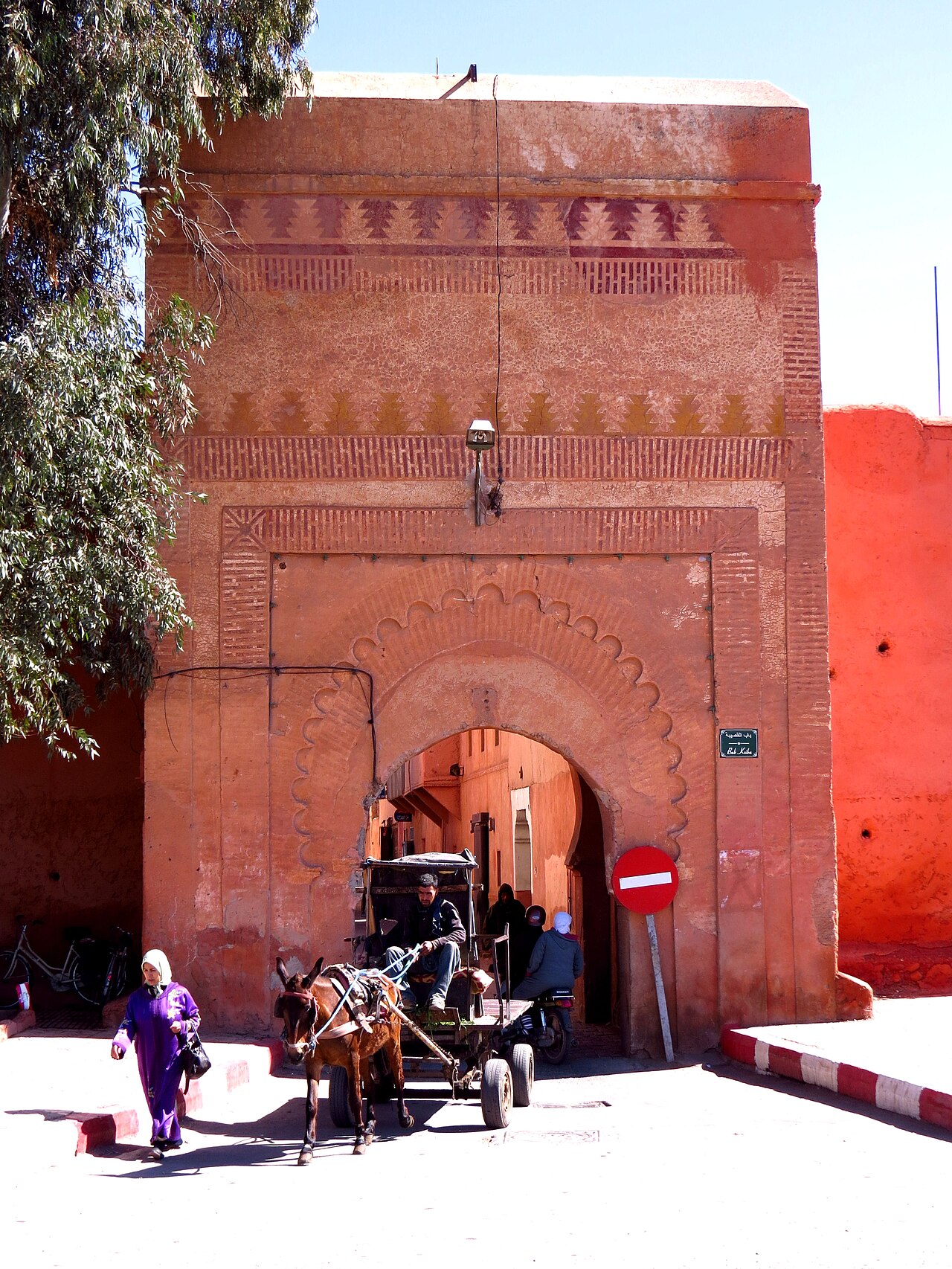
Bab Agnaou is a historic fortified gate in Marrakesh, Morocco, forming part of the medina's defensive walls. Constructed in the 12th century during the Almohad period, it served as a principal entrance to the royal kasbah district. The gate is renowned for its elaborate stone decoration, featuring carved floral motifs, geometric patterns, and Kufic inscriptions. Its name, of Berber origin, reflects its significance as a ceremonial and defensive structure. Daily, 24 hours. Bab Agnaou is an active public passage rather than an enclosed attraction. The Marrakech-Safi Regional Tourism Council states that Marrakesh's historic gates, formerly closed at night, now remain open; no weekly closure day applies.
Checked 2026-08-31 · Source
Bab Agnaou itself is a passage gateway rather than an enclosed building with interior rooms. Visitors pass through its arched portal to access the kasbah quarter. The structure comprises a main horseshoe arch with a smaller pedestrian opening. Decorative stonework adorns the exterior facade, particularly the upper portions. The surrounding kasbah area contains the Saadian Tombs, the El Badi Palace ruins, and residential streets. Bab Agnaou is an active public passage rather than an enclosed attraction. The Marrakech-Safi Regional Tourism Council states that Marrakesh's historic gates, formerly closed at night, now remain open; no weekly closure day applies.
Checked 2026-08-31 · Source
A visit to Bab Agnaou typically requires fifteen to thirty minutes for observation and photography. The gate serves as a thoroughfare, so many visitors pass through incidentally while exploring the kasbah. Those with particular interest in Islamic architecture and decorative stonework may linger longer to examine the carved details. The duration extends naturally when combined with adjacent attractions in the kasbah quarter. Free access. There is no controlled or ticketed entrance to view or pass through the public gate; separately managed nearby monuments require their own tickets.
Checked 2026-08-31 · Source
The gate functions as a public thoroughfare, generally accessible during daylight and evening hours when the surrounding streets remain open. Morning visits may offer reduced pedestrian congestion for unobstructed photography and examination of stonework details. Midday periods coincide with peak foot traffic as visitors and residents move between the kasbah and central medina. Daily, 24 hours. The visit is entirely outdoors at street level; there are no interior exhibition rooms. The City of Marrakech's restoration record shows a paved forecourt and passage through the gate. The historic paving is not uniformly smooth, and pedestrians share the active passage with local traffic.
Checked 2026-08-31 · Source
The gate operates as a public passage without evident ticketed entry mechanism. No admission infrastructure is visible at the structure itself. Visitors should verify whether any municipal or heritage fees apply to the broader kasbah district through official Moroccan tourism channels or local tourist information services. Adjacent attractions including the Saadian Tombs maintain separate ticketing arrangements. Free access. There is no controlled or ticketed entrance to view or pass through the public gate; separately managed nearby monuments require their own tickets. The visit is entirely outdoors at street level; there are no interior exhibition rooms.
Checked 2026-08-31 · Source
Bab Agnaou stands at the southern edge of Jemaa el-Fnaa, Marrakesh's central square, within the walled medina. Pedestrian access from the square involves walking south along Rue Moulay Ismail or adjacent lanes. The gate marks the entrance to the kasbah quarter. Bab Agnaou is the named Kasbah gateway on the City of Marrakech's 14.6 km Medina Walls and Gates circuit, designated for travel on foot or by horse-drawn carriage. The regional tourism authority also lists arrival in the Kasbah segment by bus, car, carriage, or taxi; use Bab Agnaou/Kasbah as the named drop-off or arrival point.
Checked 2026-08-31 · Source
The passage through Bab Agnaou involves uneven stone surfaces and moderate steps, presenting challenges for mobility-impaired visitors. Motorcycles and bicycles frequently traverse the archway alongside pedestrians, requiring situational awareness. The narrow portal creates congestion during peak hours; personal belongings warrant secure handling in crowded conditions. Street vendors and informal guides may approach in the vicinity. The visit is entirely outdoors at street level; there are no interior exhibition rooms. The historic paving is not uniformly smooth, and pedestrians share the active passage with local traffic. Yes. It is a functioning public passage open day and night, with no weekly closure day.
Checked 2026-08-31 · Source
The decorated facade of Bab Agnaou presents favourable photography subjects, particularly the upper stonework with carved inscriptions and ornamental panels. Morning light illuminates the main facade directly, enhancing relief detail visibility. The arch interior offers framed compositions of passing figures and distant kasbah street views. Tripod deployment may obstruct the active thoroughfare and should be exercised with consideration for pedestrian flow. Night photography captures artificial lighting on stone surfaces, though equipment stability remains challenging without support. Yes. It is a functioning public passage open day and night, with no weekly closure day.
Checked 2026-08-31 · Source
Yes. It is a functioning public passage open day and night, with no weekly closure day.
No. Viewing and passing through the gate are free; nearby ticketed monuments are separate attractions.
It served as the principal entrance to Marrakesh's Kasbah, the historic seat of power established by the Almohads in the 12th century.
The official regional guide renders the name as the gate of the “ram without horns” and relates it to the loss of the gate's two towers.
Bab Agnaou was built from grey-blue Guéliz stone, which the official regional guide says became reddish under windblown desert sand.
The exterior gate and its paved, street-level approach can be visited without entering a building, but uneven historic paving and the traffic-shared passage make access limited rather than fully step-free.
Loading the interactive map…
The interactive map could not be loaded.

Last updated:
Source: OpenStreetMap contributors ·