

3 min walk
Slat Al Azama Synagogue
- Must see · Heritage site
- Museum
Language · 11 published
Historic monument · Marrakesh
Palais Bahia قصر الباهية
Reviewed by Elena Voss · Roavina Travel Editor
| Monday | 09:00 – 17:00 |
|---|---|
| Tuesday | 09:00 – 17:00 |
| Wednesday | 09:00 – 17:00 |
| Thursday | 09:00 – 17:00 |
| Friday | 09:00 – 17:00 |
| Saturday | 09:00 – 17:00 |
| Sunday | 09:00 – 17:00 |
Checked 2026-08-31 · Source
Read from the OpenStreetMap access tags; anything not listed has no tag recorded.
Set the group type to family in the planner and the day window contracts to about three quarters of a solo day.
This place is a Attraction.
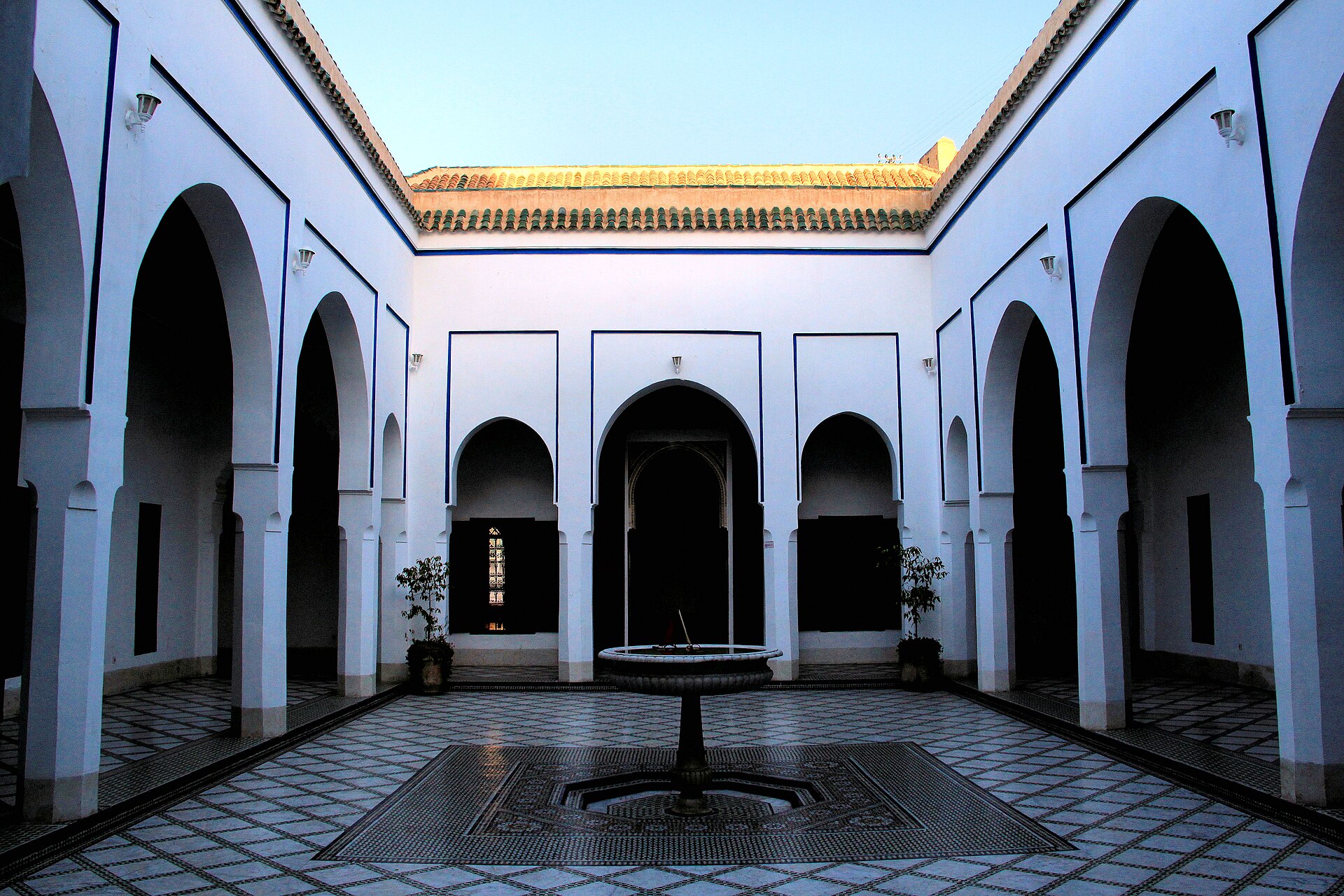
The Bahia Palace is a late nineteenth-century palace and museum in Marrakesh, built in two principal phases across an eight-hectare site. Morocco’s Ministry of Youth, Culture and Communication identifies the first residence with Si Moussa and dates its completion to 1866–1867. From 1894, Si Moussa’s son Ba Ahmed expanded the property by acquiring and joining neighbouring houses, creating the palace now known as Bahia. Daily 09:00–17:00. No regular weekly closure is published; Friday is explicitly an admission day. The ministry reported restoration work still in progress on 8 April 2026, while its current ticket portal continues to sell admission.
Checked 2026-08-31 · Source
The visitor route passes a sequence of courtyards, gardens, salons, service buildings and annexes rather than one ceremonial hall. The Ministry of Culture describes four principal courtyards, each with a distinct design, together with a Moorish bath, treasure rooms and an Agdal garden. Decoration includes marble, moucharabieh screens, zellij, stained glass, carved and painted wood, and stucco work. Fountains and planted courts separate the interior groups. No regular weekly closure is published; Friday is explicitly an admission day. The ministry reported restoration work still in progress on 8 April 2026, while its current ticket portal continues to sell admission.
Checked 2026-08-31 · Source
The public route crosses several courtyards, gardens and decorated rooms, so the time required depends on which spaces are open, visitor density and how closely the craftsmanship is examined. Keep a flexible block rather than treating an unsourced one-hour or two-hour estimate as a guaranteed circuit. Temporary closures or an event can shorten the accessible route without changing the palace’s overall scale. Confirm any timed commitment after the visit only when the day’s entrance and exit arrangements are clear.
Checked 2026-08-31 · Source
The Ministry of Culture publishes visiting hours of 09:00 to 17:00 for the Bahia Palace. The official ticket page does not record a last-admission time, weekly closing day, seasonal alternative, Ramadan schedule or complete holiday closure calendar. Do not substitute hours from a similarly named commercial website or from another Marrakesh monument. Daily 09:00–17:00. The official Marrakech tourism route approaches from Jemaa el-Fna via Rue des Banques, Rue Arset Lam'ache and Place des Ferblantiers; from El Badi Palace, turn left and then right onto Rue Bahia, where Bahia Palace stands. The route is designated for travel on foot, by carriage or by bicycle.
Checked 2026-08-31 · Source
The Ministry of Culture sells Bahia Palace admission by visitor category. At verification, the official page listed 30 MAD for a Moroccan or resident adult, 10 MAD for a Moroccan or resident child aged seven to thirteen, 100 MAD for a foreign adult and 50 MAD for a foreign child aged seven to thirteen. Foreign adult: MAD 100. Moroccan adult or resident: MAD 30. Moroccan citizens enter free every Friday and on the first day of national and religious holidays. People with reduced mobility enter free. An accessibility guide rates the palace as partially accessible and identifies a few steps.
Checked 2026-08-31 · Source
The official Marrakesh tourism service places the Bahia Palace on Avenue Imam El Ghazali, Marrakech 40000, and publishes the palace telephone number. Use the named address rather than a broad medina pin and confirm the final route with current mapping or the palace before setting out. The official Marrakech tourism route approaches from Jemaa el-Fna via Rue des Banques, Rue Arset Lam'ache and Place des Ferblantiers; from El Badi Palace, turn left and then right onto Rue Bahia, where Bahia Palace stands. The route is designated for travel on foot, by carriage or by bicycle.
Checked 2026-08-31 · Source
The Bahia Palace is both a protected historic interior and a Ministry of Culture visitor site. Keep off decorated surfaces, do not touch zellij, carved wood, stucco or painted ceilings, and follow any room closures or circulation barriers in place. Visitors with reduced mobility qualify for free admission, but free entry does not itself prove step-free access to every room. An accessibility guide rates the palace as partially accessible and identifies a few steps. The ministry grants free admission to visitors with reduced mobility. The visiting hours are 09:00–17:00 daily.
Checked 2026-08-31 · Source
The strongest photographs use the relationship between fountains, planted courtyards, zellij, carved wood and painted ceilings. Light changes sharply between open courts and interior rooms, so handheld exposure may need adjustment without blocking the route. The Ministry of Culture page does not record rules for personal photography, flash, tripods, selfie sticks, drones, portrait sessions or commercial production. Follow posted notices and staff directions, keep equipment away from historic surfaces and obtain written operator approval before any work beyond ordinary handheld visitor photography. The visiting hours are 09:00–17:00 daily. Admission costs MAD 100 for a foreign adult and MAD 30 for a Moroccan adult or resident.
Checked 2026-08-31 · Source
The visiting hours are 09:00–17:00 daily.
Admission costs MAD 100 for a foreign adult and MAD 30 for a Moroccan adult or resident.
People with reduced mobility enter free; Moroccan citizens also enter free every Friday and on the first day of national and religious holidays.
Yes. The ministry's ticket portal remains active, although the ministry reported on 8 April 2026 that post-earthquake restoration work was still underway.
The eight-hectare complex contains four main courtyards, gardens, reception rooms, outbuildings and annexes, as well as a hammam, treasury rooms and an Agdal garden.
Inscriptions date the completion of Si Moussa's earlier ensemble to 1866–1867; Ba Ahmed expanded it into Bahia Palace during a six-year campaign from 1894 to 1900.
Loading the interactive map…
The interactive map could not be loaded.
Last updated:
Source: OpenStreetMap contributors ·