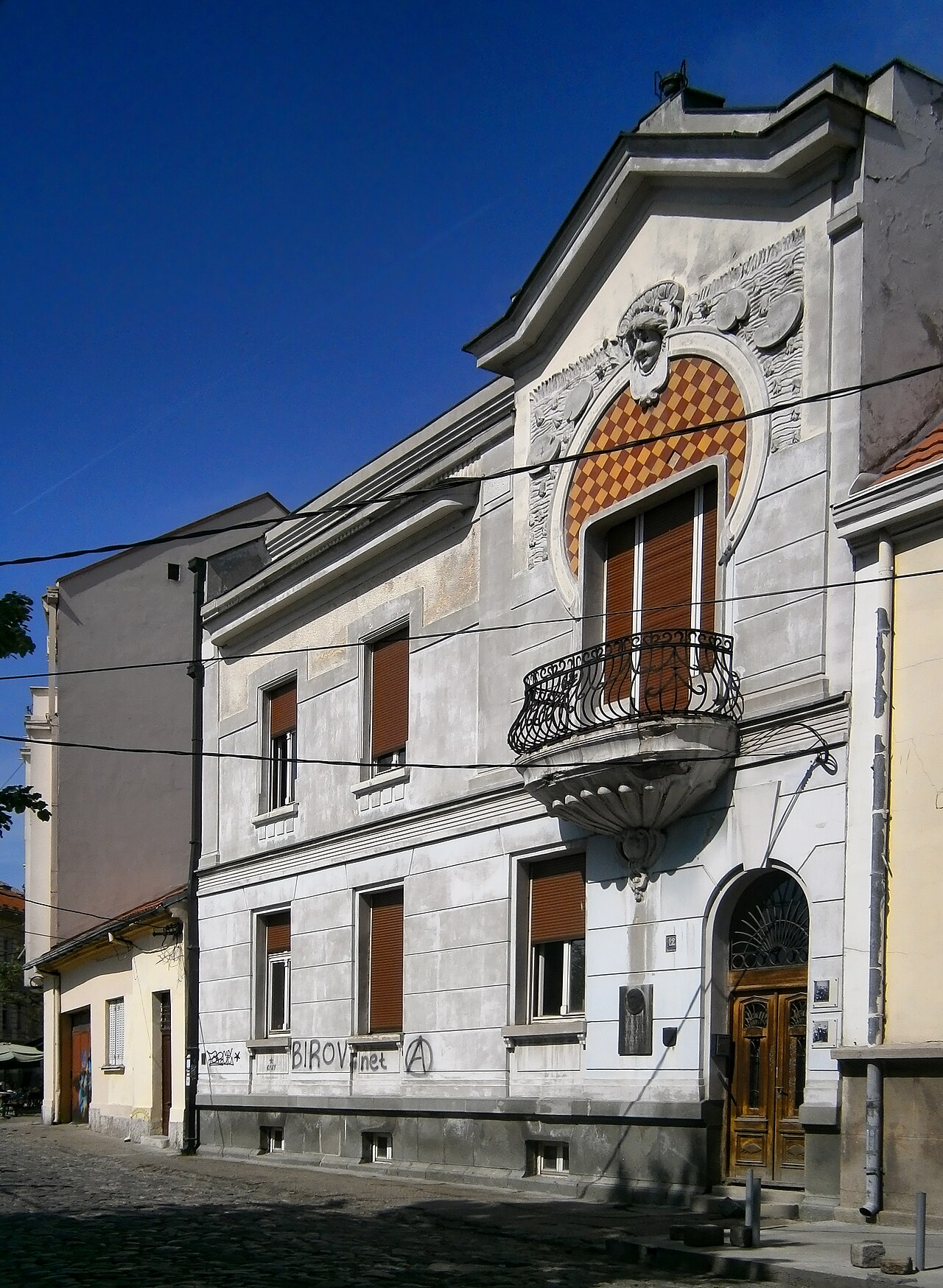
Mika Alas's House is a protected historic residence at 22 Kosančićev Venac in Belgrade’s Stari Grad municipality. Built in 1910, it was designed by architect Petar Bajalović for Mihailo Petrović, the mathematician and scientist known as Mika Alas. The address is significant because Petrović lived, worked and died here, tying the architecture to a particular Belgrade scientific and cultural biography. This private house is not a public museum, so the meaningful visit is an exterior architectural and memorial stop in the historic neighbourhood. Its importance comes from the combination of distinctive design and the life of one of Serbia’s notable scientists.
No public interior route is published for Mika Alas’s House, so plan to study the building from the street. The façade has a projecting bay and balcony, with sculpted ornament adding depth to the two-storey residence. Look closely at the street-facing details: a red-and-white checked circular panel and carp carvings on the front door. The carp imagery gives the entrance a distinctive connection with Mika Alas’s identity. Across the street, the open space holds a bust of Mika Alas made by sculptor Aleksandar Zarin in 1969, extending the visit beyond the house itself. These visible details are the substance of the stop.
Allow around 15 to 25 minutes for this stop. The shorter visit is enough to identify the bay, balcony, sculpted ornament, checked circular panel and carp-carved door, while the longer end leaves time to pause at the bust across the street and examine the façade from several public viewpoints. This estimate covers an exterior sight and the nearby memorial, not an interior tour. If Mika Alas’s House is part of a wider walk through Kosančićev Venac and Stari Grad, treat those neighbourhood explorations as separate time rather than assuming the house provides a longer museum experience. A focused visit can remain brief while still covering the principal details.
This exterior stop fits naturally into a daytime walk through Stari Grad. The responsible heritage institute’s publication gives no visitor schedule or closure days, and describes a private historic house rather than a public museum. Daylight is useful for distinguishing the façade’s sculpted ornament, balcony, checked panel and front-door carvings from the surrounding streetscape. Visit quietly and remain on the public street: the building’s residential character is part of the practical context. There is no published interior timetable to organise a museum-style visit around, so the stop can be paired with your route through Kosančićev Venac. The surrounding historic streets provide useful context without changing the house’s access status.
No verified admission price or ticket arrangement is recorded for Mika Alas’s House. The responsible heritage publication identifies it as a protected exterior cultural monument and does not publish a public interior admission scheme. Accordingly, plan for an exterior viewing stop from the public street, without assigning a ticket price or describing it as free admission. The absence of a recorded charge does not establish permission to enter. The nearby bust in the open space across the street belongs to the same exterior-focused visit, but it also should not be presented as part of a ticketed museum service.
The house stands at 22 Kosančićev Venac in central Belgrade’s Stari Grad municipality. Official route information for public transport identifies line 26 toward the Dorćol/Dunavska terminus and lists the Despota Đurđa, Kralja Petra and Braće Baruh stops. From one of those Dorćol stops, continue on foot toward Kosančićev Venac and use number 22 as your precise destination. The approach is to an address in the historic centre, not to a museum entrance or reception desk. Once there, check the open space opposite for the 1969 Mika Alas bust. Use the exact street number to distinguish the house from nearby heritage buildings.
The key expectation to manage is access. Mika Alas’s House is a private historic residence presented by the responsible heritage institute as a protected exterior cultural monument, not as a public museum. Do not approach the entrance as an invitation indoors, and keep clear of the doorway while looking at the façade. The exterior viewpoint is limited in scope: the attraction is the building’s visible architectural detail and its connection with Mika Alas, within a residential historic setting. Respect the occupants and avoid turning the entrance into a gathering point.
Treat photography as an exterior architectural study. A wider frame can place the projecting bay and balcony in the context of Kosančićev Venac, while closer views can isolate the sculpted ornament, red-and-white checked circular panel and carp carvings on the front door. The public street is the viewing position, so compose without suggesting that the private interior is open. Daylight should make the façade details easier to read. Include the open space across the street if you want the photograph to record the relationship between the house and the bust of Mika Alas, created by Aleksandar Zarin in 1969. Architectural details reward both a contextual image and a careful close view.