

7 min walk
Poble Espanyol
- Must see · Heritage site
- Museum
Language · 11 published
Historic monument · Barcelona
Torre de Comunicacions de Montjuïc
Reviewed by Elena Voss · Roavina Travel Editor
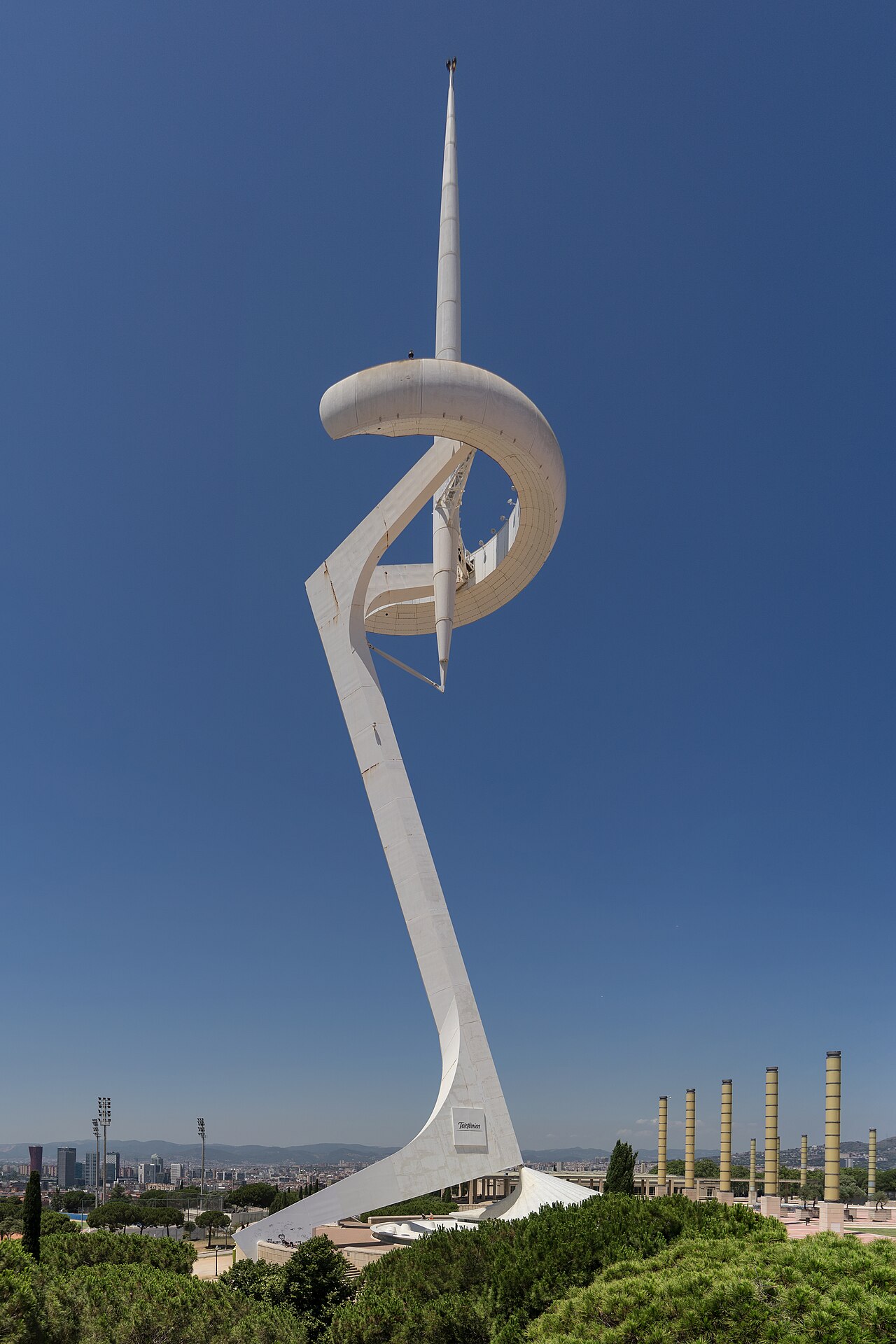
This place is a Attraction. It was established in 1989. It was built in the neo-futurism style. It was designed by Santiago Calatrava. It carries the Cultural Asset part of the cultural heritage of Catalonia heritage designation.
Torre de Comunicacions de Montjuïc is a telecommunications tower located on Montjuïc hill in Barcelona, Spain. Designed by architect Santiago Calatrava and completed for the 1992 Summer Olympics, it serves as a television and radio transmission tower. The structure features a distinctive white concrete shaft with a curved, leaning profile that evokes an athlete in motion. Its futuristic design has made it a notable landmark on the Barcelona skyline, though it remains primarily functional infrastructure rather than a conventional tourist attraction.
Checked 2026-08-26
The tower functions as operational telecommunications infrastructure and does not contain public interior spaces for visitor exploration. Its primary purpose is housing equipment for broadcasting signals across the Barcelona region. There are no observation decks, exhibition halls, or visitor facilities within the structure. The architectural interest lies entirely in its external form and engineering achievement. Visitors may appreciate the tower's sculptural qualities from surrounding viewpoints on Montjuïc hill, but should not expect to enter or tour the interior under normal circumstances.
Checked 2026-08-26
A visit to view the Torre de Comunicacions de Montjuïc requires minimal time commitment. Most visitors allocate between fifteen and thirty minutes to observe and photograph the tower from exterior vantage points. The duration depends entirely on individual interest in architectural photography and the desire to explore surrounding Montjuïc park areas. The tower itself demands no queueing or interior exploration time. Combining this stop with nearby attractions such as the Olympic Stadium, Palau Sant Jordi, or Montjuïc Castle creates a fuller half-day or full-day itinerary on the hill.
Checked 2026-08-26
The tower is visible from exterior locations at all times as it stands in open parkland on Montjuïc hill. The structure has no formal opening hours for public access since interior visitation is not permitted. Exterior viewing is theoretically possible year-round, though weather conditions affect visibility and comfort. Morning light generally provides favorable conditions for photography. Visitors should verify current circumstances independently before planning a specific visit, as maintenance activities or surrounding event preparations may occasionally restrict immediate access to the base. Check the operator's own site for the travel date before relying on a schedule or fare.
Checked 2026-08-26
No admission fee is required to view the Torre de Comunicacions de Montjuïc from public exterior spaces, as it stands within accessible parkland. There are no ticketed entry options since the tower interior is not open to visitors. Any organized tours incorporating the tower as a visual stop would operate through third-party providers with separate pricing structures. Visitors should exercise caution regarding unofficial operators claiming special access, as legitimate interior tours are not standard offerings at this functional telecommunications facility. Check the operator's own site for the travel date before relying on a schedule or fare.
Checked 2026-08-26
The tower sits on Montjuïc hill, accessible by multiple transport options. The Montjuïc funicular connects from Paral·lel metro station to hilltop areas. Several bus routes serve Montjuïc, including tourist service lines. Walking from Plaça d'Espanya through the park approaches takes approximately twenty to thirty minutes uphill. The Telefèric de Montjuïc cable car from the port area provides aerial access to the castle vicinity. Taxis and ride services can approach nearby roads. Visitors should consult current transport schedules independently, as service frequencies and routes may vary seasonally or during special events.
Checked 2026-08-26
The tower base area contains active telecommunications equipment and infrastructure not designed for public interaction. Visitors should remain on designated paths and respect any fencing or signage restricting approach. The exposed hilltop location experiences stronger winds and more variable temperatures than central Barcelona. Sun exposure is significant with limited shade near the tower itself. Mobile device connectivity should not be assumed for emergency communications despite the telecommunications function. The surrounding terrain includes slopes and uneven surfaces. Visitors with mobility limitations should research accessible route options carefully before attempting to reach closer viewpoints independently.
Checked 2026-08-26
The tower presents strong photographic subjects due to its distinctive Calatrava design and dramatic hillside positioning. Wide-angle lenses capture the full height against sky backgrounds, while telephoto options compress the structure against Barcelona's distant cityscape. The white concrete surfaces reflect harsh midday light; early morning or late afternoon illumination generally produces more favorable contrast. The tower's leaning profile rewards careful compositional attention to vertical alignment. Nearby Olympic Stadium architecture and Montjuïc's botanical gardens offer contextual landscape opportunities. Drone operation requires awareness of Spanish aviation regulations and proximity to infrastructure considerations.
Checked 2026-08-26
No. The tower functions as operational telecommunications infrastructure without public interior access. Visitors may only observe the exterior structure from surrounding public spaces.
No observation deck exists. The tower was designed for broadcasting equipment housing, not public viewing platforms.
The tower was completed for the 1992 Summer Olympics and its design evokes an athlete in motion, but it served telecommunications needs rather than direct Olympic event functions.
No standard guided tours operate for interior access. Some Barcelona architectural tours may include exterior viewing stops, but these do not enter the structure.
The Estadi Olímpic Lluís Companys, Palau Sant Jordi, and Montjuïc Castle are all within reasonable walking distance on the same hill, allowing efficient combined exploration.
Not recorded. Visitors should not assume nighttime illumination and should verify current conditions through independent observation or local inquiry.
Loading the interactive map…
The interactive map could not be loaded.

Last updated:
Source: OpenStreetMap contributors, Wikidata ·