
2 min walk
La Rambla
- Notable
- Historic monument
Language · 11 published
Historic monument · Barcelona
Plaça Reial
Reviewed by Elena Voss · Roavina Travel Editor
This place is a Attraction. It was established in 1850. It was built in the Neoclassical architecture style. It was designed by Francesc Daniel Molina i Casamajó. It carries the Cultural Asset of Local Interest heritage designation.
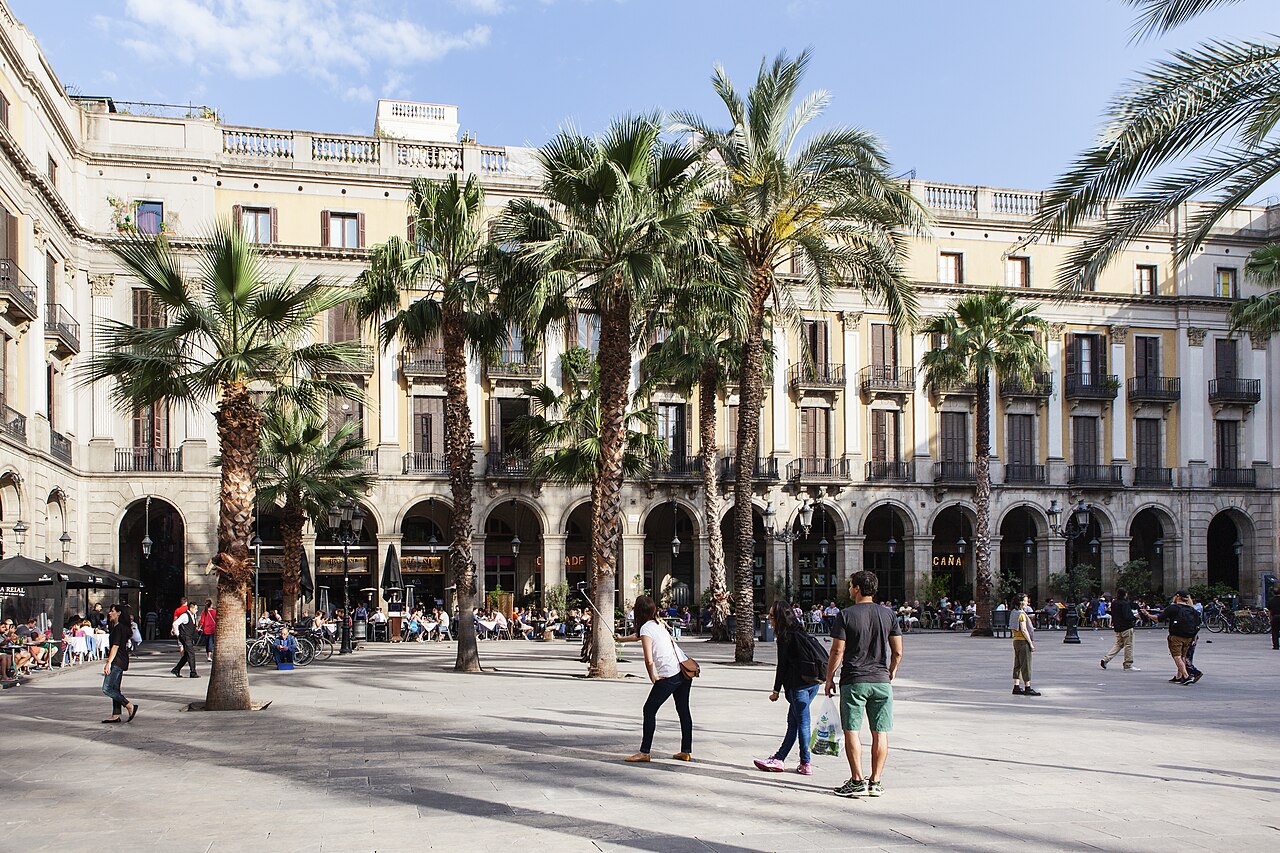
Royal Square, or Plaça Reial, is a nineteenth-century public square just off La Rambla in Barcelona’s Gothic Quarter. Neoclassical buildings with continuous porticoes enclose the rectangular plaza, while palm trees and the central Fountain of the Three Graces create its recognizable character. Today the square serves several roles at once: historic urban ensemble, meeting place, restaurant setting, and nightlife destination. Visit in daylight for architecture and details, or return after dark for its livelier social atmosphere. Plaça Reial is a public square in Barcelona's Gothic Quarter, adjacent to La Rambla. Designed in the 19th century, it features neoclassical architecture with uniform porticoed buildings enclosing a rectangular plaza. The square contains the Fountain of the Three Graces at its center and is lined with palm trees. Yes. Plaça Reial is the Catalan name; Plaza Real is the Spanish equivalent. Both refer to the same square in Barcelona's Gothic Quarter.
Checked 2026-08-26 · Source
The square’s principal features are outdoors and visible from the surrounding paving. At the centre stands the Fountain of the Three Graces, while two ornate street lamps associated with the young Antoni Gaudí flank the fountain. Uniform façades and arcades create a continuous architectural frame, with restaurants, cafés, and bars occupying the ground floors. Palm trees soften the paved space. The interest lies in seeing how a carefully planned nineteenth-century square now supports everyday dining, movement, and nightlife.
Checked 2026-08-26 · Source
A focused look at the fountain, lamps, arcades, and façades takes about fifteen to thirty minutes. Add time if you want to sit at a café or restaurant, take photographs from several corners, or experience the square after dark. There is no prescribed route and no need to examine every entrance. Royal Square works well as a short architectural pause while walking between La Rambla and the Gothic Quarter, or as a longer evening stop built around food and conversation.
Checked 2026-08-26 · Source
Daylight is best for reading the façades, examining the fountain, and photographing the Gaudí-associated lamps. Evening changes the mood as terraces, bars, and nightlife bring more people, sound, and movement into the arcades. Summer and weekend nights are especially active. Early morning is the quietest period and offers the clearest views across the square. Because it is an open public space, the attraction is available as part of an ordinary walk, with the most suitable time depending on whether you prefer calm architecture or lively urban energy.
Checked 2026-08-26 · Source
Entry to Royal Square itself is free because Plaça Reial is a public square. Money is only required for the separate services offered by the businesses around its perimeter, including meals, drinks, and other purchases. Their prices and conditions belong to each establishment rather than to the square as a whole. You can therefore walk through, admire the architecture, and photograph the fountain without buying anything, then choose whether to make the visit longer with a café or restaurant stop.
Checked 2026-08-26 · Source
Plaça Reial opens directly from La Rambla in the Gothic Quarter, making it easy to include during a central Barcelona walk. Liceu metro station on line L3 is the nearest underground access. Buses run on nearby streets, while the dense historic centre is often most pleasant to cross on foot. Approaching from elsewhere may involve narrow medieval lanes, and vehicle access around the old centre is limited. From La Rambla, look for the short passage leading into the enclosed square.
Checked 2026-08-26 · Source
The square can feel very different by day and night. Crowds rise during tourist season and evening nightlife, so keep belongings secure in the busy public space. Noise increases after dark, and restaurant terraces may be active and persistent. The open plaza offers little protection from strong sun or rain. Arcades and similar façades can make the exits feel less obvious at first, so use La Rambla as the main orientation point when leaving. Choose the timing that matches your comfort with crowds and late-night activity.
Checked 2026-08-26 · Source
The square’s symmetry is ideal for centered photographs of the Fountain of the Three Graces framed by the porticoes and Gaudí-associated lamps. Walk around the perimeter to capture repeating arches, palm trees, and the changing relationship between the fountain and façades. Morning light can reveal architectural detail with fewer people, while evening images include terrace lights and nightlife. The enclosed layout keeps the composition focused, but tripods may obstruct pedestrians. Ground-level viewpoints are the natural way to show the square as a complete urban room.
Checked 2026-08-26 · Source
Royal Square is Plaça Reial in Catalan and Plaza Real in Spanish; both names refer to the same Barcelona square.
The main landmarks are the Fountain of the Three Graces and two ornate street lamps associated with Antoni Gaudí’s early work.
No. Plaça Reial is a public square with free access. Restaurants, cafés, and bars around it charge separately for their services.
It is immediately southwest of La Rambla in Barcelona’s Gothic Quarter, close to Liceu metro station on line L3.
The square becomes busiest on summer and weekend evenings, when restaurants, terraces, bars, and nightlife bring more activity and noise.
Allow fifteen to thirty minutes for the architecture and fountain, or longer if you plan to eat, have a drink, or experience the square at night.
Loading the interactive map…
The interactive map could not be loaded.


Last updated:
Source: OpenStreetMap contributors, Wikidata ·