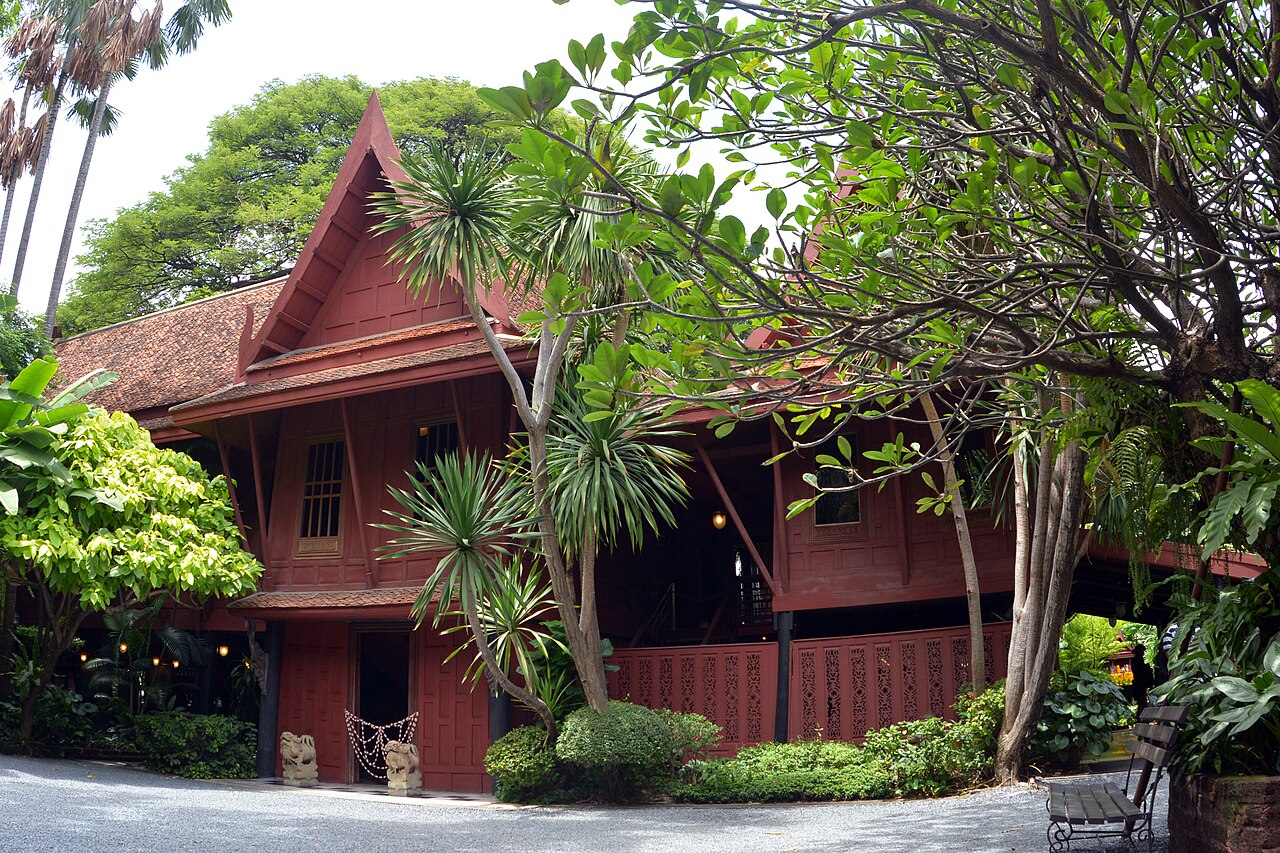
The Jim Thompson House is the preserved Bangkok home of the American who rebuilt the Thai silk trade after the Second World War, and the standard reference example of Thai vernacular domestic architecture kept as a museum. Six nineteenth-century teak houses were bought, dismantled, moved from Ayutthaya and from Bangkrua across the canal, and reassembled on this plot in 1959; Thompson lived in them until he walked into the Malaysian highlands in 1967 and was never found. Daily 10:00–17:00; last guided tour at 17:00.
The compound is a single raised structure assembled out of separate houses, so the tour moves through rooms that were never originally neighbours. Shoes come off at the stair. Inside are the drawing room, the dining room with its porcelain, the bedroom, and the study, all in dark teak with the wall panels and open verandas that define the central-plains house form — raised a full storey above the ground against flooding, with steep roofs and no fixed glazing. No regular closure day is listed. The operator warns visitors to disregard claims that the museum closes for half a day on Buddhist or public holidays.
Allow 75 minutes. That is the compulsory guided tour of the house, plus the garden and the exhibition hall, plus the queue for the next tour in a language that suits. The figure is this page's judgement: the operator does not publish a tour length anywhere on its site, and the 45 minutes quoted on review sites and blogs covers the walk through the house alone. Anyone reading the exhibition properly or eating at the restaurant should plan on two hours.
The operator states that the museum opens every day from 10:00 to 17:00, with the last guided tour at 17:00, and publishes no closed day. November to February is the season to prefer, because the tour crosses open verandas and the garden and neither is air-conditioned. Daily 10:00–17:00; last guided tour at 17:00. Take the BTS SkyTrain to National Stadium station and use Exit 1. The museum address is 6 Soi Kasemsan 2, Rama I Road, Bangkok 10330. The operator also lists arrival by car, taxi, or tuk-tuk. The main house is not step-free: visiting it involves several stairways, and there are no elevators.
Admission is 250 THB per person, from the operator's own visit page. There is one price for everyone — the museum publishes no separate Thai and foreigner rate, which is unusual in Bangkok and worth knowing before someone offers to explain the difference. Tickets are bought at the gate. General adult admission is THB 250. Visitors aged 10–21 and visitors with disabilities pay THB 150. Children aged 0–9 enter free; identification requirements apply to reduced or category-based admission. The main house is not step-free: visiting it involves several stairways, and there are no elevators.
No car is needed, and a car is the worst option — Rama I Road at the Soi Kasemsan 2 junction is one of the slower pieces of traffic in the city. From the shopping district around Siam and MBK the walk is well under fifteen minutes. Take the BTS SkyTrain to National Stadium station and use Exit 1. The museum address is 6 Soi Kasemsan 2, Rama I Road, Bangkok 10330. The operator also lists arrival by car, taxi, or tuk-tuk. No. Entry to the main house is permitted only with a museum guide.
The known problem here is the approach, not the museum. Touts working the lane and the station tell arrivals that the house is closed today for a holiday or a private function and offer an alternative destination; the museum explicitly says it opens normally on Buddhist and public holidays, so the claim is a signal to keep walking. The main house is not step-free: visiting it involves several stairways, and there are no elevators. Guides are available in Thai, English, French, Chinese, and Japanese. No. The museum does not sell tickets through online platforms; tickets are sold only at its ticket office.
The garden and the exterior are the photographs to plan for. The house is dark red-brown teak under heavy shade, so the exterior works best in the flat light of an overcast morning or in the hour after opening, when the sun is still low enough to reach the verandas without blowing out the roof line. Interior conditions are difficult: little glazing, deep eaves, dark timber, and a guide who is moving. A fast lens beats a flash in every room here. No. The museum does not sell tickets through online platforms; tickets are sold only at its ticket office.
Can visitors enter the main house without a guide?
No. Entry to the main house is permitted only with a museum guide.
Which guided-tour languages are available?
Guides are available in Thai, English, French, Chinese, and Japanese.
Can tickets be purchased online?
No. The museum does not sell tickets through online platforms; tickets are sold only at its ticket office.
Must visitors remove their shoes?
Yes. Shoes must be removed before entering the main house.
What is the rule for larger bags?
Bags over 20 cm must be left in the locker area, which is monitored by CCTV.
What photography is permitted inside the main house?
Photography is allowed, but flash, selfies, individual photos, and video recording are prohibited.
Who was Jim Thompson and why is his house a museum?
Thompson was the American who revived the Thai silk industry after the Second World War. He bought six nineteenth-century teak houses from Ayutthaya and Bangkrua, reassembled them on this plot in 1959, and filled them with Asian art; he disappeared in 1967, and the house was kept as he left it.