City guide · Beijing
What to Eat in Beijing: Food and Dining Guide
Explore Beijing food traditions and compare four documented dining formats, from Qianmen tea dining to Wangfujing and Chaoyang hotel restaurants.
Editorial responsibility: Elena Voss · Roavina Travel Editor
This guide is part of our Beijing destination coverage. Beijing
Beijing dishes to recognise beyond the restaurant shortlist
Beijing's best-known food reference point is roast duck, but it is only one part of a much wider city food culture. Official visitor material also identifies zhajiangmian, noodles with fried soybean-and-meat sauce, and traditional snack preparations such as luzhu huoshao, fried tripe and mending meat patties. These are options to recognise when reading a menu elsewhere in the city, not dishes attributed to the four establishments described below. The hotel restaurants have their own Cantonese or international formats; Laoshe Teahouse has several tea, performance and dining spaces rather than a published duck menu. (Beijing traditional flavours, checked 2026-09-29)
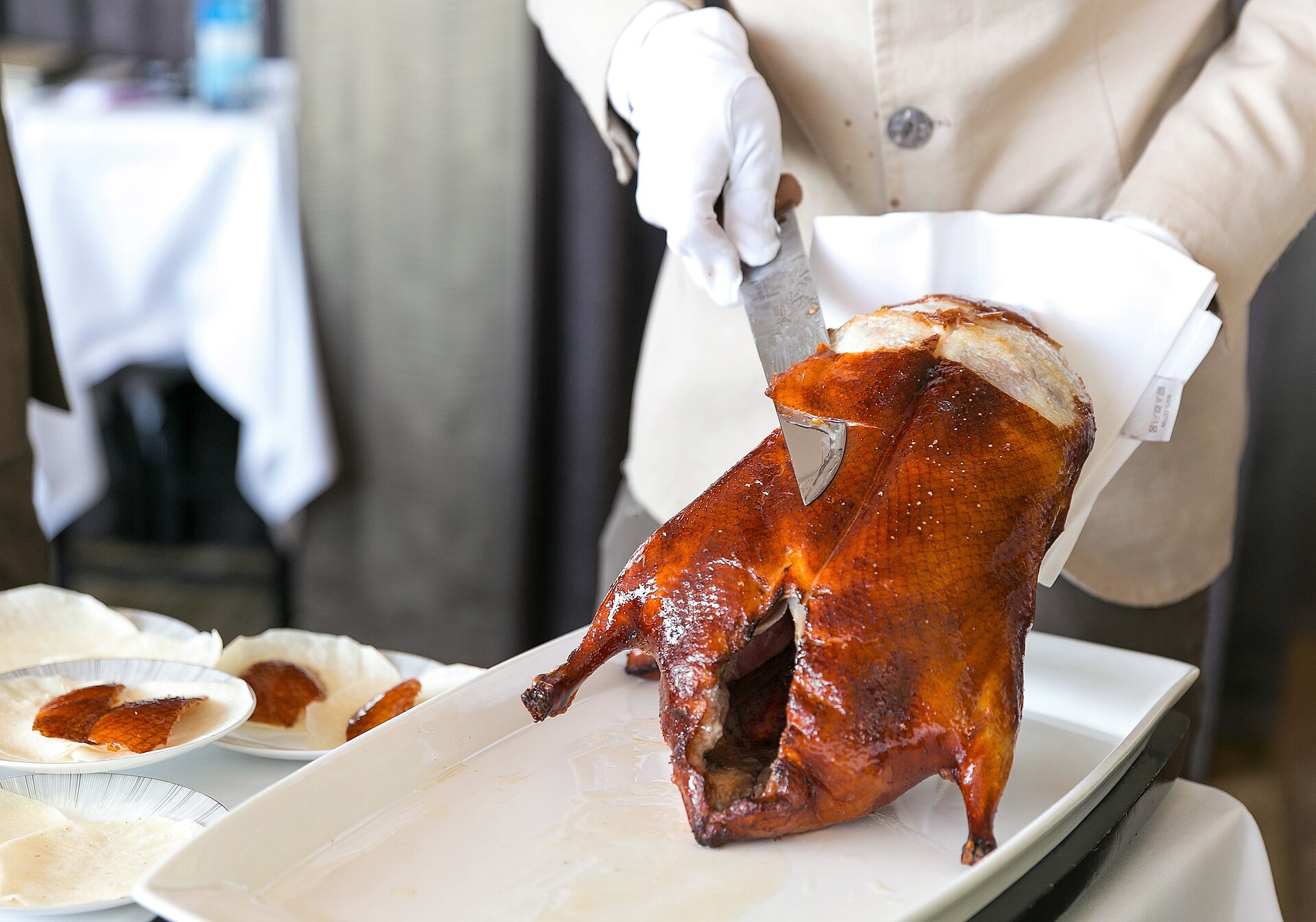
Roast duck is commonly presented with thin pancakes, sweet bean sauce and scallions or cucumber. Beijing's tourism bureau explains the hanging-oven technique associated with Quanjude as one particular heritage preparation. That cultural description does not establish a booking, menu or current service at any restaurant in this shortlist. If duck is the aim of a day, choose a separately verified duck restaurant instead of assuming a Chinese hotel restaurant serves it. (Beijing roast-duck craft, checked 2026-09-29)
For a simpler meal, zhajiangmian provides a different experience from a multi-course duck dinner: noodles and a savoury sauce are the centre of the order, so ask about the meat and vegetable components if they matter to you. The city's food-street guide also points to glutinous rice rolls filled with red bean paste, fried cakes and meat patties. Those formats make it possible to try smaller portions across a walking day, but the examples are citywide context and should be checked against the actual stall or shop before ordering. (Beijing food streets, checked 2026-09-29)
Checked 2026-09-29 · Official site · english.visitbeijing.com.cn
Choose a food stop that fits the part of Beijing you are exploring
Tea-related dining
Source and date: Tea-related dining
Source and date: Pinzhenlou on Laoshe Teahouse’s third floor offers tea-related dining and a smaller Manchu-Han banquet format.
Think of these four venues as different kinds of stop, not as interchangeable examples of one Beijing speciality. Laoshe Teahouse is a Qianmen-area venue where tea, cultural performances and dining are distinct parts of a larger business. Its operator describes Pinzhenlou, on the third floor, as the dining component. A visitor planning a meal should ask specifically for that dining space; a seat at a performance or a tea-service booking may be a different arrangement. The operator's main-branch description places the venue by Qianmen and Dashilan, so it is most naturally considered when that neighbourhood is already on the itinerary. The page does not give a full verified street address for use here. (Laoshe dining, Laoshe main branch, checked 2026-09-29)
Wan Li sits inside Renaissance Beijing Wangfujing Hotel at 57 Wangfujing Street, Dongcheng District. The hotel's own dining page calls it a Chinese restaurant with seasonal cuisine and an emphasis on Cantonese flavours. Its buffet-style description and private dining rooms suggest more than one arrangement; ask which format is being offered when you plan to go. The point recorded for research is the hotel building, not the restaurant entrance or room. (Renaissance Wangfujing dining, checked 2026-09-29)
The Garden Chinese Restaurant is in a different hotel, Renaissance Beijing Capital Hotel at 61 Dongsanhuan Middle Road, Chaoyang District. Marriott describes Cantonese cooking, fusion dishes and dim sum there. It is a considered restaurant meal for a Chaoyang or CBD day, not a substitute for a Qianmen snack walk. Beijing Bistro, at Beijing Marriott Hotel Northeast, 26A Xiao Yun Road in Chaoyang, offers an international format with live cooking counters and Asian influences. Ask each hotel whether diners who are not staying there can use the restaurant and which entrance to take; the published dining pages do not settle access arrangements. (Renaissance Capital dining, Marriott Northeast dining, checked 2026-09-29)
Checked 2026-09-29 · Official site · laosheteahouse.com
Checked 2026-09-29 · Official site · www.marriott.com
What each documented dining room actually offers
Laoshe Teahouse is the one established mapped food stop in this shortlist. Its current operator material distinguishes Pinzhenlou's tea-related dining from a tea courtyard, performance hall and retail. The operator has not exposed a complete current dish list in the material reviewed here. Neither a specific banquet dish nor a show ticket price is promised. The main branch is in the Qianmen area, but its full street address remains blank until confirmed from the operator. (Laoshe dining, Laoshe branch, checked 2026-09-29)
Wan Li and The Garden are both Chinese hotel restaurants, yet their operator descriptions point to different decisions. Wan Li at the Wangfujing Renaissance is described as seasonal Chinese buffet-style dining with a Cantonese emphasis and private rooms. The Garden at the Capital Renaissance is described through Cantonese cuisine and dim sum, including fusion alongside traditional preparations. If the meal is about trying a spread of small plates, The Garden's stated dim-sum format is more relevant. If a Wangfujing-based hotel dining room and buffet-style service suit the day, Wan Li is the closer match. The pages identify their respective hotel street addresses, and each proposed point is the hotel building rather than a restaurant-specific entrance. (Wan Li operator page, The Garden operator page, checked 2026-09-29)
Beijing Bistro is different again. The Marriott Northeast describes live counters, an international selection and Asian flavours; it does not publish a complete current dish-by-dish menu in the material used here. This makes the Bistro a reasonable choice for someone who wants a broad hotel restaurant rather than a narrowly specified Cantonese meal. Do not project a named Beijing signature dish onto its menu. Contact the hotel for the current counter selection, how the meal is served and whether an outside visitor can enter. (Beijing Bistro operator page, checked 2026-09-29)
Checked 2026-09-29 · Official site · laosheteahouse.com
Checked 2026-09-29 · Official site · www.marriott.com
Checked 2026-09-29 · Official site · laosheteahouse.com
Make the order match the service you actually want
Start by naming the intended dining format. At Laoshe, a performance, tea service and Pinzhenlou meal are not necessarily the same purchase. Ask which part of the venue receives your reservation, whether dining is included in any performance package, and whether a meal can be booked on its own. These are questions to clarify, not statements about the venue's current ticket rules. The reviewed official pages support the separate spaces but do not publish a single universal booking arrangement. (Laoshe dining, checked 2026-09-29)
At a hotel restaurant, use the exact restaurant and hotel name together. Ask for Wan Li at Renaissance Beijing Wangfujing Hotel, The Garden at Renaissance Beijing Capital Hotel, or Beijing Bistro at Beijing Marriott Hotel Northeast. State whether you are staying at the hotel; the dining pages establish an on-property restaurant but do not explicitly guarantee access to non-guests. Ask for the correct entrance and restaurant level rather than navigating only to a building-centre pin. The mapped point is useful for finding the hotel building, not for deciding which door reaches a specific dining room. (Wan Li hotel page, The Garden hotel page, Bistro hotel page, checked 2026-09-29)
Decide how much of the meal needs to be predictable. Wan Li's seasonal description means a particular dish should be confirmed for the date of dining; The Garden's dim sum description establishes a category but not each filling; Beijing Bistro's international counters leave the day's exact selection open. If the goal is to explore contrasting restaurant formats around your route, these four documented spaces provide tea-related dining, Chinese hotel dining with Cantonese emphasis, dim sum and an international hotel restaurant. (Beijing flavours, Marriott dining pages, checked 2026-09-29)
Checked 2026-09-29 · Official site · laosheteahouse.com
Checked 2026-09-29 · Official site · www.marriott.com
Checked 2026-09-29 · Official site · english.visitbeijing.com.cn
Handle ingredients and dietary needs at the right level
The source pages identify cuisine and dining formats, not complete ingredient or allergen lists for the current service. Ask staff about the particular item you intend to order and tell them which ingredients must be avoided. A general label such as Chinese, Cantonese or international cannot verify that an individual plate meets a dietary requirement. None of these reviewed pages establishes halal certification, a gluten-free kitchen, vegan preparation or cross-contact controls, so this guide does not claim any of them. (The Garden, Wan Li, Beijing Bistro, checked 2026-09-29)
The same care applies to traditional foods encountered elsewhere. Beijing's official food material describes zhajiangmian with a soybean-and-meat sauce, while many roast-duck presentations use pancakes, sweet bean sauce and accompaniments. A name familiar from a guide is not an ingredient certificate: individual kitchens and versions differ. For vegetarian or allergy-sensitive ordering, ask about sauce, stock, filling and preparation rather than relying on the short dish name. If the answer is uncertain, choose an item whose preparation can be explained clearly by the operator. (Beijing flavours, Roast-duck craft, checked 2026-09-29)
At Laoshe, clarify first whether the booking concerns the restaurant, tea service or a performance. Then ask Pinzhenlou what food is currently available and discuss ingredients for the exact meal. The official dining description does not contain a current complete item list. For an outside guest at any of the three hotels, dietary questions can be combined with access questions in one contact: identify the restaurant by name, explain the meal need and ask whether the dining room will admit non-residents at the intended time. This avoids both an unsupported menu promise and an unsupported assumption about entry. (Laoshe dining, Hotel dining example, checked 2026-09-29)
Checked 2026-09-29 · Official site · www.marriott.com
Checked 2026-09-29 · Official site · english.visitbeijing.com.cn
Checked 2026-09-29 · Official site · laosheteahouse.com
Avoid route and menu assumptions that waste a meal
Do not turn the city's famous dish list into promises about these four restaurants. Beijing tourism material explains roast duck, zhajiangmian and snacks, but the hotel pages here describe Cantonese, international and tea-related formats. If roast duck is non-negotiable, verify a duck restaurant and its exact branch separately. A specialist dish deserves a restaurant whose own current menu names it and whose address matches the branch you intend to visit. (Beijing flavours, Wan Li hotel dining, checked 2026-09-29)
Do not join all four into one short walk. Laoshe belongs to the Qianmen area; Wan Li is by Wangfujing; The Garden is at a separate Chaoyang hotel; Beijing Bistro is farther north on Xiao Yun Road. Each hotel has its own street address. Hotel building points are an honest map aid for approximate arrival, but they do not specify a restaurant door. A building-centre map point should never be mistaken for the dining-room entrance. (Laoshe branch, Wan Li, The Garden, Beijing Bistro, checked 2026-09-29)
Skip stale practical details even when a listing looks precise. A published hour, price, menu item or performance programme can change faster than a restaurant's identity. The operator pages reviewed here establish the four formats and hotel addresses, but this guide does not convert a visible schedule into a guarantee for a future visit. Confirm the current booking terms, food selection and outside-guest policy close to the date you intend to dine. At Laoshe, ask about meal and performance inclusions separately; at the hotels, ask for the named restaurant and the right entrance. (Laoshe dining, Marriott dining example, checked 2026-09-29)
Checked 2026-09-29 · Official site · english.visitbeijing.com.cn
Checked 2026-09-29 · Official site · laosheteahouse.com
Checked 2026-09-29 · Official site · www.marriott.com
Common questions
Does a Laoshe Teahouse performance ticket include dinner?
The operator describes separate dining and performance spaces. Ask which services your specific booking includes; do not assume a meal comes with a performance seat.
Where is Wan Li restaurant?
Marriott lists Wan Li inside Renaissance Beijing Wangfujing Hotel at 57 Wangfujing Street, Dongcheng District. The research point is the hotel building, so ask the hotel which entrance reaches the restaurant.
Which listed restaurant mentions dim sum?
The Garden Chinese Restaurant at Renaissance Beijing Capital Hotel describes Cantonese cuisine and dim sum. Confirm the current selection before relying on a particular filling or dish.
Is Beijing Bistro a specialist Beijing-cuisine restaurant?
The hotel's dining page describes an international restaurant with live cooking counters and Asian influences. It does not establish a specific traditional Beijing dish on the current menu.
Can visitors who are not hotel guests eat at these restaurants?
The operator pages establish on-property dining rooms but do not state a universal non-guest access policy. Ask the specific hotel before making that plan.
Are the map coordinates the restaurants' doorways?
No. The proposed WGS84 points identify the respective hotel buildings; the dining-room entrances have not been independently located. Ask the hotels for arrival instructions.