.JPG)
1 min walk · Landstraße
Museum of Art Fakes
- High
- Museum
Language · 11 published
Historic monument · Landstraße, Vienna
Reviewed by Elena Voss · Roavina Travel Editor
Read from the OpenStreetMap access tags; anything not listed has no tag recorded.
Set the group type to family in the planner and the day window contracts to about three quarters of a solo day.
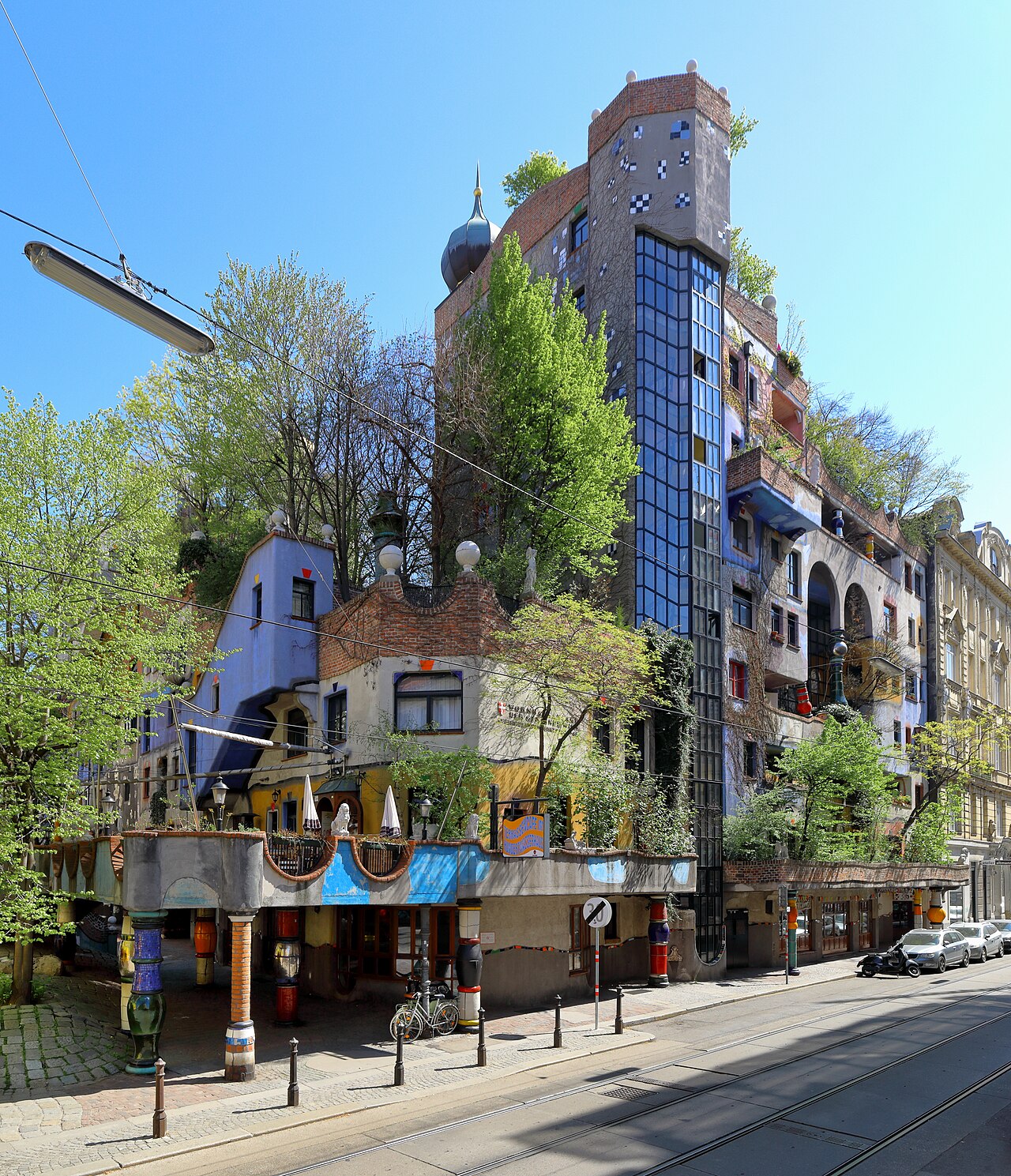
This place is a Attraction. It opened in 1986. It was built in the expressionist architecture style. It was designed by Friedensreich Hundertwasser. It carries the Listed objects in Austria heritage designation.
Hundertwasserhaus is a private residential complex in Vienna’s 3rd district, Landstraße, at the corner of Kegelgasse and Löwengasse. Friedensreich Hundertwasser created the artistic concept with architect Joseph Krawina, and construction took place from 1983 to 1985. Its irregular silhouette, vivid façade, mismatched windows and expressive surfaces make it unlike an ordinary municipal housing block. The building’s importance lies in the way Hundertwasser turned everyday housing into a deliberately individual, organic-looking work of architecture. In 2010, Austria’s Supreme Court recognised Krawina as an equal co-creator, while Hundertwasser remained the design’s sole spiritual creator.
Checked 2026-09-02 · Source
The complex contains 53 apartments, four offices, 16 private terraces and three communal terraces. About 250 trees and bushes are incorporated into the building and its roof landscape, giving the architecture a planted, living quality. Some trees grow from the rooms, with branches extending through windows; the roof is covered with grass. Floors undulate rather than forming a uniform level, and the windows vary in shape and placement instead of following a repeated grid. These details are part of the public exterior story, but the apartments themselves remain occupied private homes. Visitors should therefore expect to inspect the façades from the surrounding streets, not enter the building.
Checked 2026-09-02 · Source
Allow about 15 to 20 minutes for Hundertwasserhaus itself. The visit is an exterior stop: walk around the corner of Kegelgasse and Löwengasse, pause to compare the two street fronts, and look up at the planted roofline, columns, ceramic details and uneven window rhythm. It is easy to combine with the Hundertwasser Village opposite, a converted tyre factory now used as a shop and café; allow roughly another 20 minutes if you browse it. Kunst Haus Wien, the museum designed by Hundertwasser and devoted to his work, is about a five-minute walk away and merits a longer museum visit.
Checked 2026-09-02 · Source
Come earlier in the day if you want a quieter look at the façades, because Hundertwasserhaus is a popular stop and the pavement at the corner is narrow. The planting is most visibly leafy from late spring through early autumn, although the architecture remains legible outside the growing season. Soft or overcast light helps preserve the contrast between the white surfaces, coloured ceramic areas and strong façade details; direct midday sun can make pale sections harder to photograph. Since this is a residential street corner rather than an enclosed attraction, choose a time when you can stand without obstructing pedestrians or residents.
Checked 2026-09-02 · Source
There is no ticket to buy for Hundertwasserhaus itself. The building is private housing, with 53 occupied apartments, so the public visit is limited to viewing the exterior from the street; the recorded admission is free at EUR 0 per person. Do not confuse the building with nearby attractions: Hundertwasser Village opposite is a retail and café space, while Kunst Haus Wien is a separate museum and may charge its own admission. This page records no museum price for those neighbouring venues, because that is not an admission fee for Hundertwasserhaus.
Checked 2026-09-02 · Source
Hundertwasserhaus is in Vienna’s 3rd district, Landstraße, at the junction of Kegelgasse and Löwengasse, east of the Ring. Tram 1 stops at Hetzgasse, about a minute from the building. Landstraße station, served by U3 and U4, is roughly a ten-minute walk away; Schwedenplatz, served by U1 and U4 across the Donaukanal, is also about ten minutes on foot. Vienna’s U-Bahn generally runs from around 05:00 to 01:00, with all-night service at weekends, so public transport is practical for both daytime visits and evening neighbourhood walks.
Checked 2026-09-02 · Source
This is someone’s home, not an accessible museum interior. There is no public lobby, interior tour or visitor entrance, and visitors should not ring bells, block doorways or photograph directly into windows. The pavement is narrow and the junction carries normal city traffic, including tram movement nearby, so keep clear of the kerb and leave room for residents and pedestrians. Hundertwasser Village across the road is easy to mistake for the residential building in photographs, but it is a separate commercial conversion. Plan for an outdoor stop and bring no expectation of toilets, cloakrooms or visitor facilities.
Checked 2026-09-02 · Source
The corner of Kegelgasse and Löwengasse gives the clearest overall view, although stepping back to the opposite pavement helps fit more of the façade into a frame. A wide lens is useful for the full composition; a longer lens works better for the individual columns, ceramic sections, roof planting and irregular windows along the two street fronts. Overcast light keeps the white render and colours balanced, while hard sun can flatten or overexpose pale surfaces. Photograph the architecture, not the residents: avoid aiming into windows, respect signs, and do not obstruct entrances or the narrow pavement while composing.
Checked 2026-09-02 · Source
No. Hundertwasserhaus is private housing containing 53 apartments, and there is no public lobby, interior visit or visitor admission. See it from the surrounding streets and respect the residents’ privacy.
Friedensreich Hundertwasser developed the artistic design with architect Joseph Krawina, and the building was constructed between 1983 and 1985. Austria’s Supreme Court recognised Krawina as an equal co-creator in 2010.
Yes. About 250 trees and bushes are planted through Hundertwasserhaus and its roof landscape. Some grow from the rooms, with branches extending through windows, and the roof is covered with grass.
The undulating floors reflect Hundertwasser’s rejection of uniform, straight-lined architecture. He considered a flat floor an insult to the foot, so irregular levels, windows and surfaces were central to the design idea.
No. He took no payment for the design, explaining that the work was worthwhile if it prevented something ugly from being built on the site.
Hundertwasser Village is opposite, in a converted tyre factory now used as a shop and café. Kunst Haus Wien, the museum designed by Hundertwasser and devoted to his work, is about a five-minute walk away.
Loading the interactive map…
The interactive map could not be loaded.
Last updated:
Source: OpenStreetMap contributors, Wikidata ·