This place is a Attraction.
It was established in 1137.
It was built in the Romanesque architecture style.
It carries the Listed objects in Austria heritage designation.
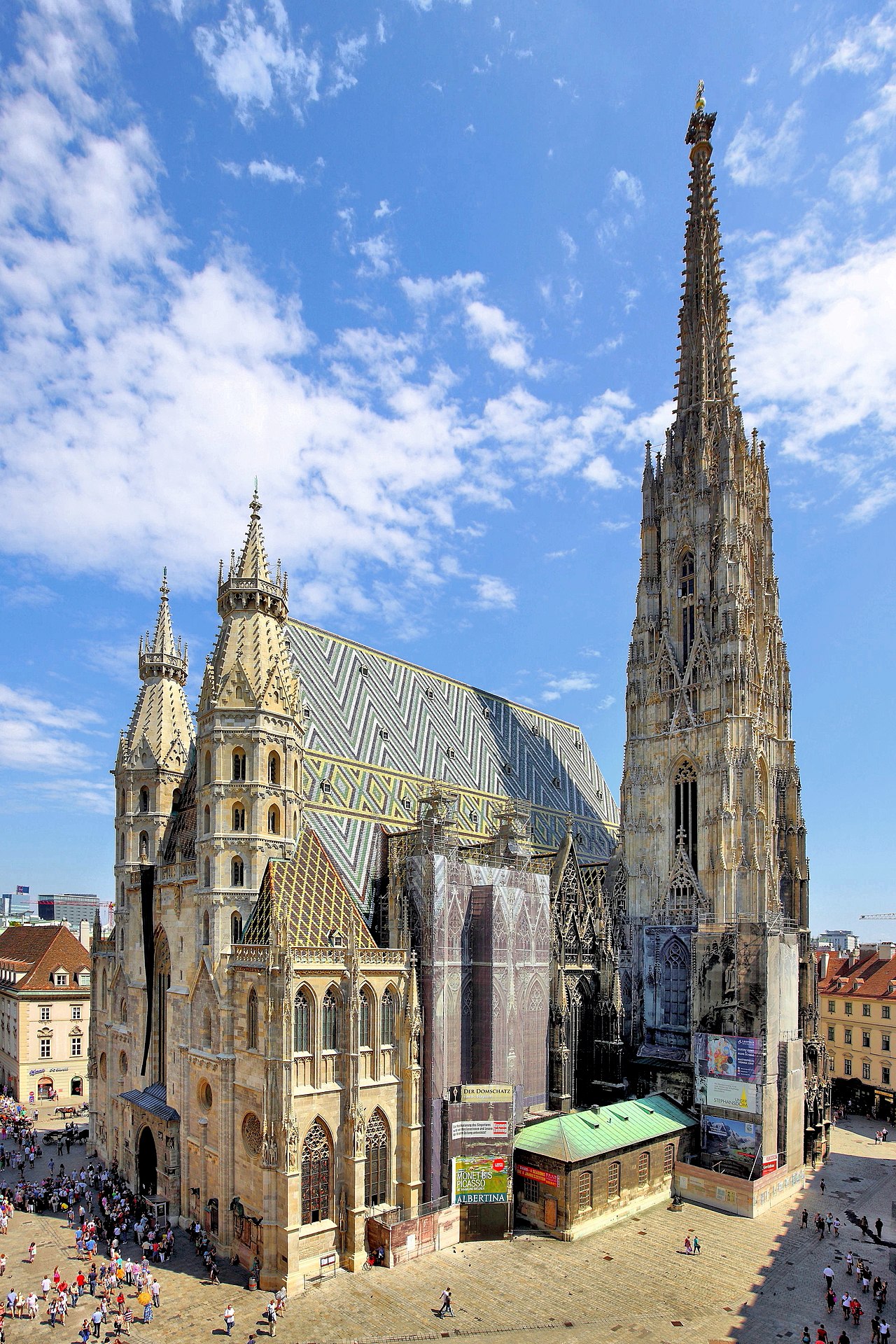
St. Stephen’s Cathedral is Vienna’s working metropolitan church and the defining landmark of Stephansplatz. Its story reaches back to a foundation in 1137, while Gothic rebuilding began in 1359 under Duke Rudolf IV. Fire destroyed much of the earlier building in 1258, and the cathedral was reconsecrated on 23 April 1263. The south tower, completed in 1433 after sixty-five years of work, rises to 136.7 metres. Construction stopped in 1511, leaving the north tower unfinished and the cathedral deliberately asymmetrical. Measuring 107 metres long and 70 metres wide, it remains both a monumental medieval building and an active place of worship at Vienna’s urban centre.
The most distinctive surface is above eye level: 230,000 glazed tiles cover a roof mosaic extending for 111 metres. Its pattern includes the Habsburg double-headed eagle and the arms of Vienna and Austria. Twenty-two bells occupy four belfries, with the Pummerin in the north tower weighing 20,130 kilograms; it was cast in 1951 to replace the original. Beneath the floor, the catacombs contain the remains of more than 11,000 people and are visited on a thirty-minute guided tour at fixed times. The decorated roof, shadowed interior and underground burial spaces give this cathedral several contrasting layers to explore.
Allow about ninety minutes for a focused visit combining the nave with one tower experience and, if the timetable fits, the catacombs tour. The free rear section of the nave takes less time, while the ticketed main nave and vertical visits extend the stop. The south tower requires 256 steps through a tight spiral staircase to its watchroom. The north tower uses a lift for the Pummerin. Catacombs tours last thirty minutes and begin at fixed times, so leave room for waiting and movement between the cathedral’s separate experiences. A slower visit rewards attention to the chapels, stonework and roof details.
Plan around the visitor schedule: Monday through Saturday from 09:00 to 16:30, and Sunday from 13:00 to 16:30. An early arrival usually gives more room to study the roof pattern, chapels and stonework. Clear weather is useful if the south tower is part of your plan, because the coloured roof mosaic is easier to appreciate from above. The shorter Sunday visitor period matters when combining the cathedral with a tower and catacombs tour, since a fixed-time underground visit can occupy a substantial part of the afternoon. A precise arrival plan is especially helpful when several separate experiences must fit into one day.
The rear of the nave is free, matching the operator admission of EUR 0 per person for that access. This free area is an introduction rather than access to every visitor experience: the main nave, south and north towers, catacombs and treasury are separate ticketed components. The catacombs are entered only through a thirty-minute guided tour at fixed times, so plan the free nave visit and paid experiences as distinct parts of the stop. The free admission applies to the rear nave access, not to the towers, treasury or underground tour.
St. Stephen’s Cathedral stands on Stephansplatz in Vienna’s Innere Stadt, the city’s 1st district. Stephansplatz station is served by U-Bahn lines U1 and U3, and its exit opens beside the cathedral’s south side. Vienna’s U-Bahn network has five lines and 109 stations across 83.9 kilometres. Services generally run from about 05:00 to 01:00, with all-night weekend service, making the central station the simplest arrival point for most visitors approaching the square. The cathedral is immediately visible when you emerge, so the final approach is straightforward even on a first visit.
The free visitor area ends at the rear of the nave; going farther requires the relevant ticket. The south tower is a demanding 256-step spiral with no lift and little room to pass, while the north tower provides lift access to the Pummerin. This is an active cathedral: dress respectfully, keep quiet during services and follow staff directions. The catacombs cannot be entered independently; join the fixed-time guided tour. Allow extra time if your plan combines several separate visitor areas, and remember that limited step-free access does not make every part of the complex suitable for every visitor.
The south tower offers the most revealing viewpoint because its watchroom looks down onto the cathedral’s 111-metre roof mosaic. From above, the glazed tiles make the Habsburg, Vienna and Austrian heraldic designs legible as a deliberate pattern rather than a distant splash of colour. At ground level, try diagonal views from the Graben or Stock-im-Eisen-Platz, where the cathedral’s height reads against the surrounding square. Inside, the nave is dim; use a steady grip and avoid flash where worship is taking place. The contrast between the patterned roof and dense city centre makes the tower viewpoint especially distinctive.
Its highest point is 136.7 metres. The cathedral is 107 metres long and 70 metres wide, and its south tower was completed in 1433 after sixty-five years of work.
Why is the north tower unfinished?
Construction stopped in 1511, and the north tower was never completed. That interruption is why the cathedral’s two towers do not form a symmetrical pair.
What is the Pummerin?
The Pummerin is the great bell in the north tower. Cast in 1951 to replace the original, it weighs 20,130 kilograms and is described as Europe’s third-largest swinging bell.
What is the cathedral roof made of?
Its 111-metre roof carries 230,000 glazed tiles arranged as a mosaic, including the Habsburg double-headed eagle and the arms of Vienna and Austria.
Is entry to St. Stephen’s Cathedral free?
The rear of the nave is free, with operator admission of EUR 0 per person for that access. The main nave, towers, catacombs and treasury are separate ticketed components; their individual prices are not included in the admission details.
What can you see in the catacombs?
The catacombs contain the remains of more than 11,000 people. Access is by a thirty-minute guided tour at fixed times, not by independent entry.
Nothing non-essential is set before you choose, in regions where consent is required. If you decline, ads still appear and analytics is switched off entirely.
.JPG)