This place is a Attraction.
It opened in 1869.
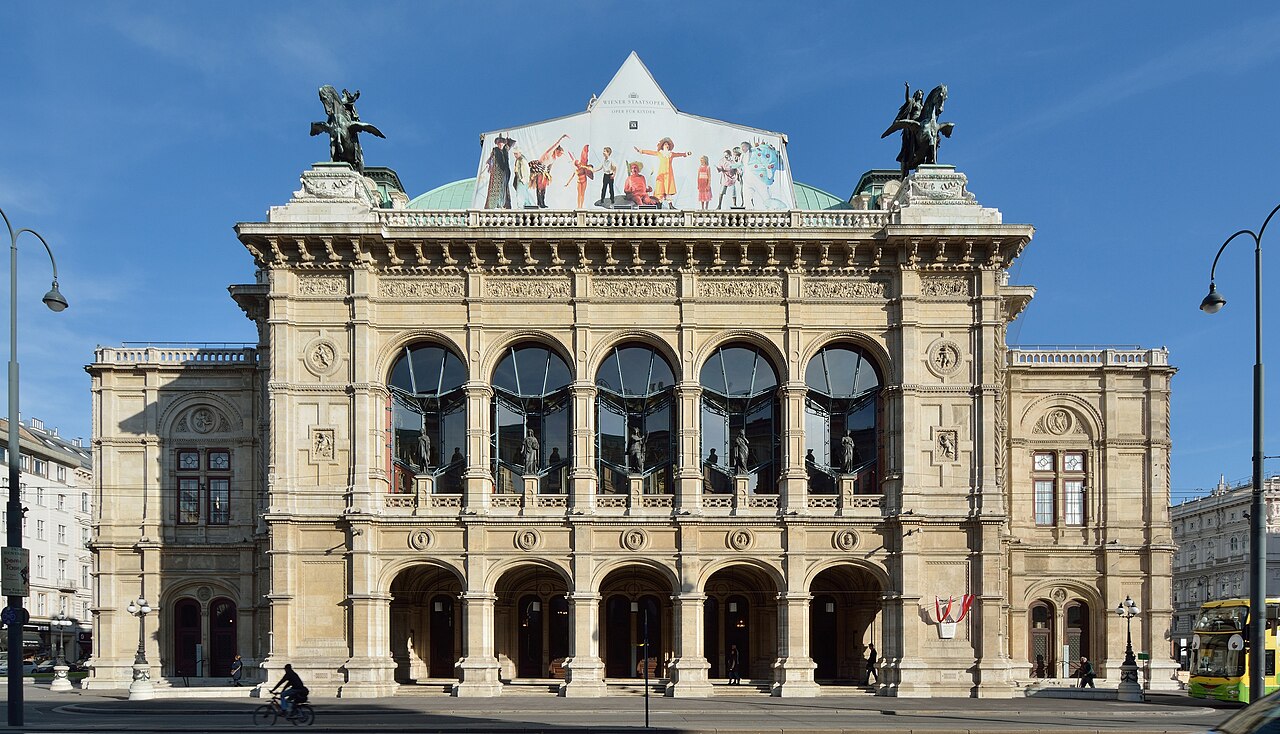
It was built in the Renaissance Revival architecture style.
It was designed by August Sicard von Sicardsburg.
It carries the Listed objects in Austria heritage designation.
The Vienna State Opera was hated when it opened and it killed both its architects.
August Sicard von Sicardsburg and Eduard van der Nüll built it between 1861 and 1869 on the new Ringstrasse. The public verdict was harsh: van der Nüll took his own life, and Sicardsburg died of tuberculosis shortly afterwards. Neither saw it finished.
It opened on 25 May 1869 with Don Giovanni, in the presence of Franz Joseph I and Empress Elisabeth.
American bombing destroyed the auditorium, the stage and the sets and costumes for more than 120 operas on 12 March 1945. It reopened on 5 November 1955 with Fidelio under Karl Böhm — Austria's first live televised performance.
An auditorium of 1,709 seats and 567 standing places, and one of the busiest opera schedules in the world.
The house runs fifty to sixty operas a year in true repertory, plus ten ballet productions, across more than 350 performances. That means a different work most nights, which no other house of this size attempts.
The Vienna Philharmonic recruits its members from the State Opera orchestra, so the players in the pit are the players on the recordings.
The Opera Ball takes over the building during carnival, when the stalls are floored over and the auditorium becomes a ballroom.
The tour is the only daytime access and goes at set times, covering the auditorium, the staircase and the salons. It is the fallback rather than the visit.
A performance is three to four hours depending on the work. Standing at the back is a legitimate way to hear it and is what students here have always done.
The Ring outside and the Albertina next door are both a few minutes away, so the opera fits into an afternoon that ends in the evening.
Whenever there is a performance, which is most nights.
The season runs from September to June, with the house dark for much of the summer. A repertory of fifty to sixty operas means the programme changes nightly and there is rarely a reason to wait for a particular date.
The Opera Ball, during carnival, closes the house to ordinary performances and is not a public event in any practical sense.
Standing-room tickets go on sale eighty minutes before curtain, so the queue for them forms in the late afternoon.
Treat the tickets details as provisional when arranging this stop in Vienna. Check the operator's own site for the travel date before relying on a schedule, fare or closure notice. Keep enough flexibility to move the visit within the same area if current conditions differ from the plan. This guide does not infer practical facts from the venue category, nearby attractions or an aggregator. Check the operator's own site for the travel date before relying on a schedule or fare.
The Innere Stadt, on the Ring at the Opernring, where the Kärntner Straße meets it.
Karlsplatz is served by U-Bahn lines U1, U2 and U4 and its underground passage comes up at the opera's side door. The Ring trams 1, 2, D and 71 stop outside.
The U-Bahn has five lines and 109 stations over 83.9 km, running from about 05:00 to 01:00 and all night at weekends.
The costumed ticket touts on the Kärntner Straße and at Stephansplatz are not selling State Opera tickets. They sell tourist concerts of Mozart favourites in other venues, at prices well above what the State Opera charges for a standing place.
Standing-room tickets are sold at the house, eighty minutes before curtain, and cannot be booked in advance.
The house is dark for much of the summer.
There is no dress code in practice, but the standing area is where the regulars stand and talking during the music is not tolerated.
The building is the least photogenic of the great Ringstrasse buildings from outside — it sits low, the Ring traffic runs right past it, and the façade is best from the Albertina terrace looking down.
Inside, the grand staircase survived the 1945 bombing and is the oldest and best part of the interior; the auditorium is a 1955 reconstruction.
The guided tour permits photography in most rooms.
Photography during performances is prohibited, including from the standing areas.
Checked 2026-08-23
Common questions
How much is a standing-room ticket?
Check the operator's own site for the travel date before relying on a schedule or fare.
When did the opera open?
25 May 1869, with Don Giovanni, in the presence of Franz Joseph I and Empress Elisabeth. It was built between 1861 and 1869.
What happened to the architects?
The public reception was harsh. Eduard van der Nüll took his own life and August Sicard von Sicardsburg died of tuberculosis shortly after. Neither saw the building finished.
Was it damaged in the war?
Yes. American bombing on 12 March 1945 destroyed the auditorium, the stage and the sets and costumes for more than 120 operas. It reopened on 5 November 1955 with Fidelio.
How many performances are there?
More than 350 a year — fifty to sixty operas in repertory plus ten ballet productions, so the programme changes most nights.
Can I visit during the day?
Only on a guided tour, at set times, covering the auditorium, staircase and salons. It is ticketed separately from performances.
Nothing non-essential is set before you choose, in regions where consent is required. If you decline, ads still appear and analytics is switched off entirely.