
11 min walk
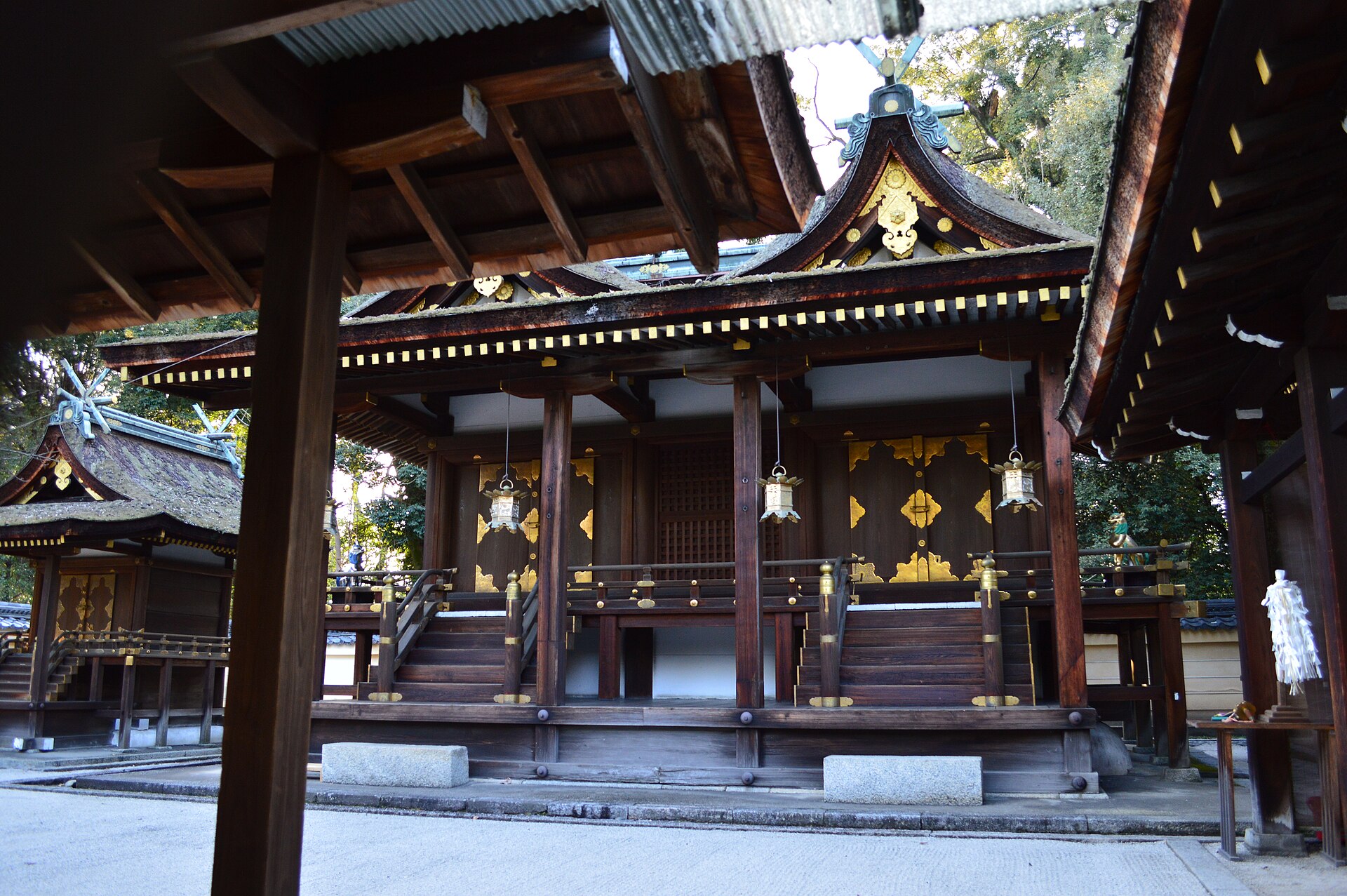
Hirano Shrine
- High · Heritage site
- Place of worship
Language · 11 published
Historic monument · Kyoto
金閣寺
Reviewed by Elena Voss · Roavina Travel Editor

| Monday | 09:00 – 17:00 |
|---|---|
| Tuesday | 09:00 – 17:00 |
| Wednesday | 09:00 – 17:00 |
| Thursday | 09:00 – 17:00 |
| Friday | 09:00 – 17:00 |
| Saturday | 09:00 – 17:00 |
| Sunday | 09:00 – 17:00 |
Checked 2026-08-31 · Source
Read from the OpenStreetMap access tags; anything not listed has no tag recorded.
Set the group type to family in the planner and the day window contracts to about three quarters of a solo day.
It was established in 1397. It is built of wood. It carries the part of UNESCO World Heritage Site heritage designation.
The temple everyone calls Kinkaku-ji is officially Rokuon-ji, a Rinzai Zen temple of the Shokoku-ji branch in the north-western corner of Kyoto. The popular name belongs to one building: the Shariden, a three-storey reliquary hall built to house relics of the Buddha, whose upper two floors are sheathed in gold leaf. The temple takes its official name from Rokuon, the Deer Park where Shakyamuni preached his first sermon, and from Rokuon-in, the posthumous name of the shogun who built the place. The land was a Kamakura-period villa of the aristocrat Saionji Kintsune, known as Kitayamadai. Yes. The principal pond viewpoint is reachable on a step-free compacted path and accessible toilets are available, but the full one-way garden route includes slopes, gravel and steps. Yes. JPY 500. No; it is viewed across the pond. No. Yes on the adapted route. Kinkakuji-michi. Open daily 09:00-17:00. Temple ceremonies, weather and maintenance can briefly alter access to parts of the garden circuit. Adult and high-school admission is JPY 500; primary and junior-high students pay JPY 300. The principal pond viewpoint is reachable on a step-free compacted path and accessible toilets are available, but the full one-way garden route includes slopes, gravel and steps. Kyoto City Bus stops Kinkakuji-michi beside the entrance; Kitaoji subway station connects by bus 204 or 205. Yes. JPY 500. No; it is viewed across the pond. No. Yes on the adapted route. Kinkakuji-michi. Open daily 09:00-17:00. Temple ceremonies, weather and maintenance can briefly alter access to parts of the garden circuit. Adult and high-school admission is JPY 500; primary and junior-high students pay JPY 300. The principal pond viewpoint is
Checked 2026-08-31 · Source
The grounds run to roughly 132,000 square metres, of which about 92,400 are the garden itself, a designated historic and scenic landmark. The route is a marked one-way circuit and you walk it in the order the temple sets, entering through the Somon main gate past the Kuri living quarters, whose Zen style is thought to date from 1492 to 1504, and the belfry, whose bell the Saionji family is said to have commissioned in the Kamakura period. JPY 500. Kyoto City Bus stops Kinkakuji-michi beside the entrance; Kitaoji subway station connects by bus 204 or 205.
Checked 2026-08-31 · Source
Allow about forty-five minutes on the grounds. The temple does not publish a suggested visit length, and the figure here is a judgement rather than a recorded fact, but the shape of the visit makes it a reliable one: the route is a single fixed loop of a few hundred metres with no rooms to enter, no galleries to work through and no way to double back once you have passed the pavilion. Most of that time goes to two places. No; it is viewed across the pond.
Checked 2026-08-31 · Source
Open daily 09:00-17:00. Temple ceremonies, weather and maintenance can briefly alter access to parts of the garden circuit. Kyoto City Bus stops Kinkakuji-michi beside the entrance; Kitaoji subway station connects by bus 204 or 205. The principal pond viewpoint is reachable on a step-free compacted path and accessible toilets are available, but the full one-way garden route includes slopes, gravel and steps.
Checked 2026-08-31 · Source
Adult and high-school admission is JPY 500; primary and junior-high students pay JPY 300. Open daily 09:00-17:00. Temple ceremonies, weather and maintenance can briefly alter access to parts of the garden circuit. The principal pond viewpoint is reachable on a step-free compacted path and accessible toilets are available, but the full one-way garden route includes slopes, gravel and steps.
Checked 2026-08-31 · Source
Kyoto City Bus stops Kinkakuji-michi beside the entrance; Kitaoji subway station connects by bus 204 or 205. The principal pond viewpoint is reachable on a step-free compacted path and accessible toilets are available, but the full one-way garden route includes slopes, gravel and steps. Open daily 09:00-17:00. Temple ceremonies, weather and maintenance can briefly alter access to parts of the garden circuit.
Checked 2026-08-31 · Source
The principal pond viewpoint is reachable on a step-free compacted path and accessible toilets are available, but the full one-way garden route includes slopes, gravel and steps. Yes. JPY 500. No; it is viewed across the pond. Historic surfaces, crowds and security remain relevant. Open daily 09:00-17:00. Temple ceremonies, weather and maintenance can briefly alter access to parts of the garden circuit.
Checked 2026-08-31 · Source
Almost every photograph of Kinkaku-ji is taken from the same forty metres of path on the south-east shore of the Kyoko-chi pond, because that is the only stretch where the pavilion, its reflection and the pine-covered slope behind it all line up. The consequence is a bottleneck. Arriving within twenty minutes of the 9:00 a.m. opening is the single most effective thing you can do, both for the space to stand and for the light, which at that hour comes over your shoulder onto the gold rather than into the lens. Adult and high-school admission is JPY 500; primary and junior-high students pay JPY 300.
Checked 2026-08-31 · Source
Yes.
JPY 500.
No; it is viewed across the pond.
No.
Yes on the adapted route.
Kinkakuji-michi.
Loading the interactive map…
The interactive map could not be loaded.
Last updated:
Source: OpenStreetMap contributors, Wikidata ·