
1 min walk · Stari Grad
Gallery "Zvono"
- High
- Art and culture venue
Museum · Stari Grad, Belgrade
Музеј позоришне уметности
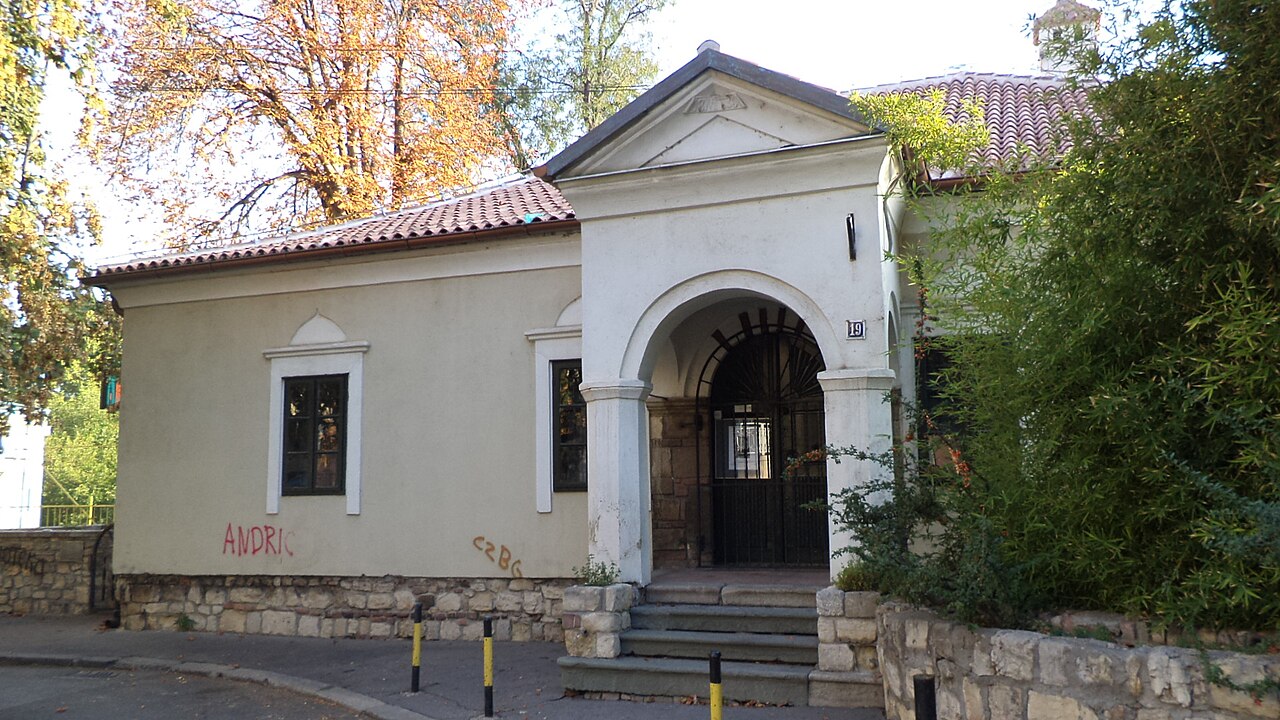
The Museum of Theatrical Arts of Serbia is a specialist Belgrade institution that preserves the country’s theatre memory through objects, images, documents, and recorded material. Its identity is tied to Božić House at Gospodar Jevremova 19, where the museum moved in September 1952, two years after its founding. This pairing of a national theatre collection with a protected historic house gives the visit a distinctive focus: the setting is not a neutral gallery shell, but part of the story. The museum suits travellers who want to understand how Serbian performance was created, staged, remembered, and studied across time.
Checked 2026-09-02 · Source
The holdings document theatrical life from several angles. Visitors may encounter theatre photographs, programmes and posters, archival records, art and memorial objects, audio and video recordings, bequests, a special library, and a press archive. Together, these materials show more than what appeared on stage: they preserve the visual language of productions, the work of performers and institutions, critical and administrative traces, and the personal memory attached to theatre. Since the museum works with documentary and memorial evidence as well as display objects, it rewards close looking and reading. It is particularly suitable for visitors interested in cultural history, performance, archives, or Serbian artists.
Checked 2026-09-02 · Source
Plan roughly 45 to 75 minutes for a focused museum visit. That range allows time to read labels, examine photographs and printed theatre material, and absorb the character of the historic house without turning the stop into a rushed checklist. The visit may take longer for travellers following a particular artist, institution, period, or exhibition theme. Research is a different use of the museum: the operator lists researcher access Monday to Friday from 10:00 to 14:00. Those hours describe research activity, not the ordinary visitor schedule, so allow additional time only when your purpose is archival work.
Checked 2026-09-02 · Source
For a standard visit, the operator lists Monday to Friday from 09:00 to 18:00 and Saturday from 09:00 to 14:00, with Sunday closed. A weekday morning is a sensible time for a calmer, more attentive visit and leaves room for another Stari Grad sight afterwards. Saturday works well when the museum is part of a compact central-city route, but its shorter opening window makes a late arrival less forgiving. Keep the separate researcher schedule in mind: Monday to Friday, 10:00 to 14:00, for people using the museum for research rather than ordinary sightseeing.
Checked 2026-09-02 · Source
General admission is free. The operator separately lists curated tours in English or French at 500 RSD per person. For groups of 10 to 30 visitors, a curated group tour costs 5,000 RSD and requires advance booking. In practical terms, an independent traveller can enter for the free general visit, while a language-specific guided experience carries a fee. Groups should arrange the tour before setting out, because the booking requirement means the 5,000 RSD option is not simply an automatic charge at the door. These are the operator’s stated admission and tour prices.
Checked 2026-09-02 · Source
The museum stands at Gospodar Jevremova 19 in Stari Grad, in Belgrade’s historic centre. Visitor guidance for the nearby Museum of Vuk and Dositej identifies Studentski park, Kralja Petra, Kalemegdan, and Trg Republike as useful access points for this part of Gospodar Jevremova. Studentski park is served by bus 31 and trolleybuses 19, 21, 22, 22L, 28, 29, and 41. Kralja Petra has bus 79 and trams 2, 5, and 10; Kalemegdan has tram 2. Trg Republike adds buses 24, 26, 27, 27E, 31, 32E, 35, 37, 43, 44, and 96, trolleybuses 19, 21, 22, 22L, 28, 29, and 41, plus minibuses E2 and E8. From any point, continue on foot through the old city streets.
Checked 2026-09-02 · Source
Božić House is a protected cultural monument built in 1836 for the merchant Miloje Božić, and its historic character shapes the stop. The museum presents thematic exhibitions rather than a permanent display, so the subject and arrangement can change between visits. Travellers looking for a particular artist, institution, or period should treat the current exhibition as the deciding factor in how much time to allow. Researchers should plan around the distinct weekday research hours of 10:00 to 14:00. The museum’s documentary material also calls for attentive, respectful behaviour around archival, memorial, and historically sensitive objects.
Checked 2026-09-02 · Source
The museum is a strong place to look at the visual evidence surrounding theatre: production photographs, programmes, posters, art and memorial objects, and audiovisual records each preserve a different layer of stage culture. The emphasis is not one famous view but the details that connect performers, institutions, productions, and periods. Because the museum has used thematic exhibitions rather than a permanent display since the late 1960s, the photographic opportunities and subjects depend on the current presentation. Photograph only where the exhibition permits it, and treat archival or sensitive material with the same care you would give any working collection.
Checked 2026-09-02 · Source
It was founded on 28 November 1950 by decree of the Ministry of Science and Culture of the Federal People’s Republic of Serbia.
It moved to the adapted Božić House at Gospodar Jevremova 19 in September 1952.
Božić House is a protected cultural monument built in 1836 for the merchant Miloje Božić.
Its collections include theatre photographs, programmes and posters, archives, art and memorial objects, audio and video recordings, bequests, a special library, and a press archive.
Since the late 1960s, it has used thematic exhibitions rather than a permanent display, covering artists, theatre institutions, historical periods, and related subjects.
Yes. Curated tours cost 500 RSD per person or 5,000 RSD for groups of 10–30 visitors, and advance booking is required.
Loading the interactive map…
The interactive map could not be loaded.
Last updated:
Source: OpenStreetMap contributors, Wikidata ·