
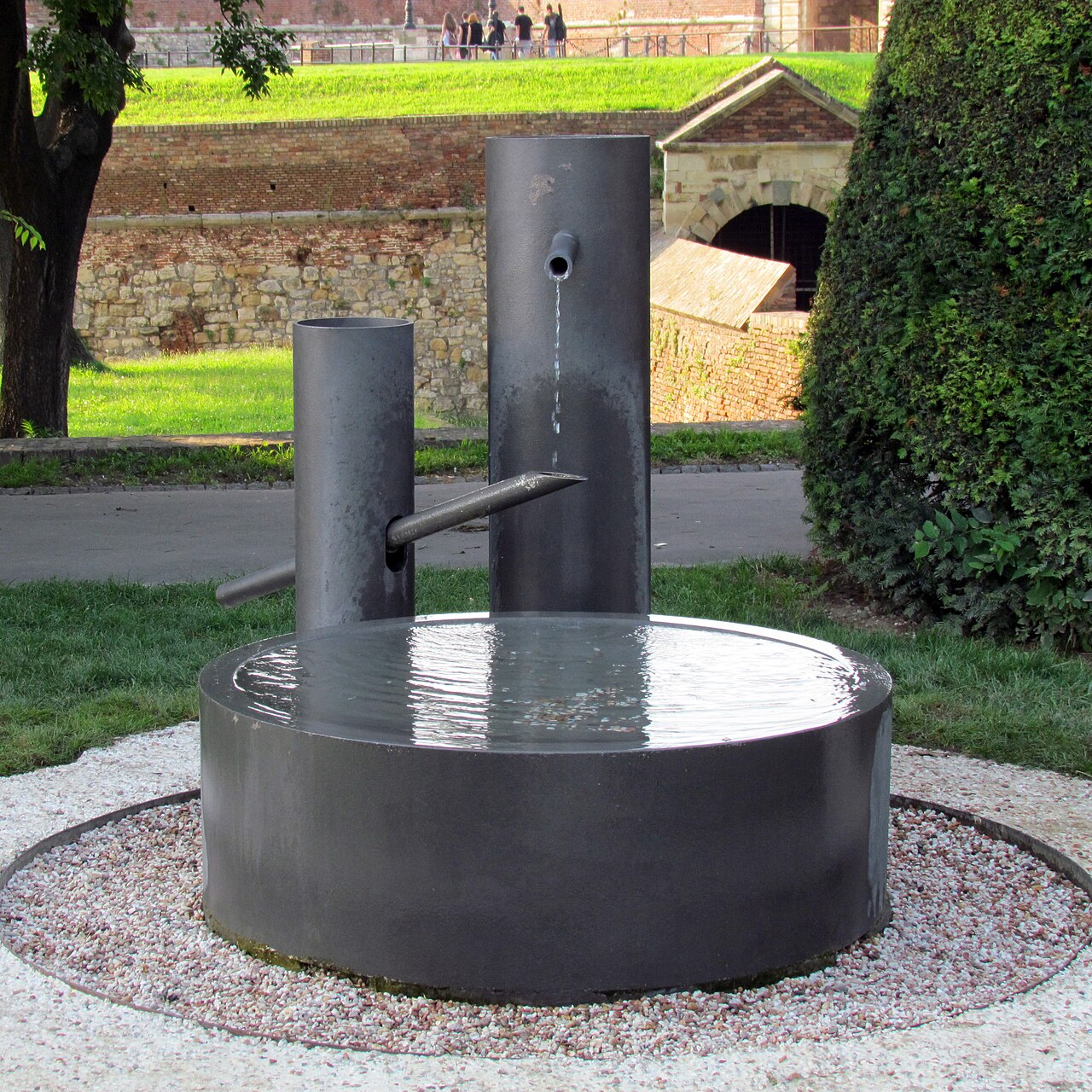
1 min walk · Stari Grad
Japanese Fountain
- High
- Art and culture venue

Historic monument · Stari Grad, Belgrade
Гробница народних хероја
The Tomb of National Heroes is a memorial in Kalemegdan Park at Belgrade Fortress. The public enterprise that manages the fortress dates the tomb to 1948. It contains the graves of Đura Đaković, Ivan Milutinović, Ivo Lola Ribar and Moša Pijade, identified by granite markers and portrait busts.
The first three names appear together in the operator’s account of the original memorial. Moša Pijade was buried there in 1957, creating the four-person composition seen today. The Belgrade City Assembly declared the tomb a cultural monument in 1983. This protected status applies to the specific memorial, while Belgrade Fortress and Kalemegdan Park form the larger historic complex around it.
Checked 2026-09-06 · Source
The memorial brings four graves and four sculpted portrait busts into one outdoor composition. Granite slabs mark the graves of Đura Đaković, Ivan Milutinović and Ivo Lola Ribar. The fortress operator says these slabs came from the construction site of the Church of Saint Sava.
Stevan Bodnarov made the busts of Đaković, Milutinović and Ribar in 1949. Moša Pijade’s grave and portrait were added later: he was buried here in 1957, and his bust is the work of Slavoljub Stanković. The different dates and sculptors are part of what the monument records. Read the names and dates on the memorial rather than treating the four portraits as a single work made at one time.
Checked 2026-09-06 · Source
The official monument page does not give a recommended visit duration for the Tomb of National Heroes. It records the memorial’s construction date, the people buried there, the origin of the granite slabs and the sculptors of the portrait busts, but it provides no timed route, guided-tour length or suggested stay.
Use those documented features to plan a self-paced stop: read the four names, compare the portrait busts and examine the granite markers. Decide the duration on site rather than presenting an invented operator recommendation. The source records no minimum visit, fixed interval, booking slot or scheduled interpretation for this memorial.
Checked 2026-09-06 · Source
No monument-specific opening hours are published for the Tomb of National Heroes. The operator’s visitor page gives seasonal timetables and last-entry times for named enclosed facilities at Belgrade Fortress, including the Clock Tower, Roman Well and Military Bunker, but it does not include this memorial in that schedule. Those facility hours must not be copied onto the tomb.
Check the official Belgrade Fortress website for current notices before travelling, particularly when an event or maintenance project may affect movement through the complex. Choose a time when you can read an outdoor monument comfortably, but treat weather and daylight as personal planning factors rather than published access conditions. No weekly closure day or last-entry time is recorded for this exact sight.
Checked 2026-09-06 · Source
The operator does not publish a separate admission price, ticket type or booking process for the Tomb of National Heroes. Its current visitor page lists individual and combined prices for several named fortress facilities, but the tomb is not one of the ticketed attractions in that table. This absence does not by itself prove a permanent free-admission policy.
Do not buy a ticket intended for the Roman Well, Clock Tower, Military Bunker, Big Gunpowder Magazine, Nebojša Tower or casemates on the assumption that it controls access to the memorial. If a temporary programme changes access around Kalemegdan Park, rely on the operator’s current notice. No concession category, reservation requirement, ticket desk or payment method is recorded for this exact monument.
Checked 2026-09-06 · Source
Use the official Belgrade Fortress interactive map to locate the Tomb of National Heroes within Kalemegdan Park. The map’s Park Sights layer names the memorial and plots it alongside the Bandstand and Sava Promenade. Selecting the tomb marker opens an operator description that identifies the monument and dates its construction to 1948.
Use that live marker as the destination and confirm the final approach against the map. The recorded map does not provide a street number, named gate, public-transport line, parking instruction or step-free route for this sight, so plan those parts separately with current official visitor information rather than inventing directions from the administrative address.
Checked 2026-09-06 · Source
Treat the tomb as a protected cultural monument, not as street furniture or a neutral backdrop. The Belgrade City Assembly declared it a cultural monument in 1983. After graffiti was placed on it in 2020, the fortress operator issued a public appeal asking visitors not to desecrate monuments or damage Belgrade’s cultural heritage.
Do not write on, climb on, attach objects to or otherwise interfere with the granite markers and portrait busts. Keep the names of the four people and the memorial’s political-historical context in view when visiting. The operator page does not publish a dress code, staffed interpretation schedule, baggage rule, accessibility specification or safety warning for this exact sight. Follow any current barriers, notices and staff directions encountered within the fortress complex.
Checked 2026-09-06 · Source
The fortress operator’s preservation appeal asks visitors not to desecrate monuments or destroy Belgrade’s cultural heritage. It reports graffiti on the Tomb of National Heroes, identifies the tomb as a protected cultural monument and names the sculptors responsible for its four portrait busts. Any photography at the memorial must respect that published preservation request and leave the monument untouched.
The recorded appeal does not set out rules for flash, tripods, commercial photography, drones or staged shoots. Do not turn the absence of those details into blanket permission. Check current signs at the monument and follow any barriers or staff directions encountered there, while keeping cameras and other equipment away from the protected fabric of the tomb.
Checked 2026-09-06 · Source
It is a 1948 memorial in Kalemegdan Park containing the graves and portrait busts of Đura Đaković, Ivan Milutinović, Ivo Lola Ribar and Moša Pijade.
The memorial contains the graves of Đura Đaković, Ivan Milutinović, Ivo Lola Ribar and Moša Pijade. The first three belong to the 1948 memorial; Pijade was buried there in 1957.
Stevan Bodnarov made the busts of Đaković, Milutinović and Ribar in 1949. Slavoljub Stanković made the bust of Moša Pijade, who was buried at the memorial in 1957.
Yes. The Belgrade City Assembly declared the tomb a cultural monument in 1983. The fortress operator asks visitors not to deface monuments or damage the city’s cultural heritage.
The Belgrade Fortress operator does not publish monument-specific opening hours or a last-entry time for the tomb. Its seasonal facility schedule does not list this memorial, so check current official notices before visiting.
The operator publishes no separate price or ticket process for this memorial. Its current price table covers named fortress facilities but not the tomb, so no admission amount is recorded.
Loading the interactive map…
The interactive map could not be loaded.
Last updated:
Source: OpenStreetMap contributors, Wikidata ·