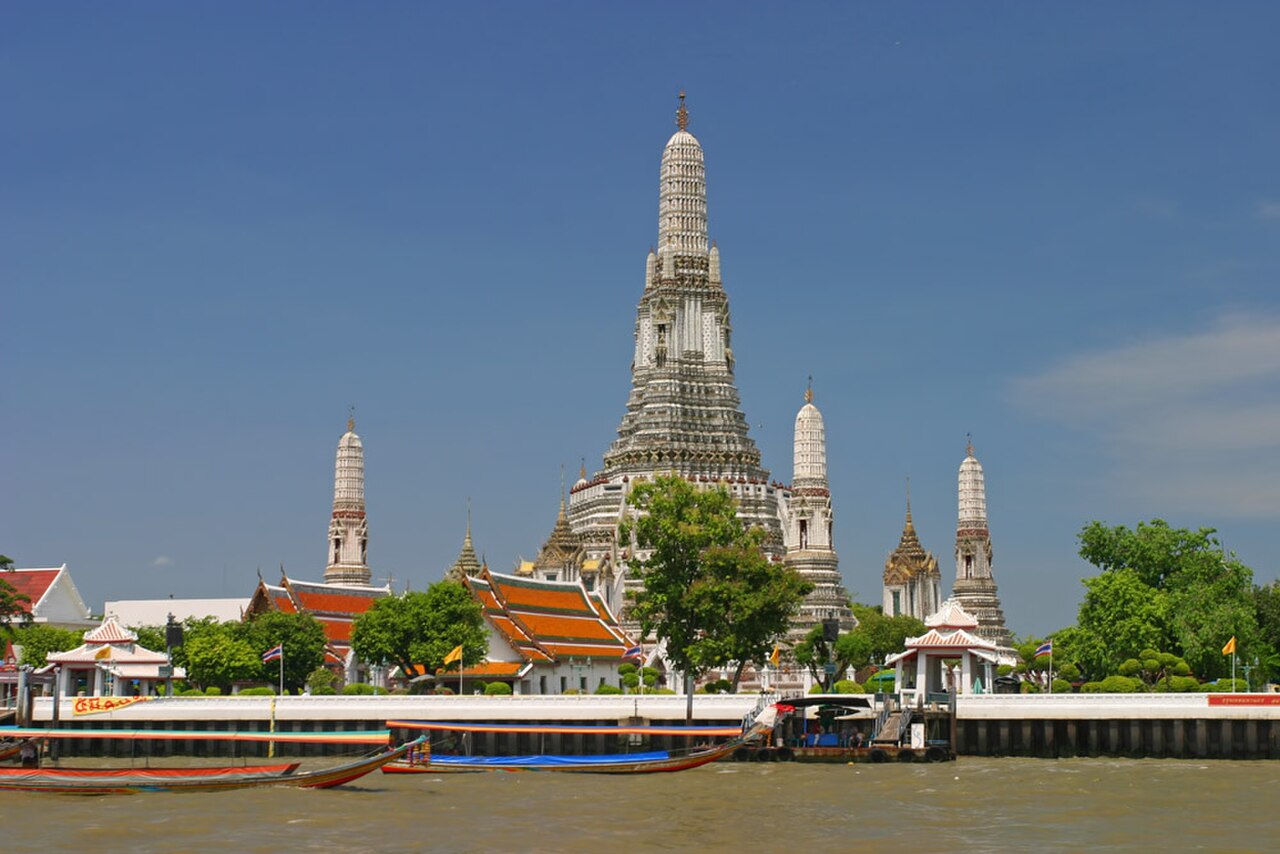
Wat Arun is a Buddhist temple on Bangkok’s Thonburi bank, beside the Chao Phraya River. Its best-known feature is the central prang, a tall tower decorated with porcelain and surrounded by four smaller prangs. The temple’s position gives it a close relationship with the river crossing and the historic city on the opposite bank. Wat Arun also contains an ordination hall and other religious spaces, so the visit is a temple-complex experience rather than a single monument. Its history reaches back to Thonburi, the capital that preceded modern Bangkok, and the Emerald Buddha was once kept here. Visitors should remember that Wat Arun remains an active religious site and dress accordingly.
The central prang is the main focus. It rises from a square terrace whose corners are marked by smaller prangs, while porcelain pieces create detailed floral and geometric surfaces across the tower. Sculpted demon and monkey figures support the tiers and become easier to understand from close range than from the opposite riverbank. Steep stairs lead towards an upper gallery, where visitors can look across the Chao Phraya and Bangkok’s historic core. The compound also includes an ordination hall and river-facing areas worth seeing after the prang. The tower route is physically demanding, and visitors who cannot manage steep stairs may need to remain on the lower paths.
Allow about 60 to 90 minutes for Wat Arun. A brief visit can cover the central terrace, the lower porcelain decoration, and the river outlook, but the steep stair route, pauses on narrow landings, and the ordination hall make a rushed stop unsatisfying. Extra time is useful if you want to examine the ceramic surfaces closely or wait for space on the terrace when groups arrive. The climb is slower than the compact layout suggests because people use the stairs in both directions.
The supplied public schedule records Wat Arun as open daily from 08:00 to 18:00, with no regular weekly closure day listed. Arriving near opening is practical for visitors who want cooler conditions on the stair route and more room around the central terrace. Late afternoon offers softer light on the porcelain, but leave enough time to enter and finish the visit before 18:00. Wat Arun is an active temple, so worship, ceremonies, or temporary on-site arrangements may affect how visitors move through the compound even when the normal daily schedule applies. Wear clothing that covers the shoulders and knees, and be ready to follow instructions around religious areas.
Treat that amount as the entrance charge for the visitor areas described here, and keep it separate from the small ferry fare across the Chao Phraya. No verified operator tariff was supplied for children, concessions, guided visits, or other categories, so those prices are not stated. Admission does not mean the full compound is step-free: the central prang terraces are reached by steep stairs. Wat Arun is a functioning Buddhist temple, so visitors should dress respectfully and follow any instructions concerning prayer spaces or temporarily restricted areas. Carry Thai baht or confirm accepted payment methods at the entrance before travelling.
The most distinctive route is the cross-river ferry from Tha Tien Pier on the Rattanakosin bank, immediately west of Wat Pho. The crossing takes about three minutes, runs back and forth continuously through the day, and lands at Wat Arun’s own gate for a fare of a few baht. Chao Phraya Express Boat services also call at Wat Arun Pier. The nearest MRT stop is Itsaraphap station, BL32, on the Blue Line. Itsaraphap has elevators and rampways at exits 1 and 2. Even with an accessible MRT arrival, the temple’s central prang route remains limited because of its steep stairs.
The central prang stairs require particular care, especially on the descent. The supplied temple guide advises caution when going down and assistance for older visitors. Expect visitors to move in both directions, and avoid stopping on landings while taking photographs. Wet conditions can make the stair surfaces more difficult, so secure footwear is sensible. The lifts and rampways at Itsaraphap MRT exits 1 and 2 improve access to the station, but they do not make Wat Arun’s compound or upper prang terraces step-free. Cover shoulders and knees, avoid sleeveless tops and shorts, and follow staff directions if worship or a ceremony changes access to an area.
Photograph Wat Arun from both sides of the river. From the Rattanakosin bank or the ferry, the full central prang reads as a vertical silhouette and the temple’s river setting becomes part of the image. Inside the compound, move closer to capture the porcelain fragments, patterned surfaces, and sculpted figures that disappear at distance. The four smaller corner prangs help frame the central tower from the lower terrace. The upper stair route is narrow and active, so stop only where other visitors can pass safely. Late-afternoon light can bring out the surface patterns, but photography should remain secondary to worship, staff instructions, and safe movement on the stairs.
Nothing non-essential is set before you choose, in regions where consent is required. If you decline, ads still appear and analytics is switched off entirely.