.jpg)

4 min walk
Wat Chiang Yuen
- Must see · Heritage site
- Place of worship
Place of worship · Chiang Mai
วัดเชียงมั่น
| Monday | 06:00 – 17:00 |
|---|---|
| Tuesday | 06:00 – 17:00 |
| Wednesday | 06:00 – 17:00 |
| Thursday | 06:00 – 17:00 |
| Friday | 06:00 – 17:00 |
| Saturday | 06:00 – 17:00 |
| Sunday | 06:00 – 17:00 |
Checked 2026-08-31 · Source
| Per person | Free entry |
|---|
Checked 2026-08-31 · Source
Read from the OpenStreetMap access tags; anything not listed has no tag recorded.
Set the group type to family in the planner and the day window contracts to about three quarters of a solo day.
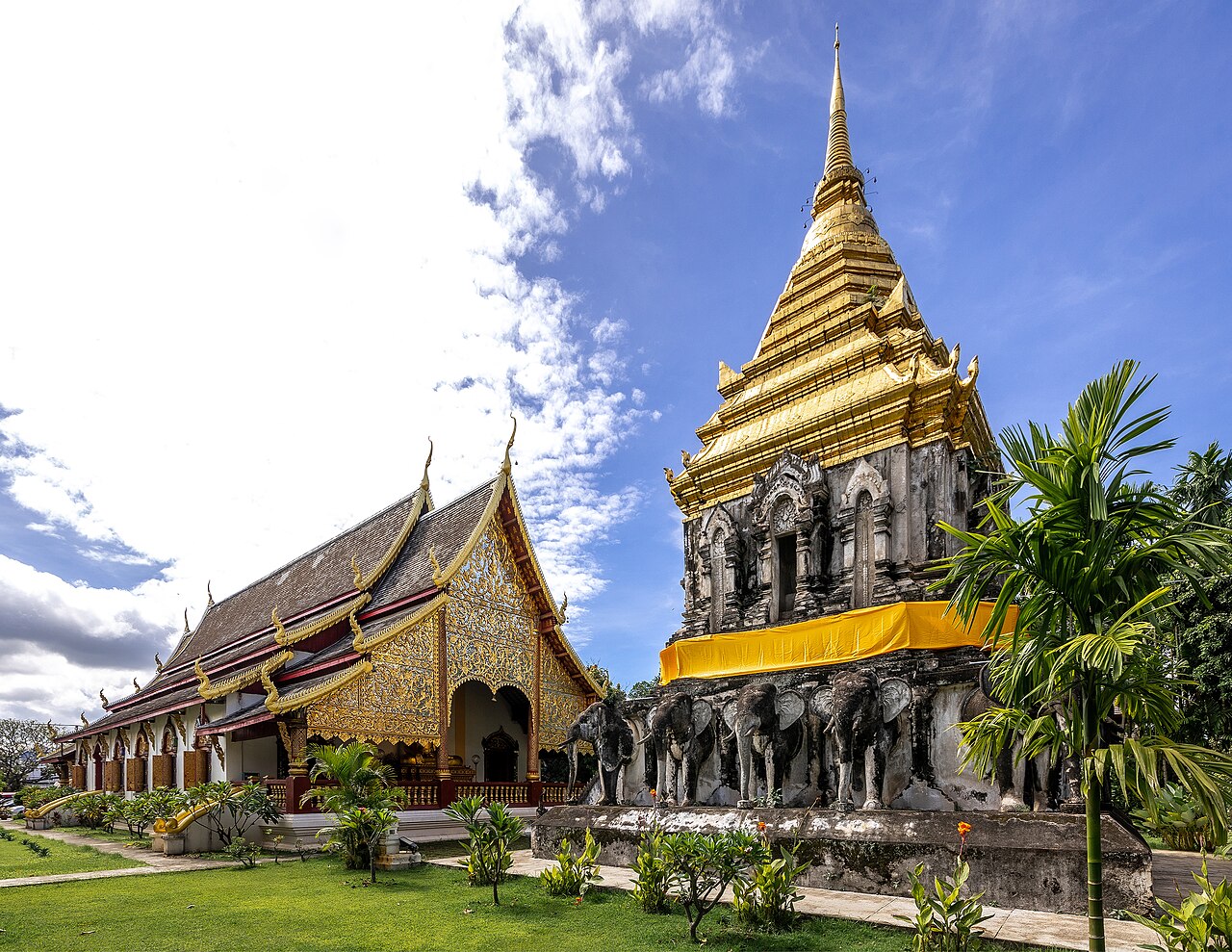
Wat Chiang Man is a Buddhist temple in Chiang Mai, northern Thailand. It holds significance as reputedly the oldest temple in the city, founded during the establishment of Chiang Mai as the capital of the Lanna Kingdom. The temple complex contains historical religious structures and serves as an active place of worship. Its age and foundational status make it a point of interest for visitors seeking to understand the early religious and architectural heritage of Chiang Mai. Daily 06:00–17:00. The Tourism Authority of Thailand lists the temple as open every day, with no regular weekly closure day.
Checked 2026-08-31 · Source
The temple grounds contain several notable structures. These include a chedi supported by elephant-shaped buttresses, a characteristic architectural feature. There are multiple viharns housing Buddha images. The temple preserves ancient artifacts including crystal and marble Buddha statues of religious significance. Decorative elements and traditional Lanna-style architecture are present throughout the compound. The spatial arrangement follows typical Thai temple layout with sacred buildings oriented according to religious convention. Visitors can observe both exterior architectural details and interior religious imagery. The Tourism Authority of Thailand lists the temple as open every day, with no regular weekly closure day.
Checked 2026-08-31 · Source
A visit to Wat Chiang Man typically requires between thirty minutes and one hour for a general walkthrough of the main structures. Visitors with particular interest in Buddhist art, architecture, or photography may choose to spend additional time examining details. The compact nature of the temple grounds allows for efficient viewing. Those combining this temple with other nearby religious sites in the old city area might allocate half a day for multiple locations. Free general admission. A flat-surface path permits wheelchair circulation around Wihan Luang, Chedi Chang Lom and the chapel exterior.
Checked 2026-08-31 · Source
Visitors should verify current access times before planning their visit. Early morning hours generally offer cooler temperatures and fewer visitors at temples in Chiang Mai. Midday brings stronger sunlight and increased heat. The dry season from November to February typically provides more comfortable conditions for outdoor temple exploration. Rainy season months may present intermittent precipitation. Daily 06:00–17:00. RTC Chiang Mai City Bus routes R3 Red and R3 Yellow both serve Chang Phuak Gate. From there, continue into the Old City to 171 Ratchapakhinai Road. The Tourism Authority of Thailand also places the temple about 1 km north of Tha Phae Gate, approximately five minutes by car.
Checked 2026-08-31 · Source
Many Buddhist temples in Thailand do not charge formal admission fees, though some request voluntary donations for maintenance. Visitors should carry small denomination currency for potential contribution boxes. Some temples may implement modest fees for foreign visitors. Current pricing structures should be verified on arrival or through official channels. Donations directly support temple upkeep and religious activities. Free general admission. A flat-surface path permits wheelchair circulation around Wihan Luang, Chedi Chang Lom and the chapel exterior. Wihan Luang is not step-free: the documented entrance has stairs only, preventing wheelchair access to the Buddha images inside.
Checked 2026-08-31 · Source
Wat Chiang Man sits within Chiang Mai's old city moat area in the northeastern section. The temple is accessible by foot from many central accommodations. Songthaew shared trucks and tuk-tuk three-wheeled vehicles serve as common local transport options. Bicycle and motorbike rental provides independent mobility. RTC Chiang Mai City Bus routes R3 Red and R3 Yellow both serve Chang Phuak Gate. From there, continue into the Old City to 171 Ratchapakhinai Road. The Tourism Authority of Thailand also places the temple about 1 km north of Tha Phae Gate, approximately five minutes by car.
Checked 2026-08-31 · Source
Visitors must dress modestly covering shoulders and knees as required at Thai Buddhist temples. Shoes must be removed before entering any viharn or sacred building interior. Respectful quiet behavior is expected near worshippers and monks. Photography restrictions may apply in certain interior spaces. Watch for uneven surfaces and steps around ancient structures. Sun exposure is significant during midday hours. A flat-surface path permits wheelchair circulation around Wihan Luang, Chedi Chang Lom and the chapel exterior. It remains an active Theravada Buddhist monastery with six resident monks and is officially registered as a national ancient monument.
Checked 2026-08-31 · Source
The elephant-buttressed chedi provides distinctive architectural photography subjects. Exterior shots of temple buildings work well in morning and late afternoon light. Interior photography requires awareness of restrictions and worshipper privacy. Flash use is generally inappropriate in sacred spaces. The contrast of ancient structures against tropical vegetation offers compositional opportunities. Respectful distance from religious ceremonies and individuals in prayer is essential. Tripods may attract attention or restrictions. The compact site allows varied angles without extensive movement. Patience rewards capture of uncrowded moments. King Mangrai used the site as his residence while Chiang Mai was being built, then established the temple there after the city’s completion.
Checked 2026-08-31 · Source
It remains an active Theravada Buddhist monastery with six resident monks and is officially registered as a national ancient monument.
King Mangrai used the site as his residence while Chiang Mai was being built, then established the temple there after the city’s completion.
The temple’s recorded history links its establishment to King Mangrai’s founding of Chiang Mai in 1296.
The compound includes a chedi, Ho Trai scripture library, vihara assembly hall, ubosot ordination hall, pavilion and pond.
Its base is decorated with 15 half-elephant figures around the sides and an additional elephant at each corner.
The temple houses Phra Kaew Khao, also called Phra Sae Tang Khamani, a white crystal Buddha, and Phra Sila, a stone Buddha image.
Loading the interactive map…
The interactive map could not be loaded.
Last updated:
Source: OpenStreetMap contributors, Wikidata ·