
3 min walk
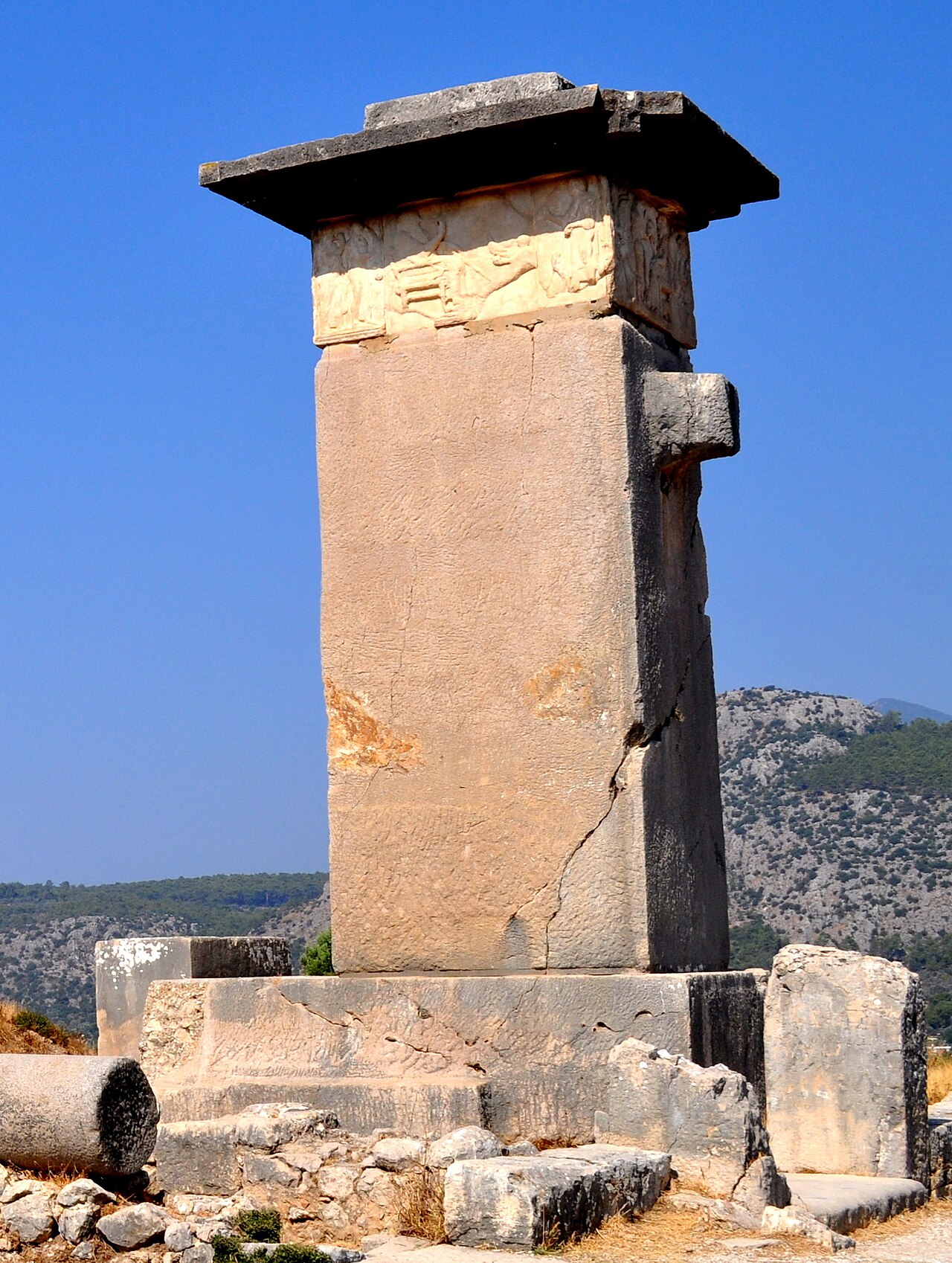
Harpy Tomb
- Notable
- Historic monument
Language · 11 published
Historic monument · Antalya
Reviewed by Elena Voss · Roavina Travel Editor
| Monday | 08:00 – 20:00 |
|---|---|
| Tuesday | 08:00 – 20:00 |
| Wednesday | 08:00 – 20:00 |
| Thursday | 08:00 – 20:00 |
| Friday | 08:00 – 20:00 |
| Saturday | 08:00 – 20:00 |
| Sunday | 08:00 – 20:00 |
Checked 2026-08-31 · Source
Read from the OpenStreetMap access tags; anything not listed has no tag recorded.
Set the group type to family in the planner and the day window contracts to about three quarters of a solo day.
This place is a Attraction. It carries the part of UNESCO World Heritage Site heritage designation.
Xanthos was the capital of ancient Lycia, and what survives of it stands on two hills above the plain of the Eşen Çayı, the river the Greeks called the Xanthos, in the village of Kınık in Antalya province. UNESCO inscribed it in 1988 as one serial property together with Letoon, its sanctuary downstream in Muğla province: dossier 484, criteria (ii) and (iii), 126.4 hectares of protected property with a 63.4 hectare buffer zone. Xanthos is not a reconstructed showpiece.
Checked 2026-08-31 · Source
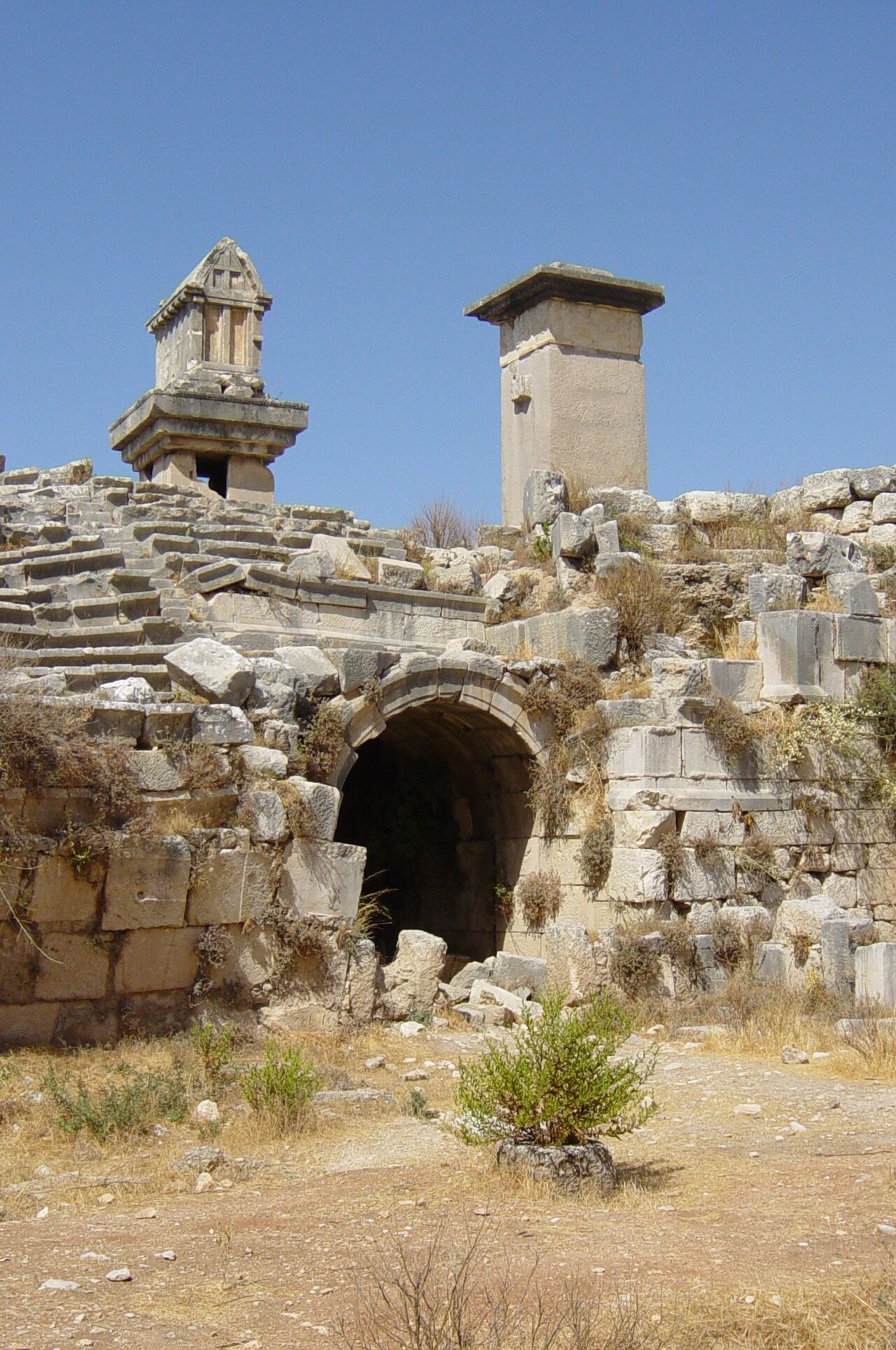
The set piece is the Roman theatre, which sits above the Roman agora with two Lycian funerary pillars standing immediately beside it, so that six centuries of building appear in a single view. One of those pillars carried the Harpy Monument, whose reliefs of human and bird-bodied figures were shipped to England in the nineteenth century along with the Tomb of Payava and the Nereid Monument; what stands here is the pillar and its casts. No weekly closure day is listed. The ticket office closes 30 minutes before the site.
Checked 2026-08-31 · Source
Neither the Ministry's page for Xanthos nor the UNESCO listing publishes a suggested visit length, so the figure recorded here, ninety minutes, is this guide's own judgement rather than an operator statement. It is built from the shape of the ground. Ninety minutes lets you cross the road to the second zone, walk the lower town past the agora and the Byzantine churches, and reach the Arch of Vespasian without hurrying. The variable is footing, not distance. Foreign adult/general admission: €3. Turkish citizens may enter with Müzekart.
Checked 2026-08-31 · Source
The Ministry's page for Xanthos, read on 26 August 2026, gives one schedule and no seasonal split: opening at 08.00, closing at 20.00, ticket office closing at 19.30, and closed days recorded as open every day. Within the day, go early or go late. Xanthos has almost no shade. Open daily. Special 2026 summer hours, 1 May–1 October: 08:00–20:00. Published regular hours: 1 April–31 October 08:30–19:00; 1 November–31 March 08:30–17:30. The special 2026 hours supersede the regular schedule through 1 October.
Checked 2026-08-31 · Source
The Ministry's own price list for museums and archaeological sites, published by DÖSİMM and read on 26 August 2026, records Xanthos at three euros for foreign visitors, charged per person. Holders of a Turkish identity card enter on the Müzekart rather than paying that fare, which the same list states explicitly for this site. Foreign adult/general admission: €3. Turkish citizens may enter with Müzekart. The official site description places Xanthos across two hills and identifies two separate acropolises. The theatre occupies a hillside, and its seating is divided by stairways; a fully step-free circuit through the ruins is therefore not possible.
Checked 2026-08-31 · Source
The Ministry gives the address as Kınık Mahallesi, Fethiye Karayolu, with a single telephone number, 0242 845 47 99, and publishes nothing else about how to arrive: no parking note, no bus guidance and no shuttle. The Ministry of Culture and Tourism lists access by Kaş–Fethiye buses. Use the Kınık/Xanthos stop for the archaeological site at Xanthos Antik Kenti, Kınık Mahallesi, Kaş, Antalya. The site is approximately 45 km from Kaş and 46 km from Fethiye. The theatre occupies a hillside, and its seating is divided by stairways; a fully step-free circuit through the ruins is therefore not possible.
Checked 2026-08-31 · Source
The road is the first thing. It carries real traffic at real speed through the middle of a World Heritage site, the two halves of Xanthos are on opposite sides of it, and crossing between them is done on foot with no signalled crossing. Take that seriously with children. The third is footing. The fourth is expectation. The official site description places Xanthos across two hills and identifies two separate acropolises. The official visitor listing identifies parking, toilets, a café and a shop. Xanthos is open 08:00–20:00 under the special 1 May–1 October 2026 schedule; the ticket office closes at 19:30.
Checked 2026-08-31 · Source
The photograph that only Xanthos gives you is the Roman theatre with the two Lycian pillar tombs standing at its edge, because it puts a fifth-century BC funerary form and a Roman auditorium in one frame with nothing modern between them. Work it early. By midday the same stone reads as flat white and the pictures are worthless. The Arch of Vespasian at the southern end works better in the shade of the day's end than at noon. Xanthos is open 08:00–20:00 under the special 1 May–1 October 2026 schedule; the ticket office closes at 19:30.
Checked 2026-08-31 · Source
Xanthos is open 08:00–20:00 under the special 1 May–1 October 2026 schedule; the ticket office closes at 19:30.
Foreign adult/general admission is €3. Turkish citizens may enter with Müzekart.
Yes. The Ministry of Culture and Tourism identifies the Kaş–Fethiye bus service as the public-transport route to Xanthos at Kınık.
Yes. Xanthos and Letoon were jointly inscribed in 1988 as UNESCO World Heritage property number 484.
Letoon is approximately 4 km from Xanthos.
The site includes two acropolises, a Roman theatre and agora, the Harpy Monument, the Lycian Sarcophagus, the Inscribed Pillar, a colonnaded street, Byzantine basilicas and roughly 2 km of fortification walls.
Loading the interactive map…
The interactive map could not be loaded.

Last updated:
Source: OpenStreetMap contributors, Wikidata ·