.JPG)
2 min walk
Kaleici Museum
- Must see
- Museum
Language · 11 published
Historic monument · Antalya
Hadrian Kapısı
Reviewed by Elena Voss · Roavina Travel Editor
| Monday | 00:00 – 23:59 |
|---|---|
| Tuesday | 00:00 – 23:59 |
| Wednesday | 00:00 – 23:59 |
| Thursday | 00:00 – 23:59 |
| Friday | 00:00 – 23:59 |
| Saturday | 00:00 – 23:59 |
| Sunday | 00:00 – 23:59 |
Checked 2026-08-31 · Source
Read from the OpenStreetMap access tags; anything not listed has no tag recorded.
Set the group type to family in the planner and the day window contracts to about three quarters of a solo day.
This place is a Monument.
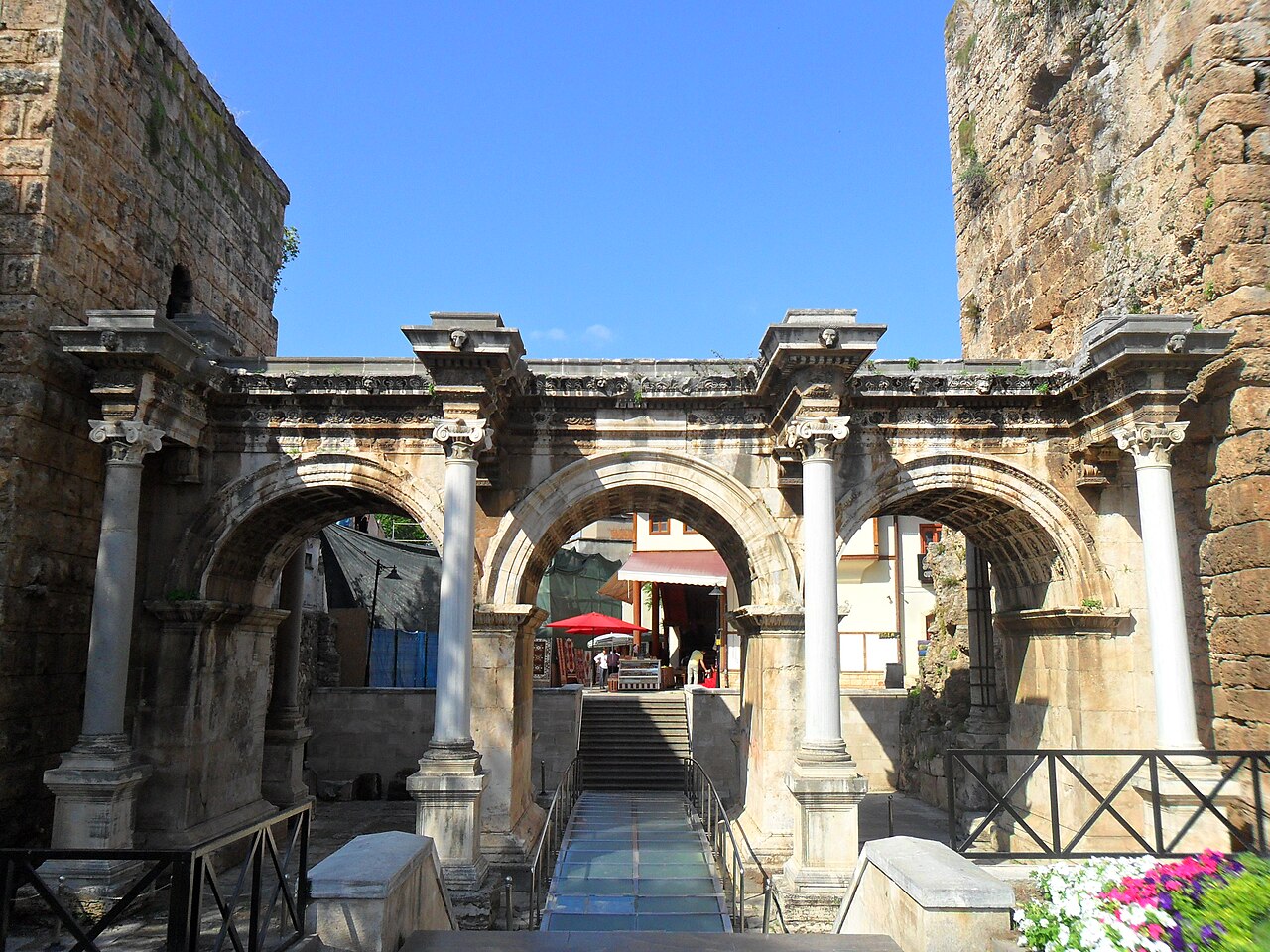
Hadrian's Gate is a triumphal arch in Antalya's Kaleiçi district, built to commemorate the visit of Roman Emperor Hadrian to the city in 130 CE. The structure features three arched gateways with decorative marble columns and intricate reliefs. It stands as one of the most preserved Roman monuments in the region, marking the former boundary between the ancient city and its outskirts. The gate has undergone various restorations over centuries while maintaining its historical character. Open daily, 24 hours. Hadrian's Gate is an outdoor public passage on Antalya Metropolitan Municipality's Kaleiçi walking routes. There are no weekly, seasonal or public-holiday closure days.
Checked 2026-08-31 · Source
The monument consists of three archways formed by four pylons with Corinthian-style columns. Two towers flank the structure, with the southern tower dating from Roman times and the northern tower rebuilt during Seljuk period. The upper sections contain decorative friezes and inscriptions. Visitors can walk through the central and side passages. The surrounding Kaleiçi old town contains narrow streets, Ottoman-era houses, small shops, and restaurants extending from this historical threshold into the ancient city interior. Hadrian's Gate is an outdoor public passage on Antalya Metropolitan Municipality's Kaleiçi walking routes. There are no weekly, seasonal or public-holiday closure days.
Checked 2026-08-31 · Source
A visit to Hadrian's Gate itself requires approximately fifteen to thirty minutes for observation and photography. Most visitors combine this stop with exploration of the broader Kaleiçi district, extending the total experience to two or three hours. The gate functions primarily as a passage point rather than an enclosed attraction. There are no interior rooms or exhibitions requiring extended time. The surrounding neighborhood rewards wandering, with numerous historical buildings and viewpoints accessible on foot from this central landmark location. Free public access; no ticket, reservation or general-admission charge.
Checked 2026-08-31 · Source
Antalya experiences hot Mediterranean summers and mild winters. Spring and autumn months generally offer comfortable temperatures for walking and outdoor photography. Summer visits may be preferable during early morning or evening hours due to heat intensity. The gate remains visible at all hours as an open-air street-level monument. Open daily, 24 hours. Take Antalya's Nostalji Tramvayı to the named Üçkapılar stop. The gate stands beside Atatürk Caddesi at the entrance to Kaleiçi; approach from the tram stop along the pavement. Inside Kaleiçi, Hesapçı Street continues from the gate toward Hıdırlık Tower.
Checked 2026-08-31 · Source
Hadrian's Gate is situated within a public street and accessible without admission charge. No ticketing infrastructure is present at the site. Visitors should anticipate no direct costs for viewing or passing through the monument itself. Nearby museums and some historical buildings within Kaleiçi may maintain separate fee structures. Free public access; no ticket, reservation or general-admission charge. The exterior can be viewed from the modern street-level pavement beside Atatürk Caddesi. The passage beneath the arches is below modern street level and reached by steps, so it is not wheelchair accessible.
Checked 2026-08-31 · Source
The gate stands at the intersection of Atatürk Boulevard and the entrance to Kaleiçi old town in central Antalya. Public buses serve the surrounding city center with stops within walking distance. The tram system provides access to nearby stations. Taxis and ride services operate throughout the area. Take Antalya's Nostalji Tramvayı to the named Üçkapılar stop. The gate stands beside Atatürk Caddesi at the entrance to Kaleiçi; approach from the tram stop along the pavement. Inside Kaleiçi, Hesapçı Street continues from the gate toward Hıdırlık Tower. The passage beneath the arches is below modern street level and reached by steps, so it is not wheelchair accessible.
Checked 2026-08-31 · Source
The structure integrates with active vehicle and pedestrian traffic, requiring awareness when photographing or pausing in archways. Cobblestone surfaces in surrounding streets present slip hazards, particularly when wet. Summer heat demands hydration and sun protection. The area attracts numerous visitors, creating congestion during peak periods. Street vendors and restaurant touts operate in the vicinity with varying degrees of persistence. The exterior can be viewed from the modern street-level pavement beside Atatürk Caddesi. Sections of original stone paving and historic wheel ruts create an uneven walking surface. The monumental gate was erected in honour of Roman emperor Hadrian's visit to Attaleia in AD 130.
Checked 2026-08-31 · Source
The gate offers strong frontal symmetry for composition, best captured during morning or late afternoon for favorable natural lighting. The contrast between ancient marble and surrounding vegetation creates visual interest. Night photography may benefit from artificial illumination on the structure. Wide-angle lenses accommodate the full height within confined street space. Including human figures provides scale reference against monumental dimensions. The archway frames views into Kaleiçi streets for layered compositions. Tripod use may obstruct pedestrian flow and should be exercised with consideration. The monumental gate was erected in honour of Roman emperor Hadrian's visit to Attaleia in AD 130.
Checked 2026-08-31 · Source
The monumental gate was erected in honour of Roman emperor Hadrian's visit to Attaleia in AD 130.
Üç Kapılar means “Three Gates,” referring to the monument's three arched passages.
It was Attaleia's eastern monumental entrance, opening toward the routes to Perge, Aspendos and Side; it was designed primarily as a ceremonial structure rather than a defensive gate.
No. Although older reconstructions depicted two levels, later technical study of the surviving blocks concluded that the arch was originally single-storeyed.
Mahmut Akok directed excavations and restoration during the 1960s, after which the gate acquired its present appearance.
The southern tower beside the gate was commissioned by Julia Sancta and is dated by its inscription; the surrounding fortifications were altered repeatedly in later Byzantine, Seljuk and Ottoman periods.
Loading the interactive map…
The interactive map could not be loaded.

Last updated:
Source: OpenStreetMap contributors, Wikidata ·