.JPG)
1 min walk · Wieden
Karol Szymanowski
- High
- Historic monument
Language · 11 published
Historic monument · Wieden, Vienna
Reviewed by Elena Voss · Roavina Travel Editor
| Monday | 09:00 – 18:00 |
|---|---|
| Tuesday | 09:00 – 18:00 |
| Wednesday | 09:00 – 18:00 |
| Thursday | 09:00 – 18:00 |
| Friday | 09:00 – 18:00 |
| Saturday | 09:00 – 18:00 |
| Sunday | 11:45 – 19:15 |
Checked 2026-08-31 · Source
Read from the OpenStreetMap access tags; anything not listed has no tag recorded.
Set the group type to family in the planner and the day window contracts to about three quarters of a solo day.
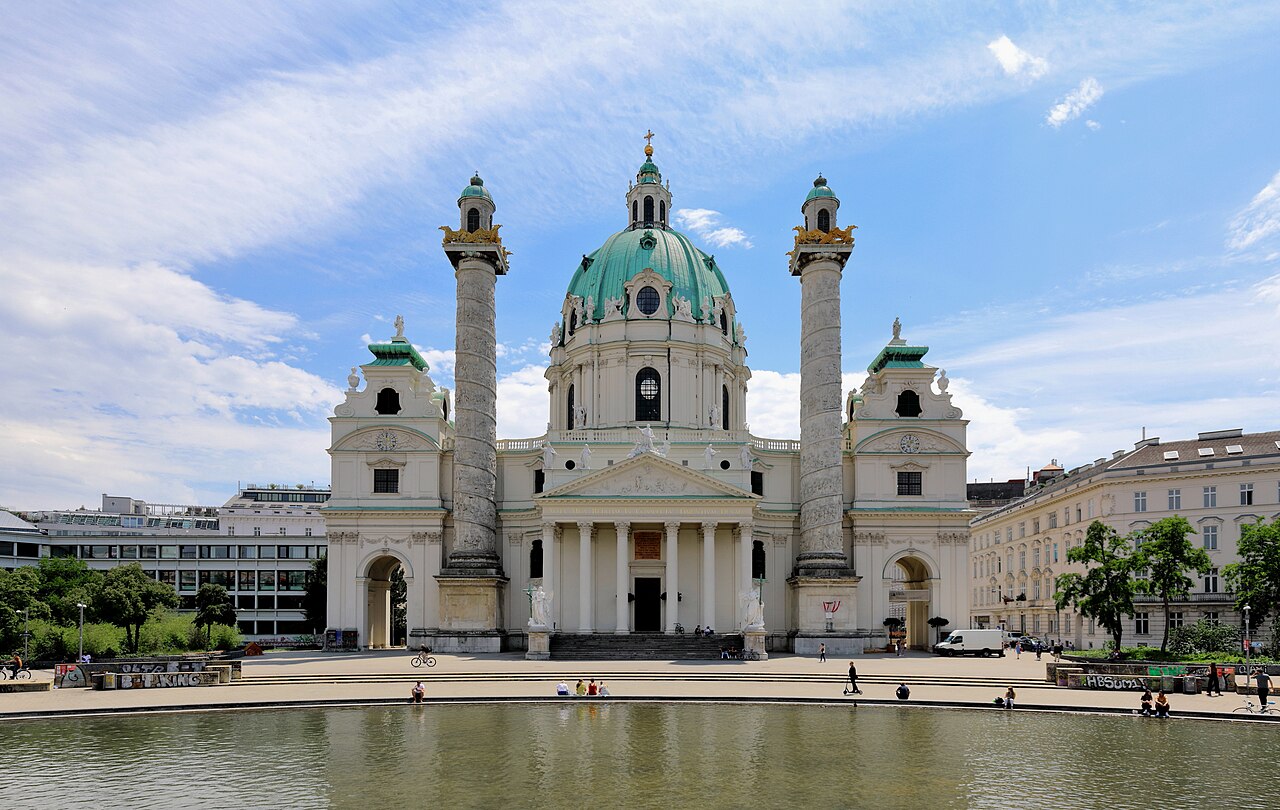
This place is a Attraction. It opened in 1737. It was built in the baroque architecture style. It was designed by Johann Bernhard Fischer von Erlach. It carries the Listed objects in Austria heritage designation.
Karlskirche is Vienna’s great Baroque church on the south side of Karlsplatz, but its identity is unusually theatrical: a classical portico sits between two monumental spiral-relief columns and two tower pavilions, beneath a 70-metre dome. Charles VI vowed the church in 1713, after Vienna’s last major plague epidemic, and dedicated it to Charles Borromeo, a healer of plague victims. Johann Bernhard Fischer von Erlach won the design competition; after his death in 1723, his son Joseph Emanuel completed the building in 1737. The result is both a votive church and a carefully staged architectural statement, facing the reflecting pool of Resselpark.
Checked 2026-09-02 · Source
Inside, the main reward is the vertical journey towards the dome fresco. A panoramic lift, when installed and operating, carries visitors to within a few metres of the ceiling painting; a final flight of stairs leads above the lift platform. The fresco depicts Charles Borromeo interceding with the Virgin and is associated with Johann Michael Rottmayr and Gaetano Fanti. The two columns outside, carved by Lorenzo Mattielli, are modelled on the idea of Trajan’s Column and use spiral reliefs to narrate the life of Charles Borromeo. Chapel frescoes are credited to Daniel Gran. The church therefore works best as both a dramatic exterior monument and an interior programme read from below and above.
Checked 2026-09-02 · Source
Allow about an hour for a visit. Spend roughly fifteen minutes reading the nave and its chapels, then allow around thirty minutes for the lift experience, the final stairs and the view of the fresco from the upper platform. Keep additional time for the exterior: the pool in front of Karlskirche reflects the façade, while the scale of the dome and the two narrative columns are easier to understand from across the water than from the entrance steps. If you are building a nearby walking route, the Wien Museum and the Secession Building are both close enough to combine with the church without turning the visit into a rushed stop.
Checked 2026-09-02 · Source
Late morning is a strong choice when daylight can reach the dome and the exterior pool still gives a clear reflection. Karlskirche remains a working church: services take priority over sightseeing, and the building serves the Catholic student ministry of the Vienna University of Technology. The dome lift is not a permanent architectural feature; it has been removed during restoration work in the past, so the interior experience can change even when the church itself is open. Plan around the operator’s visiting schedule and allow flexibility for religious use of the nave. The church’s position on Karlsplatz also makes it easy to visit before nearby museums and the Secession.
Checked 2026-09-02 · Source
The recorded visitor admission is €9.50 per person. This is a paid visit rather than a free church entry, and the admission includes access to the dome lift when the lift is operating. That distinction matters: the lift may be absent during restoration, while the building remains a functioning church rather than a museum. Concerts held at Karlskirche are separate events and may have their own organiser, ticket and conditions. For the ordinary monument visit, budget €9.50 per person and treat the lift as an included feature whose availability depends on the current installation.
Checked 2026-09-02 · Source
Karlskirche stands in Vienna’s 4th district, Wieden, on the south side of Karlsplatz just outside the Ring. The simplest public-transport approach is Karlsplatz station: U1, U2 and U4 serve the interchange, and the Resselpark exit brings you out facing the church across the pool. Ring trams stop at Kärntner Ring, about five minutes north on foot. Vienna’s U-Bahn network has five lines and 109 stations across 83.9 kilometres; services generally run from about 05:00 until 01:00, with all-night operation at weekends. From the station, use the open park and pool as your visual guide.
Checked 2026-09-02 · Source
Check the dome-lift situation before making it the centre of your visit. The lift is not permanently installed, and restoration has previously required its removal. When it is available, the upper platform is high and the final approach includes stairs, so visitors who dislike heights or have difficulty with stairs should factor that into the plan. Remember that Karlskirche is an active place of worship: services can limit access to the nave, and quiet, modest dress and respectful conduct are appropriate. The underground passages around Karlsplatz and the park are better crossed above ground after dark, especially if you are unfamiliar with the area.
Checked 2026-09-02 · Source
The best exterior composition is across the reflecting pool, where the water can double the façade and leave room for the full width of the portico, columns and tower pavilions. A wide lens helps preserve the relationship between the two Trajan-inspired columns and the central entrance; a tight view from the steps loses the architectural argument. Late afternoon gives the front a warmer presence, while calmer early light can produce a cleaner reflection. Inside, the dome fresco is the decisive subject, particularly from the lift platform when it is installed. The nave is dim, so steady support helps with interior photographs and respectful silence should take priority.
Checked 2026-09-02 · Source
Charles VI vowed Karlskirche in 1713, after Vienna’s last major plague epidemic, and dedicated it to Charles Borromeo, who was venerated as a healer of plague victims.
Johann Bernhard Fischer von Erlach won the competition. After his death in 1723, his son Joseph Emanuel completed the church in 1737.
Yes. A panoramic lift carries visitors close to the fresco when it is installed and operating, followed by a final flight of stairs above the lift platform. The lift has been removed during restoration.
The dome is 70 metres high. The church measures 55 metres long and 40 metres wide.
They are Lorenzo Mattielli’s copies of the Trajan’s Column idea, with spiral reliefs narrating the life of Charles Borromeo.
No. The recorded admission is €9.50 per person, and it includes the dome lift when the lift is operating.
Loading the interactive map…
The interactive map could not be loaded.
Last updated:
Source: OpenStreetMap contributors, Wikidata ·