
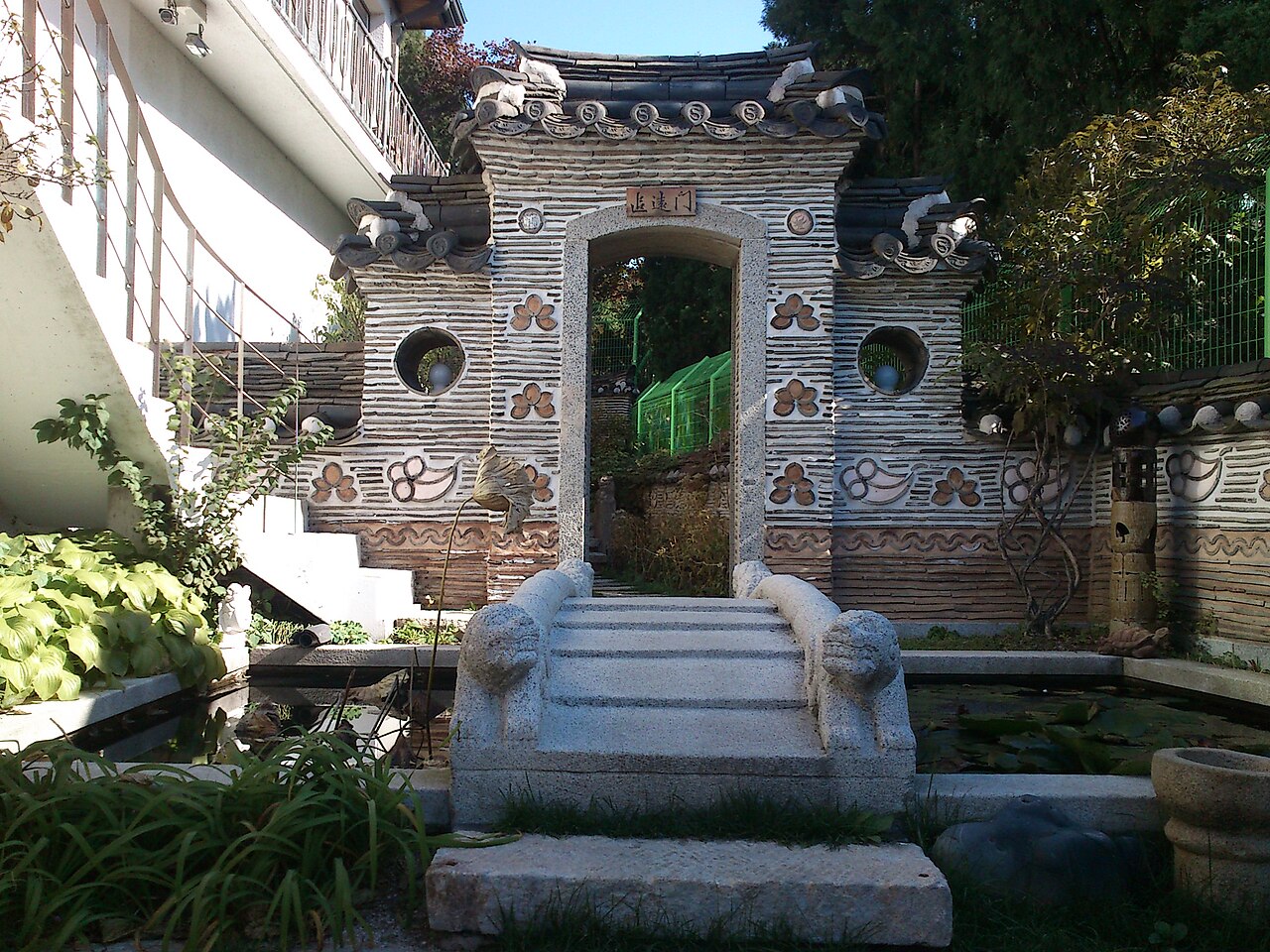
4 min walk
Bukchon Art Museum
- High
- Art and culture venue
Historic monument · Seoul
북촌한옥마을 ДЕРЕВНЯ
| Monday | 10:00 – 17:00 |
|---|---|
| Tuesday | 10:00 – 17:00 |
| Wednesday | 10:00 – 17:00 |
| Thursday | 10:00 – 17:00 |
| Friday | 10:00 – 17:00 |
| Saturday | 10:00 – 17:00 |
| Sunday | Closed |
Checked 2026-08-31 · Source
| Per person | Free entry |
|---|
Checked 2026-08-31 · Source
Read from the OpenStreetMap access tags; anything not listed has no tag recorded.
Set the group type to family in the planner and the day window contracts to about three quarters of a solo day.
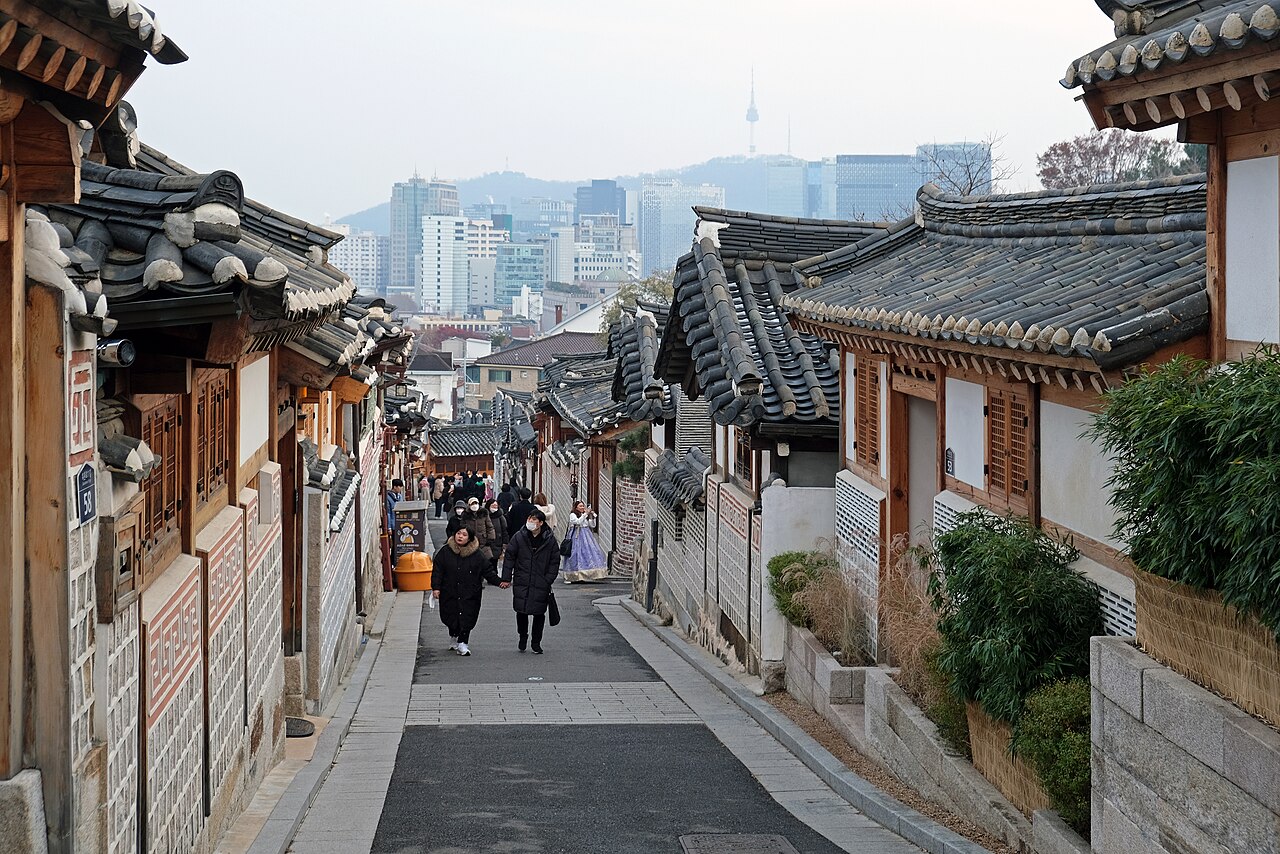
Bukchon is a lived-in neighbourhood rather than a museum village, and every rule a visitor meets there follows from that one fact. It occupies the slope north of Jongno and the Cheonggyecheon stream — bukchon means north village — and covers five administrative dong: Wonseo-dong, Jae-dong, Gye-dong, Gahoe-dong and Insa-dong. Under the late Joseon dynasty it housed the court's senior officials, and a 1906 family register recorded that 43. 6 per cent of its population belonged to that class. Most of the hanok standing today are newer than that.
Checked 2026-08-31 · Source
What there is to see is the street pattern itself: narrow lanes climbing between tiled roofs, with the Gyeongbokgung palace wall closing one side of the district and Changdeokgung the other. Gahoe-dong holds the densest surviving rows, hundreds of hanok shoulder to shoulder, and the alley of Bukchon-ro 11-gil — about 34,000 square metres of ground — is both the postcard view and the most tightly regulated part of the village. The Bukchon Village Information Center and the Bukchon Cultural Center explain what a visitor is looking at, and they are the right first stop for anyone who wants context rather than a photograph.
Checked 2026-08-31 · Source
Ninety minutes is the honest figure. Neither the Seoul Tourism Organization's page for the village nor Jongno-gu's notice publishes a suggested visit length, so ninety minutes is this guide's judgement, built out of the numbers they do publish. Bukchon is walkable ground rather than a building: the restricted alley alone is about 34,000 square metres, and a full loop from Anguk Station up Bukchon-ro, across the Gahoe-dong lanes and back down Gyedong-gil runs a little over two kilometres on a persistent slope. Ninety minutes covers that at a pace that allows stopping, plus one interior — a cultural centre, a gallery or a tea room.
Checked 2026-08-31 · Source
Monday–Saturday 10:00–17:00; closed Sunday. Bukchon is a residential neighborhood. Tourist access to the Bukchon-ro 11-gil Red Zone is prohibited from 17:00 until 10:00 the following day; the restriction has been enforced with a KRW 100,000 fine since 2025-03-01. Tourist visiting hours are 10:00 to 17:00, and the Seoul Tourism Organization publishes those hours for the village as a whole. Outside them, from 17:00 until 10:00 the following morning, tourists are prohibited from entering the restricted area. That single rule shapes the entire visit: there is no early morning in Bukchon and no evening, and the light a photographer would want at either end of the day is not lawfully available inside the restricted alley.
Checked 2026-08-31 · Source
Free entry to the village streets; independently operated museums, workshops and cultural activities may charge their own fees. There is no ticket. Bukchon is a public residential neighbourhood of ordinary city streets, and no gate, booth or barrier stands between a visitor and the lanes. The Seoul Tourism Organization's page for the village carries no fee line at all, where its pages for ticketed sites such as neighbouring Changdeokgung Palace carry both a fee and a holiday line — the absence is the answer, though it should be said plainly that no source consulted states in so many words that entry is free.
Checked 2026-08-31 · Source
Take Seoul Subway Line 3 to Anguk Station and use Exit 3. Seoul’s official visitor listing places Bukchon Hanok Village 516 metres from that exit, at 37 Gyedong-gil, Jongno-gu. This is the named approach for an independent visit. No car is needed, and a car is closer to a liability. The village address is 37 Gyedong-gil, Jongno-gu, and the nearest station is Anguk on Seoul Subway Line 3: exit 3 leaves a visitor about 516 metres away, uphill along Bukchon-ro. That is the approach the official site gives and it is the one to take, because it puts the information centres near the start of the walk and leaves the descent for the end.
Checked 2026-08-31 · Source
Bukchon is an outdoor network of public streets and alleys rather than a single attraction with one step-free entrance. The official neighborhood map marks uphill and downhill sections, so gradients vary and some routes to the viewpoints are steep. The official map identifies accessible toilets, elevators and escalators at specific locations, allowing a route to be planned around those facilities. The access description applies to the documented visitor route. The rule that catches people out is the clock. Jongno-gu has designated Bukchon-ro 11-gil a red zone inside the Bukchon special management area, and a tourist found there between 17:00 and 10:00 can be fined KRW 100,000.
Checked 2026-08-31 · Source
Bukchon is photographed more than almost anywhere else in Seoul, and that is the reason the restrictions exist, so the etiquette here is not optional. The one flat prohibition is interiors: no photograph and no film of the inside of a house, even where a gate or a door stands open. Nothing in the official guidance forbids photographing the streets and roofs themselves, and no source consulted publishes a rule on tripods, so the constraint that actually binds a photographer is the timetable.
Checked 2026-08-31 · Source
No. It is an inhabited residential neighborhood containing hundreds of traditional hanok, located between Gyeongbokgung Palace and Changdeokgung Palace.
Tourist visits to the approximately 34,000-square-metre Bukchon-ro 11-gil Red Zone are prohibited from 17:00 to 10:00; violations carry a KRW 100,000 fine.
Seoul’s official visitor guidance limits groups to a maximum of 10 people and prohibits microphones, megaphones and loudspeakers.
No. Visitors must not photograph or film house interiors, even when a door is open.
The official route takes about two to three hours and runs from Unhyeongung Palace through Bukchon Culture Center, Gahoe-dong and Jeongdok Public Library to Paik In-je’s House.
No. Since 2026-01-01, chartered buses have been prohibited at all times on the designated sections of Bukchon-ro, Bukchon-ro 5-gil and Changdeokgung 1-gil; fines begin at KRW 300,000.
Loading the interactive map…
The interactive map could not be loaded.

Last updated:
Source: OpenStreetMap contributors, Wikidata ·