
2 min walk
Sejong Center
- Must see
- Art and culture venue
Historic monument · Seoul
광화문광장
| Monday | 00:00 – 23:59 |
|---|---|
| Tuesday | 00:00 – 23:59 |
| Wednesday | 00:00 – 23:59 |
| Thursday | 00:00 – 23:59 |
| Friday | 00:00 – 23:59 |
| Saturday | 00:00 – 23:59 |
| Sunday | 00:00 – 23:59 |
Checked 2026-08-31 · Source
| Per person | Free entry |
|---|
Checked 2026-08-31 · Source
Read from the OpenStreetMap access tags; anything not listed has no tag recorded.
Set the group type to family in the planner and the day window contracts to about three quarters of a solo day.
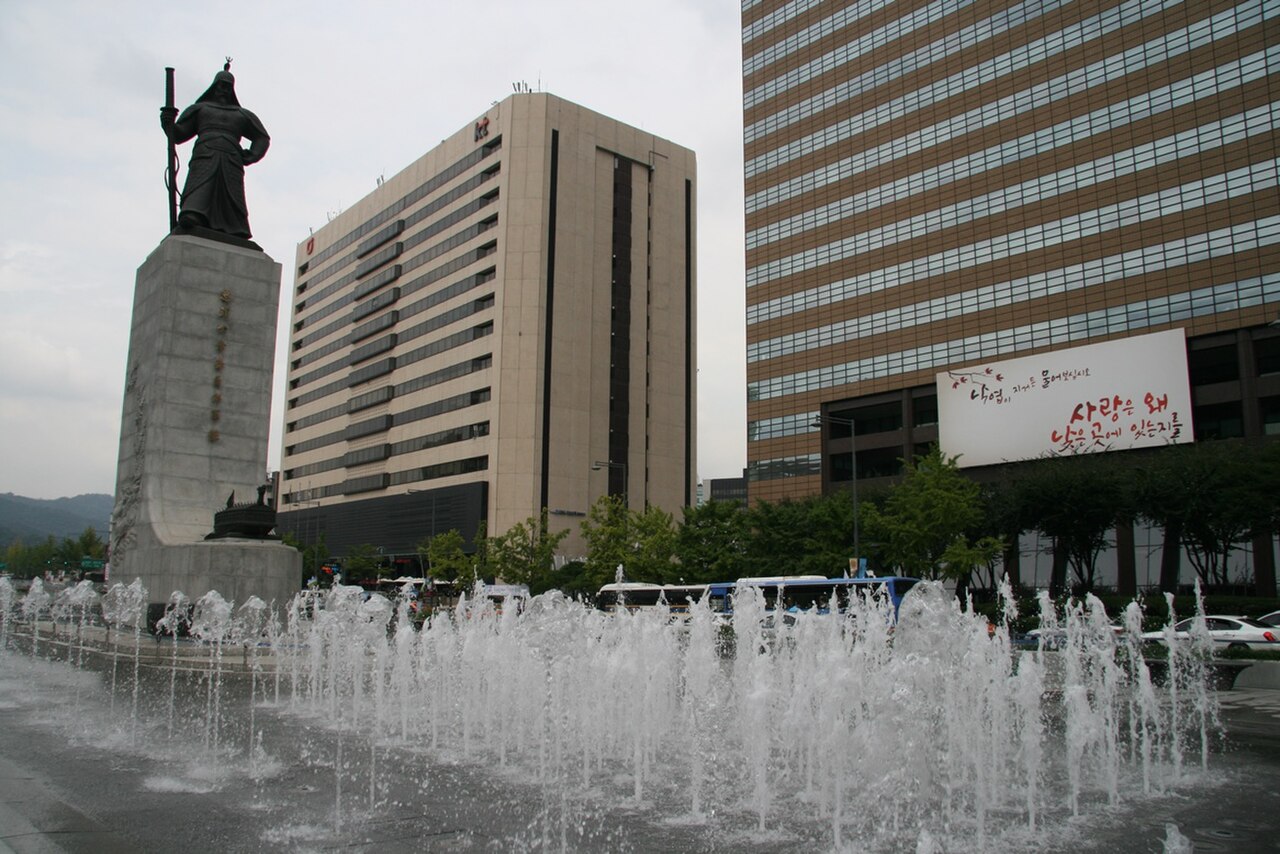
Gwanghwamun Plaza is a major public open space in central Seoul, South Korea. The plaza sits in front of Gwanghwamun, the main gate of Gyeongbokgung Palace, the largest of the Five Grand Palaces built during the Joseon Dynasty. The area serves as a significant ceremonial and gathering space in the city. The plaza has undergone redevelopment and expansion over time. It features statues of notable historical figures and provides a foreground to one of Seoul's most recognizable architectural landmarks. The space connects to broader pedestrian routes in the Jongno and Sejongno areas.
Checked 2026-08-31 · Source
The plaza contains the statue of King Sejong the Great, the fourth king of the Joseon Dynasty who oversaw the creation of the Korean alphabet, Hangul. Another prominent feature is the statue of Admiral Yi Sun-sin, a celebrated naval commander. Water features and landscaping elements are present in the space. The plaza provides views toward Gwanghwamun gate and the mountains beyond. Underground facilities exist beneath portions of the plaza. The surrounding area includes government buildings and other institutional structures. The specific current configuration of amenities and installations should be verified through direct observation.
Checked 2026-08-31 · Source
The time visitors spend at Gwanghwamun Plaza varies considerably depending on individual interests. Some visitors pass through quickly as part of a walking route between destinations. Others may spend extended periods observing the statues, reading informational displays, or attending to scheduled events. The plaza functions as both a destination and a thoroughfare. Photography and casual observation typically require shorter visits. Those combining the plaza with palace visits or surrounding attractions will allocate time accordingly. Personal pacing and weather conditions influence duration. No guided tour structure dictates a fixed visit length.
Checked 2026-08-31 · Source
Open 24 hours daily, year-round. The public square has no regular closure day. Individual facilities and programmed activities may have their own operating times. Seasonal considerations in Seoul include hot humid summers and cold dry winters. The plaza's open character means it offers different atmospheric conditions throughout the year. Visitors should consult current official sources for any access restrictions. Event schedules may affect typical visiting conditions. Personal tolerance for temperature extremes and precipitation should inform timing decisions.
Checked 2026-08-31 · Source
Free general admission to the square. As a public plaza, no entrance fee is typically expected for the open space itself. However, adjacent attractions including Gyeongbokgung Palace require separate admission. The distinction between free plaza access and paid palace entry warrants attention. Any special exhibitions or underground facility charges would require separate confirmation from authoritative sources.
Checked 2026-08-31 · Source
The address is 172 Sejong-daero, Jongno-gu, Seoul. From Gwanghwamun Station on Line 5, use the passageway to Haechi Lounge or Exit 7 toward Forest Square. From Gyeongbokgung Station on Line 3, use Exit 6 and walk toward Government Complex Seoul and Gwanghwamun Gate. Gwanghwamun Plaza is located in central Seoul with multiple access options. The area connects to Seoul Subway Line 5 via Gwanghwamun Station. Additional nearby stations on other lines provide alternative approaches. Bus routes serve the surrounding Sejongno and Jongno corridors. The plaza's prominence makes it recognizable to taxi drivers and navigable through mapping applications. Walking connections extend to adjacent districts including Insadong and Cheonggyecheon stream. Traffic congestion affects surface transport during peak periods. Visitors should consult current transit schedules and route information, as service details change over time.
Checked 2026-08-31 · Source
The official Seoul tourism record identifies accessible pathways. Accessible restrooms are available. The plaza's open design exposes visitors to weather conditions without shelter. Sun exposure and precipitation require appropriate preparation. Large crowds gather during political demonstrations, cultural events, and national holidays, altering normal conditions. The crossing of major traffic arteries at plaza edges demands pedestrian awareness. Surface conditions vary with maintenance schedules and weather. Statue bases and water features present standard tripping hazards. The proximity to active roadways generates noise and air quality considerations. Visitors with mobility concerns should assess current surface conditions and crossing infrastructure. Personal belongings require standard urban vigilance.
Checked 2026-08-31 · Source
Gwanghwamun Plaza offers prominent photographic subjects including the Sejong and Yi Sun-sin statues, the Gwanghwamun gate backdrop, and mountain views. The open space permits varied angles and distances. Lighting conditions shift throughout the day with the sun's arc. Night illumination of statues and gate creates alternative photographic opportunities. Crowd density affects compositional possibilities. Tripod use may attract security attention in this politically sensitive location. The plaza's ceremonial function means unexpected events may interrupt planned photography. Respect for other visitors and any event participants remains essential. Equipment should be secured against standard urban risks.
Checked 2026-08-31 · Source
The renovated square reopened in August 2022.
The square contains the statues of King Sejong and Admiral Yi Sun-sin; Myeongnyang Fountain and the Yi Sun-sin Monument surround the admiral's statue.
Haechi Lounge links Gwanghwamun Station with the square and provides space for resting and meeting.
One restroom is in Haechi Lounge and operates from 05:00 to 01:00; another is on B1 of Sejong-ro Public Parking Lot and is open 24 hours.
Media Art at Haechi Lounge is presented daily from 08:00 to 22:00.
The History Waterway uses inscribed stone slabs to trace Korean history from the founding of the Joseon dynasty in 1392 to the present.
Loading the interactive map…
The interactive map could not be loaded.
Last updated:
Source: OpenStreetMap contributors, Wikidata ·