_Quatre_Columnes_(Four_Columns)_by_Josep_Puig_i_Cadafalch.jpg)
1 min walk
Magic Fountain of Montjuïc
- Must see · Heritage site
- Historic monument
Language · 11 published
Historic monument · Barcelona
Les Quatre Columnes
Reviewed by Elena Voss · Roavina Travel Editor
This place is a Monument. It opened in 2011. It was designed by Josep Puig i Cadafalch. It is built of cast stone. It carries the public art in Barcelona heritage designation.
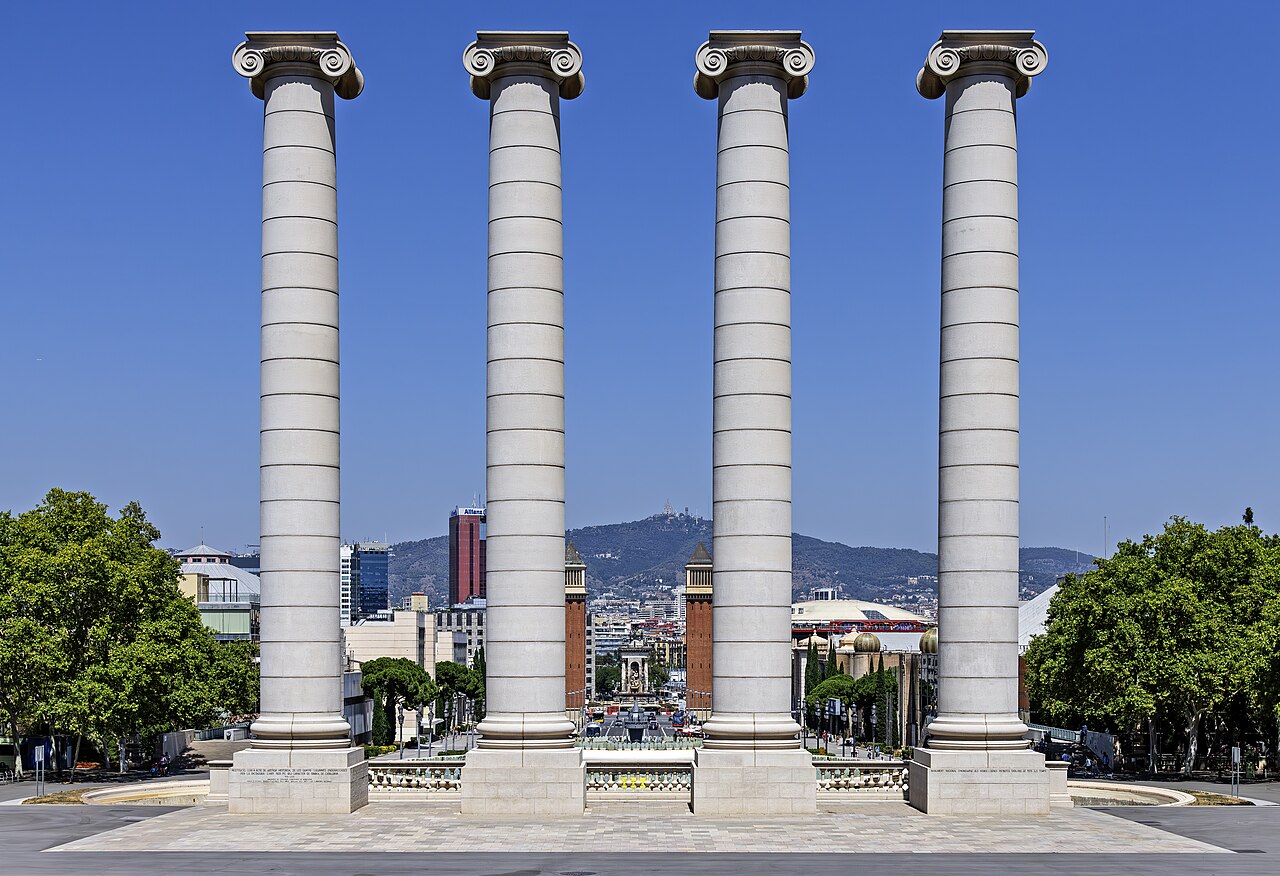
The Four Columns, or Les Quatre Columnes, are a public monument at the foot of Montjuïc in Barcelona. Josep Puig i Cadafalch designed the original columns in 1919 as symbols of the four red stripes of the Catalan senyera. The first monument was demolished in 1928 during the dictatorship of Primo de Rivera. The present reconstruction stands near the original location, close to Plaça d’Espanya, the Magic Fountain, and the Palau Nacional. The Four Columns, known locally as Les Quatre Columnes, are a monument located in Barcelona, Spain. The original columns were erected in 1919 by architect Josep Puig i Cadafalch as symbols of the four stripes of the Catalan senyera flag. They were demolished in 1928 during the dictatorship of Primo de Rivera. The current reconstruction dates from 2010, standing near their original site at the base of Montjuïc hill, close to the Magic Fountain and the Palau Nacional. No. The Four Columns stand in open public space with no admission charge, ticket office, or barrier.
Checked 2026-08-26 · Source
There is no interior to enter: the monument consists of four tall Ionic columns arranged in a row on a stepped platform. Visitors can walk around the base and view the columns against the open Montjuïc setting. The stone shafts and classical capitals create a simple, strongly symmetrical composition. Nearby paths, landscaped areas, and the monumental approach toward the Palau Nacional make the surrounding space part of the experience. The monument consists of four tall Ionic columns arranged in a row, set upon a stepped platform. There is no enclosed structure or interior space to enter. Visitors can walk around the base and view the columns from multiple angles. The surrounding area forms part of the broader Montjuïc parkland, with paved walkways, landscaped gardens, and open public space.
Checked 2026-08-26 · Source
Allow ten to twenty minutes for the Four Columns, including a walk around the platform and a few photographs. The monument works best as part of a Montjuïc route rather than as a stand-alone long visit. Pair it with the Palau Nacional, the National Art Museum of Catalonia, the Magic Fountain area, or the Olympic precinct. A longer stop makes sense when you want to study the symmetry, historical symbolism, and changing views toward Plaça d’Espanya.
Checked 2026-08-26 · Source
The open monument is easy to visit during daylight, when the columns and their setting are clearest. Early morning brings softer light and fewer people, while late afternoon gives the stone warmer tones. Summer visits can feel exposed because the platform has little shade. Evening changes the mood as nearby illumination becomes visible. The Four Columns are especially convenient when your Montjuïc walk already passes between Plaça d’Espanya and the hill.
Checked 2026-08-26 · Source
The Four Columns are viewed from open public space, so the monument itself has no entrance procedure. There are no rooms, ticket barriers, or enclosed galleries. Nearby museums and attractions operate separately and may have their own admission arrangements. Treat the columns as a short civic and historical stop within a larger Montjuïc day, leaving your time and spending decisions for the surrounding attractions you choose to visit.
Checked 2026-08-26 · Source
Plaça d’Espanya is the most useful approach, served by metro lines L1 and L3 and several bus routes. From the square, walk toward Montjuïc; the Four Columns are visible near the base of the hill. The Aerobus terminates near Plaça d’Espanya, making the monument a possible first stop after arriving from Barcelona airport. The route from the city centre is also walkable, although the broad avenue and uphill surroundings affect the pace.
Checked 2026-08-26 · Source
The stepped platform can be slippery after rain, and the open position gives little protection from strong sun. Watch bicycles and pedestrians on nearby paths, particularly while photographing from low angles. The columns offer no shelter in poor weather. The monument is quieter than many central Barcelona sights, but keep personal belongings secure in busy approach areas. At night, lighting and visibility change, so remain aware of the surrounding paths and traffic.
Checked 2026-08-26 · Source
The Four Columns are naturally suited to symmetrical compositions. Shoot from the platform to emphasise the four shafts, or include the Palau Nacional as a large architectural backdrop. Early morning and golden hour reveal texture in the stone, while evening illumination creates a stronger contrast. A wide lens helps from close range, but step back when possible to keep the columns upright. Personal photography needs no special setting inside the open monument.
Checked 2026-08-26 · Source
The four columns symbolise the four red stripes of the Catalan senyera flag and carry a strong connection with Catalan identity.
No. The original columns were erected in 1919 and demolished in 1928. The monument seen today is a reconstruction dating from 2010.
No. The Four Columns are freestanding architectural elements on an open platform, without an enclosed interior or rooms to enter.
They stand at the base of Montjuïc near Plaça d’Espanya, close to the Magic Fountain and the Palau Nacional.
Ten to twenty minutes is enough for the monument itself, although the stop can become part of a much longer Montjuïc walking route.
Yes. Their symmetry, stepped platform, stone texture, and relationship with the Palau Nacional provide clear subjects from several viewpoints.
Loading the interactive map…
The interactive map could not be loaded.

Last updated:
Source: OpenStreetMap contributors, Wikidata ·