.jpg)
4 min walk
Royal Botanic Garden of Madrid
- Must see · Heritage site
- Nature site
Language · 11 published
Museum · Madrid
Reviewed by Elena Voss · Roavina Travel Editor
| Monday | 10:00 – 20:00 |
|---|---|
| Tuesday | 10:00 – 20:00 |
| Wednesday | 10:00 – 20:00 |
| Thursday | 10:00 – 20:00 |
| Friday | 10:00 – 20:00 |
| Saturday | 10:00 – 20:00 |
| Sunday | 10:00 – 19:00 |
Checked 2026-08-31 · Source
Read from the OpenStreetMap access tags; anything not listed has no tag recorded.
Set the group type to family in the planner and the day window contracts to about three quarters of a solo day.
This place is a Museum. It opened in 1819. It was designed by Juan de Villanueva. It carries the bien de interés cultural heritage designation.
The Prado is Spain's national painting museum, and the building it occupies was never meant to hold pictures. Juan de Villanueva designed it in 1785 for a Natural History Cabinet, on the orders of Charles III. The change of purpose came a generation later under his grandson Ferdinand VII, pushed by Queen Maria Isabel de Braganza, and the Royal Museum of Paintings and Sculptures opened to the public in November 1819. It was renamed the National Museum of Paintings and Sculptures and finally the Museo Nacional del Prado. What that origin means for a visitor is that the collection is a royal one rather than an encyclopaedic one.
Checked 2026-08-31 · Source
The core is Spanish painting up to 1800, and the two rooms most visitors come for are Room 064, which holds Goya's The 3rd of May 1808 in Madrid, and the Velazquez rooms with Las Meninas. Bosch's Garden of Earthly Delights Triptych has its own gallery, rebuilt around it. Beyond those, the Museum's published list of masterpieces runs through Fra Angelico's The Annunciation, Rogier van der Weyden's The Descent from the Cross, Dürer's Self-portrait of 1498, Raphael's The Cardinal, Titian's Emperor Charles V at Mühlberg, El Greco's The Nobleman with his Hand on his Chest, Rubens's The Three Graces, Rembrandt's Judith at the Banquet of Holofernes, Ribera's Jacob's Dream and Tiepolo's The Immaculate Conception.
Checked 2026-08-31 · Source
Allow three hours. The Prado publishes no recommended visit length, but it does publish three self-guided itineraries through the Collection — one hour, two hours and three hours — and counting the works in each is the closest thing to an official answer available. The one-hour route stops at 15 works. The two-hour route stops at 30. The three-hour route stops at 54, and that is the longest one the Museum offers, which is a fair signal that three hours is the sensible upper end for a first visit rather than a compromise. The building will hold a visitor much longer than that.
Checked 2026-08-31 · Source
Monday-Saturday 10:00-20:00; Sunday and holidays 10:00-19:00. Timed events, ceremonies, maintenance and security measures can alter ordinary access. The Prado opens every day of the year except three: 1 January, 1 May and 25 December. Monday to Saturday it runs 10:00 to 20:00, and Sundays and public holidays 10:00 to 19:00. Three more dates run short at 10:00 to 14:00 — 6 January, 24 December and 31 December — and a visitor who has planned a Christmas Eve afternoon there will find the doors shut. Entry closes 30 minutes before closing time and the galleries are cleared 10 minutes before, so the last useful arrival on a weekday is 19:30 and on a Sunday 18:30.
Checked 2026-08-31 · Source
Adult EUR 15; final two hours free subject to capacity. Special tours, exhibitions and upgrades use separate tickets. General admission is €15 and covers both the Collection and the temporary exhibitions — there is no separate exhibition ticket to buy. Reduced admission is €7. 50 and applies to people over 65, youth card holders and members of large families. Free admission covers, among others, under-18s, students aged 18 to 25, students over 25 on an arts degree in the Spanish education system, people with a disability level of 33% or more, the legally unemployed and active teaching staff.
Checked 2026-08-31 · Source
Banco de España or Estación del Arte Metro. This named stop or station is the clearest public-transport reference for an independent visit. No car is needed, and the Museum's own transport page makes the case better than any argument. The nearest bus stop, Museo del Prado – Botanical Garden, is 64 metres from the door and takes routes 001, 10, 14, 27, 34, 37, 45 and C03; Alfonso XII – Botanical Garden is 260 metres and Prado – Atocha 366 metres. On the Metro, Banco de España on line 2 is 650 metres away, Estación del Arte on line 1 is 800 metres, and Retiro is 1. 3 km.
Checked 2026-08-31 · Source
Step-free entrances or public paving, lifts where needed, and accessible toilets serve principal areas. The access description applies to the principal visitor route rather than every historic or operational space. The luggage rule is the one that strands people. Suitcases and bulky items larger than 40 by 40 centimetres are not allowed into the Museum at all, and locker capacity is explicitly described as limited, so a visitor arriving from Atocha with a wheeled case has a problem rather than an inconvenience. Scooters and bicycles are refused too, as are animals apart from authorised ones.
Checked 2026-08-31 · Source
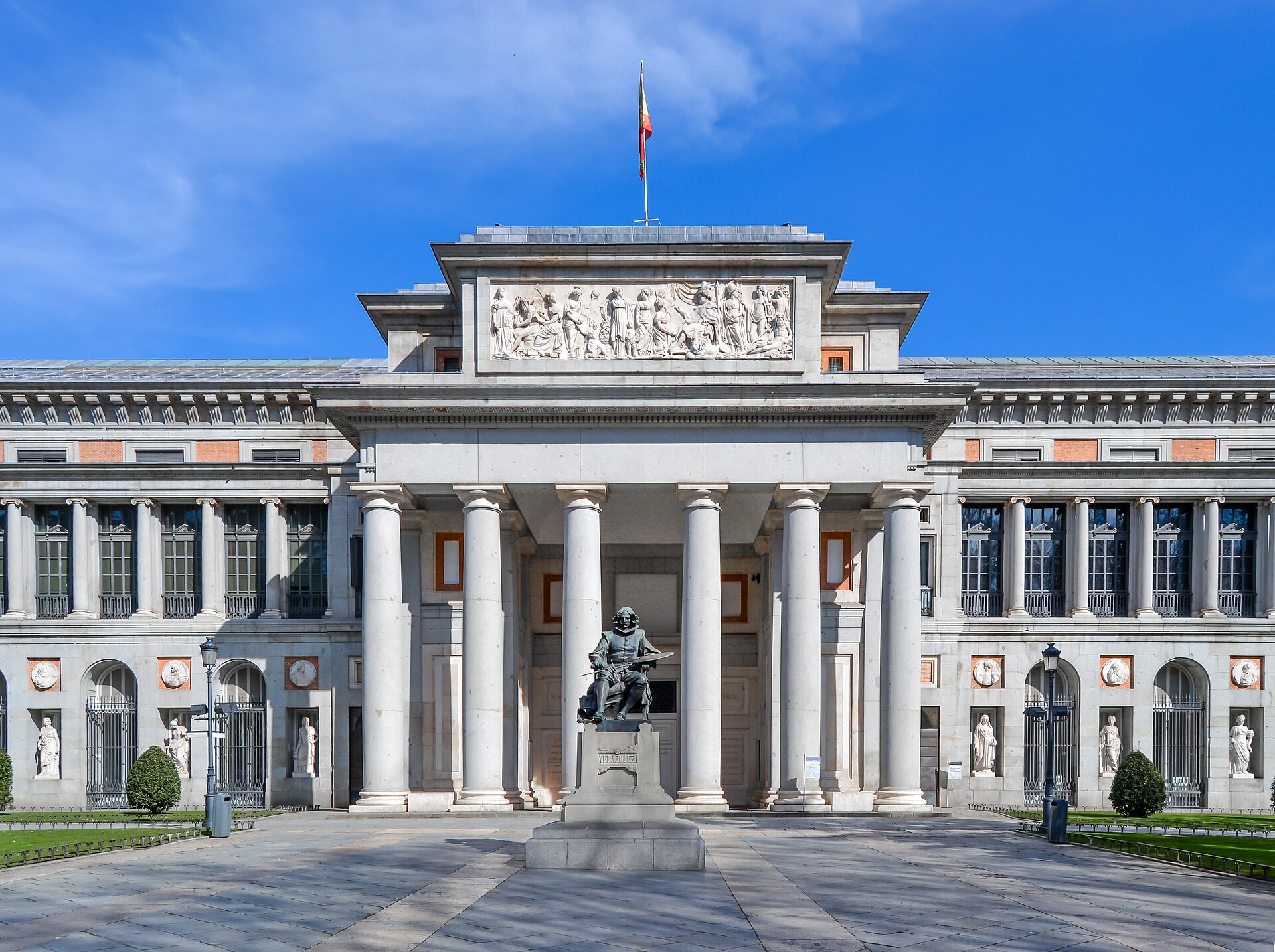
There is no photography at the Prado. The Museum's regulations state plainly that photography or filming in the galleries is not permitted, and unlike most large museums this is a blanket rule rather than a restriction on flash, tripods or particular rooms. A visitor cannot photograph Las Meninas, The Garden of Earthly Delights or The 3rd of May 1808 in Madrid, no matter how the camera is held. Plan for a visit spent looking rather than shooting, and expect staff to say so if a phone comes up. That leaves the exterior, which is worth some attention.
Checked 2026-08-31 · Source
Monday-Saturday 10:00-20:00; Sunday and holidays 10:00-19:00.
Adult EUR 15; final two hours free subject to capacity.
Step-free entrances or public paving, lifts where needed, and accessible toilets serve principal areas.
Banco de España or Estación del Arte Metro.
Yes. Events, ceremonies, maintenance and security can change ordinary access.
No. Special tours, exhibitions and upgrades use separate tickets.
Loading the interactive map…
The interactive map could not be loaded.
Last updated:
Source: OpenStreetMap contributors, Wikidata ·