.jpg)
2 min walk
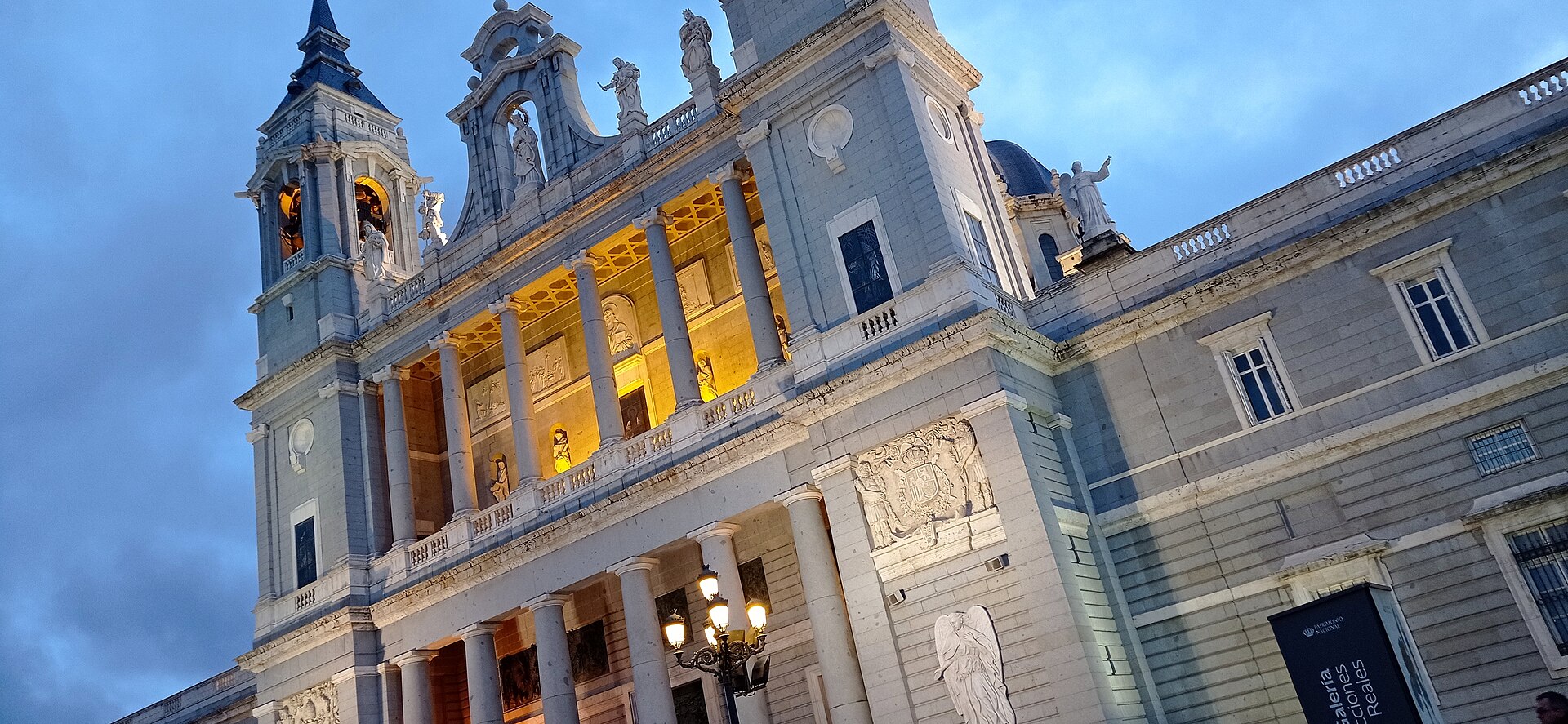
Almudena Cathedral
- Must see
- Place of worship
Museum · Madrid
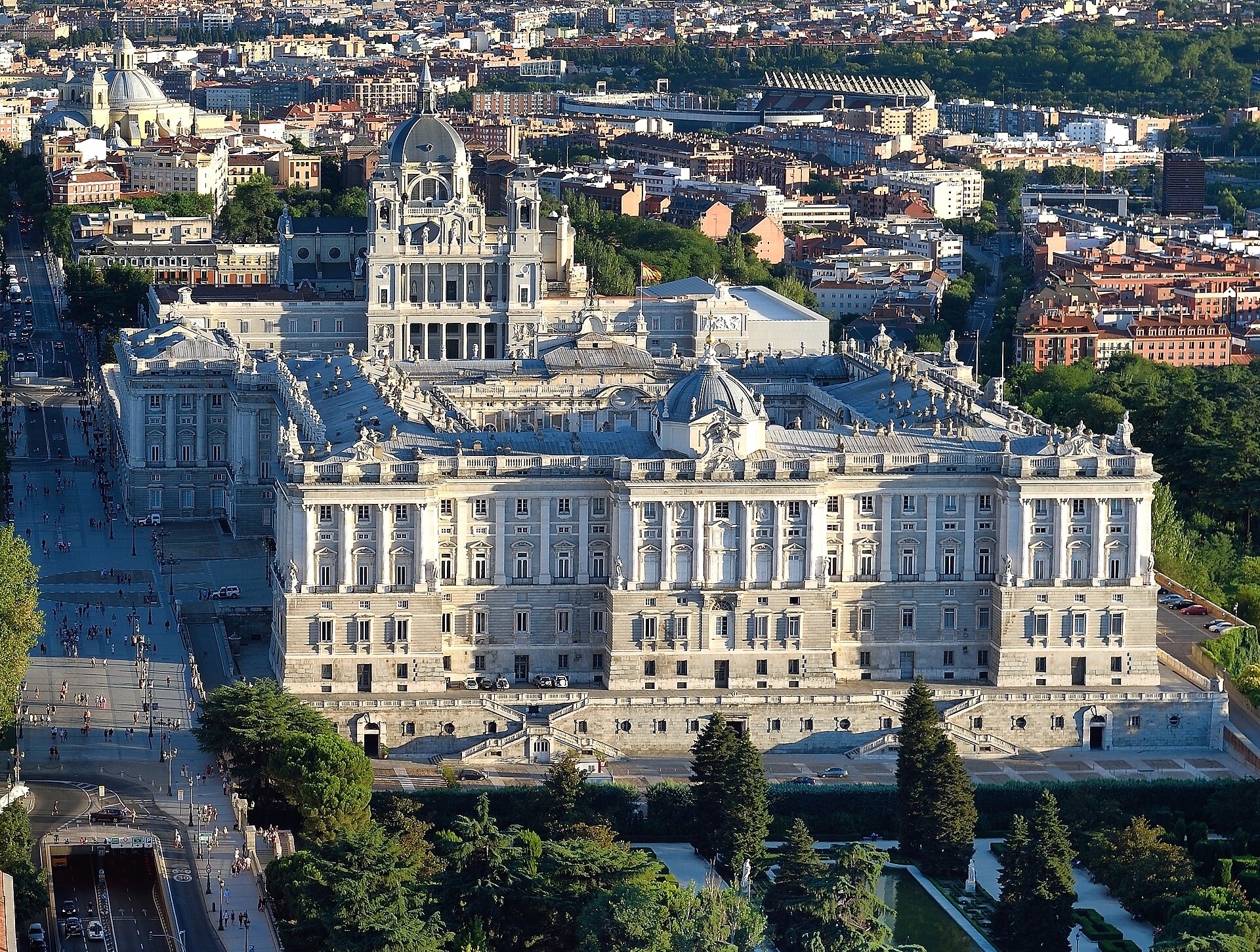
Palacio Real de Madrid
| Per person | €18.00 |
|---|
Checked 2026-08-31 · Source
Read from the OpenStreetMap access tags; anything not listed has no tag recorded.
Set the group type to family in the planner and the day window contracts to about three quarters of a solo day.
The Royal Palace of Madrid stands on the ridge above the Manzanares where the medieval Alcazar stood until fire destroyed it on Christmas Eve 1734. Patrimonio Nacional, the state body that runs it, calls it the largest palace in Western Europe: more than 135,000 square metres and 3,418 rooms. It also describes it as the only official residence of a head of state anywhere that is open to the public. The King of Spain still uses it for audiences and official events, so the rooms on the route are working state rooms rather than a museum reconstruction of them. Philip V sent for Filippo Juvarra, who died before the work began in earnest, and his pupil Giambattista Sacchetti adapted the project.
Checked 2026-08-31 · Source
The visit is the main floor, walked as a fixed circuit of state rooms rather than a set of galleries to browse in any order. The quarters of Charles III still carry the decoration Francisco Sabatini directed, uniform across the whole floor. The Throne Room and the Gasparini Chamber are the two rooms most people remember afterwards; Patrimonio Nacional calls them the most representative ensembles of Charles III's taste, rococo in its most exuberant Italian version. The ceiling frescoes are by Giambattista Tiepolo and Anton Raphael Mengs, the two painters Charles III brought in to decorate the residence, Mengs as his first court painter.
Checked 2026-08-31 · Source
Patrimonio Nacional publishes two numbers rather than one, and both are worth taking literally. A self-guided visit to the Halls, meaning the main-floor state rooms, is given as approximately forty-five minutes. The Royal Armoury is given as a further thirty minutes. Seventy-five minutes is therefore the operator's own figure for walking the whole standard route, and seventy-five minutes is what this guide records as the visit duration. That figure covers the rooms and nothing else. It does not include the security check, the walk across the Plaza de la Armeria from the Almudena esplanade entrance, or the wait the hour happens to produce. Tickets are sold for a timed slot, so the wait is bounded, but it is not nothing.
Checked 2026-08-31 · Source
Daily seasonal hours; official acts can close rooms. Timed events, ceremonies, maintenance and security measures can alter ordinary access. Two fixed ceremonies shape the week and both can be watched without a ticket. The Changing of the Guard at the Puerta del Principe runs every Wednesday and Saturday from 11:00 to 14:00, with fourteen guards and four horses, the mounted sentries riding along the facade every ten minutes. Between 19 June and 18 September it runs earlier, from 10:00 to 12:00. It takes place on Calle Bailen and is watched freely from the street.
Checked 2026-08-31 · Source
Adult EUR 18; weekday free periods apply to eligible visitors. Special tours, exhibitions and upgrades use separate tickets. Admission is charged and every ticket type is published. The standard self-guided ticket is 18 euros per person. The reduced ticket is 9 euros and covers citizens aged 5 to 16, people over 65, and accredited students up to 25 holding a current national or international student card; between 14 and 16 an identity card or passport is asked for.
Checked 2026-08-31 · Source
Ópera Metro. This named stop or station is the clearest public-transport reference for an independent visit. The address is Calle de Bailen with no number, 28071 Madrid, on the Plaza de Oriente side of the hill. Since 20 August, access for individual visitors and for groups has been through the esplanade of the Almudena Cathedral and the Plaza de la Armeria, so an older set of directions pointing at a different gate will send a visitor the wrong way around a very large building. The Metro is the obvious approach: lines 2 and 5 at Opera, a few minutes on foot. Buses 3, 25, 39 and 148 stop nearby.
Checked 2026-08-31 · Source
Accessible routes serve principal areas, but historic stairs, thresholds or operational constraints limit the complete circuit. The access description applies to the principal visitor route rather than every historic or operational space. The building is in official use, and Patrimonio Nacional states plainly that beyond the closures already published there may be further ones for official events. That is the risk no amount of planning removes, and it is the reason to check the site on the morning of the visit rather than the week before.
Checked 2026-08-31 · Source
Photography without flash is permitted for personal use, except in places where it is expressly prohibited, and those places are signposted on the route rather than listed in advance. Tripods, selfie sticks and similar accessories are not allowed anywhere. Patrimonio Nacional also asks that the privacy of other visitors and of staff be respected, which in practice means the room attendants are not part of the picture. Inside, the real constraint is not the rule but the circuit: it moves in one direction at the pace of the people in it, and the rooms that most reward a photograph, the Throne Room and the Gasparini Chamber, are the ones where the crowd is thickest.
Checked 2026-08-31 · Source
Daily seasonal hours; official acts can close rooms.
Adult EUR 18; weekday free periods apply to eligible visitors.
Accessible routes serve principal areas, but historic stairs, thresholds or operational constraints limit the complete circuit.
Ópera Metro.
Yes. Events, ceremonies, maintenance and security can change ordinary access.
No. Special tours, exhibitions and upgrades use separate tickets.
Loading the interactive map…
The interactive map could not be loaded.
Last updated:
Source: OpenStreetMap contributors, Wikidata ·