_-_IMG_24.jpg)
2 min walk
Wat Buppharam
- Must see · Heritage site
- Place of worship

Place of worship · Chiang Mai
วัดแสนฝาง
| Monday | 06:00 – 18:00 |
|---|---|
| Tuesday | 06:00 – 18:00 |
| Wednesday | 06:00 – 18:00 |
| Thursday | 06:00 – 18:00 |
| Friday | 06:00 – 18:00 |
| Saturday | 06:00 – 18:00 |
| Sunday | 06:00 – 18:00 |
Checked 2026-08-31 · Source
| Per person | Free entry |
|---|
Checked 2026-08-31 · Source
Read from the OpenStreetMap access tags; anything not listed has no tag recorded.
Set the group type to family in the planner and the day window contracts to about three quarters of a solo day.
Wat Saen Fang is a Buddhist temple in Chiang Mai, northern Thailand. The temple sits within the historical and cultural fabric of the city, which served as the capital of the Lanna Kingdom. Chiang Mai's old city contains numerous temples reflecting centuries of religious architecture and practice. Wat Saen Fang contributes to this dense concentration of heritage sites that draw visitors seeking to understand northern Thai Buddhist traditions. Daily 06:00–18:00. Active temple. No weekly closure day or midday break is listed. Free general admission; no entrance ticket is required for the temple grounds.
Checked 2026-08-31 · Source
Buddhist temples in Chiang Mai typically contain ordination halls, viharn assembly halls, chedi stupas, and Buddha images, though individual configurations vary considerably. The temple may include structures common to Lanna-style religious compounds, such as multi-tiered roofs with elaborate wooden carvings. Visitors should observe what is visible from public areas and respect any spaces marked for worshippers only. Active temple. No weekly closure day or midday break is listed. Free general admission; no entrance ticket is required for the temple grounds.
Checked 2026-08-31 · Source
The appropriate duration for visiting Wat Saen Fang depends on individual interest and the extent of accessible areas. Temple visits in Chiang Mai's old city generally range from fifteen minutes for exterior observation to forty-five minutes for those who explore grounds thoroughly and observe religious activities. Visitors with strong interest in architectural details or Buddhist practice may linger longer. The compact nature of many old city temples suggests modest time requirements compared to major complexes outside the walls. Free general admission; no entrance ticket is required for the temple grounds.
Checked 2026-08-31 · Source
Many Chiang Mai temples are technically open during daylight hours, though specific gates or buildings may have varying accessibility. Early morning and late afternoon often provide more comfortable temperatures for walking in the old city. Buddhist holy days and local festivals may affect access or create special observances. Daily 06:00–18:00. Take Chiang Mai RTC City Bus R3 Red or R3 Yellow to the named Tha Phae Gate stop. From the gate, walk approximately 600 metres east along Tha Phae Road to the temple entrance at 188 Tha Phae Road, Chang Moi. Red songthaews can also drop passengers at Wat Saen Fang by name.
Checked 2026-08-31 · Source
Many Buddhist temples in Chiang Mai do not charge entrance fees, though some prominent temples request donations or have instituted modest charges for foreign visitors. If fees exist, they typically remain low by international standards. Visitors should carry small denomination cash in case donations are appropriate or requested. Free general admission; no entrance ticket is required for the temple grounds. The outdoor compound can be entered at ground level from the narrow Tha Phae Road approach. The viharn and other principal buildings have raised thresholds or steps, so the complete visit is not step-free.
Checked 2026-08-31 · Source
Wat Saen Fang lies within Chiang Mai's old city, a roughly square area bounded by moat and remnants of ancient walls. The old city is walkable and traversable by bicycle, songthaew shared trucks, tuk-tuk auto-rickshaws, and ride-hailing services. The main railway station lies east of the old city. Take Chiang Mai RTC City Bus R3 Red or R3 Yellow to the named Tha Phae Gate stop. From the gate, walk approximately 600 metres east along Tha Phae Road to the temple entrance at 188 Tha Phae Road, Chang Moi. Red songthaews can also drop passengers at Wat Saen Fang by name.
Checked 2026-08-31 · Source
Visitors to Buddhist temples in Thailand should dress modestly, covering shoulders and knees, as a sign of respect regardless of whether enforcement is visible. Remove shoes before entering buildings. Be aware that some areas may be restricted to worshippers or monks. Dogs and uneven surfaces are common on temple grounds. Sun exposure and heat demand hydration, particularly during hot season months. The outdoor compound can be entered at ground level from the narrow Tha Phae Road approach. The elevated Ho Trai stands within a pond and is not on the step-free outdoor route.
Checked 2026-08-31 · Source
Most Buddhist temples in Thailand permit exterior photography, while interior rules vary significantly. Some buildings prohibit photography entirely; others allow it without flash; some impose no restrictions. Visitors should observe posted signs and follow cues from temple staff or worshippers. Photographing monks requires particular sensitivity and often direct permission. Tripods and professional equipment may attract scrutiny or prohibition. Drone use is generally inappropriate and often illegal near religious sites without permits. When in doubt, asking permission demonstrates respect. Yes. It is an active Buddhist temple overseen by an abbot; the Chiang Mai Provincial Office of Buddhism documented an official ceremony there in June 2025.
Checked 2026-08-31 · Source
Yes. It is an active Buddhist temple overseen by an abbot; the Chiang Mai Provincial Office of Buddhism documented an official ceremony there in June 2025.
The temple is at 188 Tha Phae Road, Chang Moi, Mueang Chiang Mai, Chiang Mai.
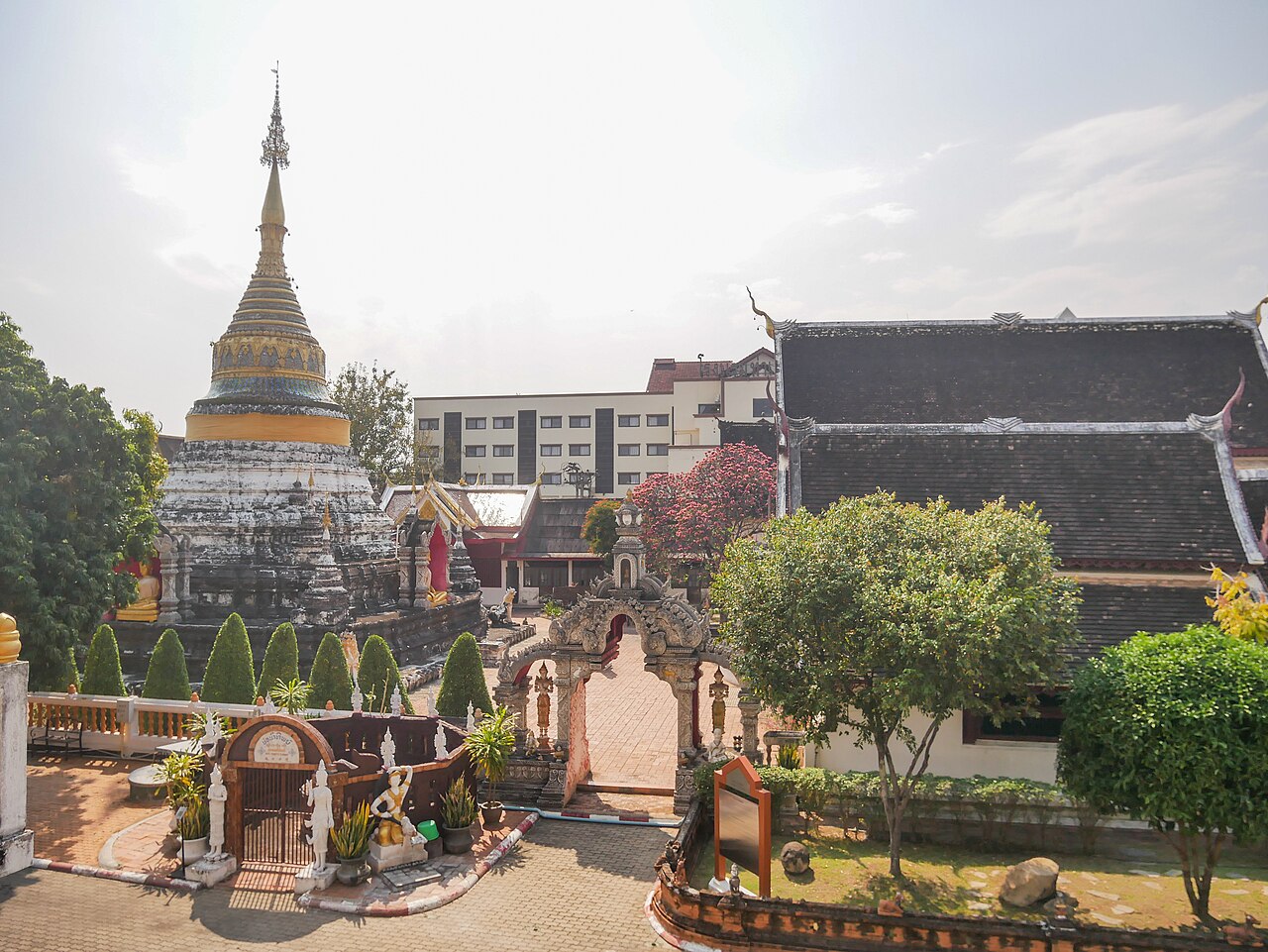
Its Mongkhon Saen Mahachai chedi is a Burmese-style structure modeled on Yangon's Shwedagon Pagoda and decorated with gilding and glass mosaic.
The viharn incorporates a former royal residence associated with Chiang Mai ruler Kawirolot; his successor Inthawichayanon converted it into a viharn in 1878.
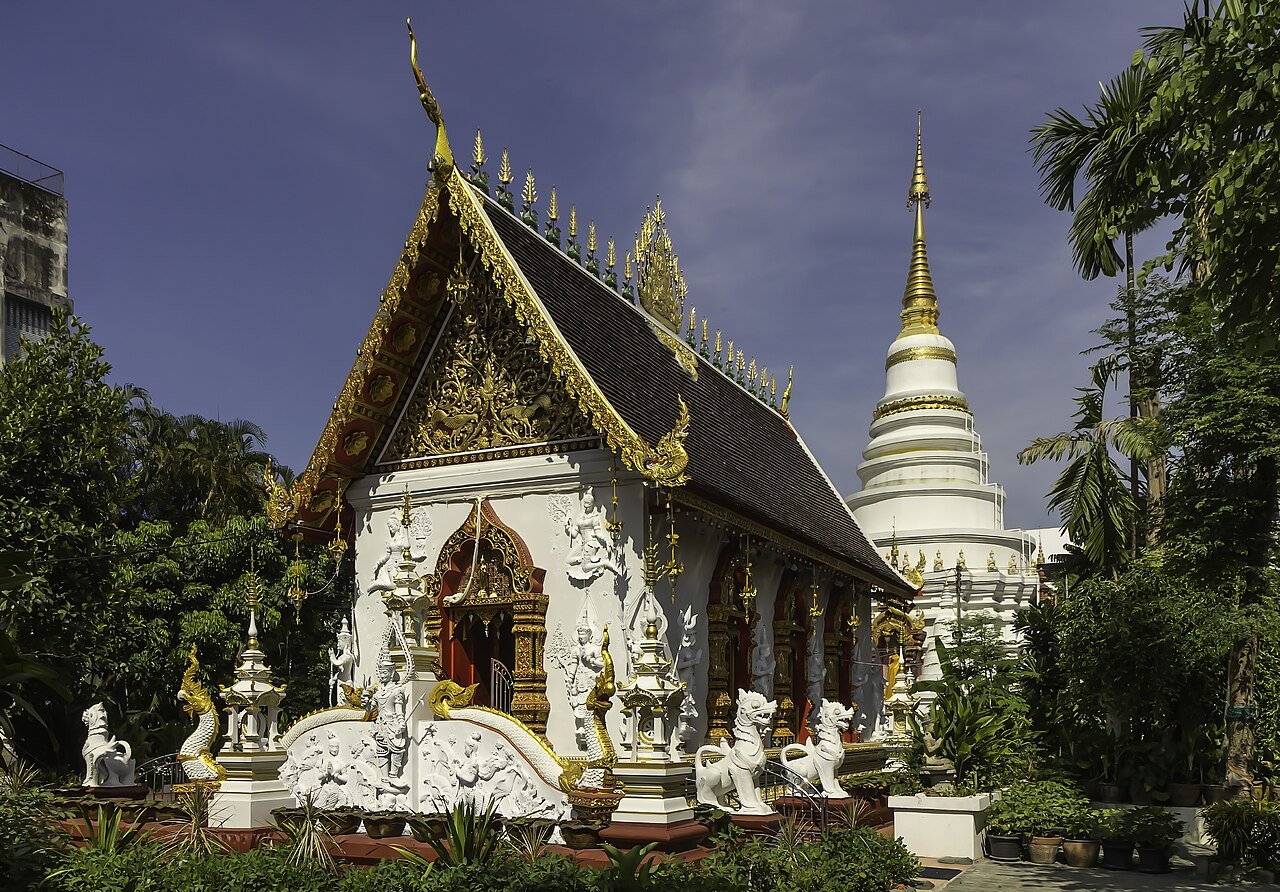
The ordination hall combines Burmese and Lanna forms and has kinnara figures along its upper roofline.
The raised Ho Trai scripture library stands within a pond, a distinctive feature of the compound.
Loading the interactive map…
The interactive map could not be loaded.
Last updated:
Source: OpenStreetMap contributors, Wikidata ·