
11 min walk
Thủ Lệ Park
- Must see
- Family attraction
Language · 11 published
Place of worship · Hanoi
Reviewed by Elena Voss · Roavina Travel Editor
Read from the OpenStreetMap access tags; anything not listed has no tag recorded.
Set the group type to family in the planner and the day window contracts to about three quarters of a solo day.
This place is a Place of worship.
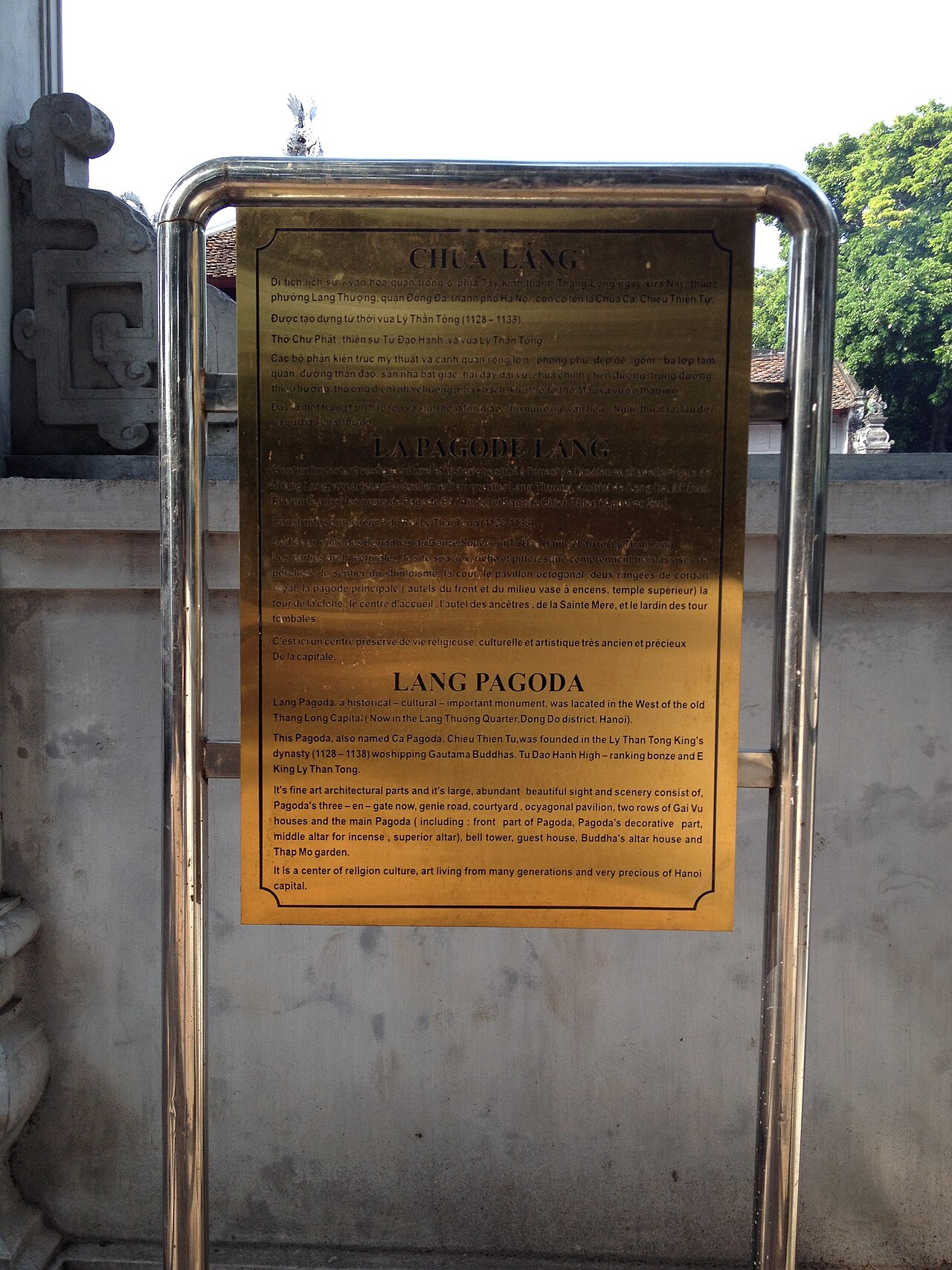
Lang Pagoda, known locally as Chùa Láng, is a Buddhist temple in Hanoi, Vietnam. The pagoda holds historical significance as a place of worship and cultural heritage within the capital. It represents traditional Vietnamese religious architecture and serves as an active spiritual site for practitioners. The pagoda contributes to Hanoi's rich tapestry of religious landmarks, offering visitors insight into Buddhist practices and local devotion. Its presence in the city reflects the enduring role of temple complexes in Vietnamese urban life and community identity.
Checked 2026-08-31 · Source
The pagoda grounds contain structures typical of Vietnamese Buddhist temple design, including worship halls and courtyard spaces. Visitors may encounter altars, incense burners, and religious statuary. Gardens or landscaped areas may surround the main buildings, providing contemplative spaces. The interior spaces serve religious functions, with arrangements designed for ceremony and meditation.
Checked 2026-08-31 · Source
A visit to Lang Pagoda typically requires between thirty minutes and one hour for casual observation of the grounds and main structures. Visitors with particular interest in Buddhist architecture or religious practice may wish to allocate additional time for contemplation or detailed examination of features. The compact nature of many urban Vietnamese pagodas suggests a relatively brief visit compared to larger temple complexes. Duration depends on individual pace, crowd conditions, and whether one observes active ceremonies. No guided tour duration is specified.
Checked 2026-08-31 · Source
Lang Pagoda remains an active place of worship and hosted public ceremonies in April 2026. Neither Láng Ward nor Hanoi’s cultural authority publishes recurring daily visitor hours. No fixed weekly closure day is stated by the responsible public bodies. The ward’s 2026 festival coverage confirms active public use, including early-morning attendance on 23 April 2026. Visitors should verify opening times before planning their visit, as religious sites in Vietnam may observe variable schedules tied to worship activities, lunar calendar events, or monastic routines. Early morning and late afternoon often coincide with prayer sessions, which may affect accessibility or atmosphere. Festival periods, particularly around Buddhist holidays such as Vesak, may bring increased activity or modified hours. Seasonal weather in Hanoi includes hot humid summers and cool winters, which may influence comfort during outdoor portions of a visit.
Checked 2026-08-31 · Source
Free general entry. Hanoi’s municipal heritage-fee schedule identifies the sites authorized to charge admission; Lang Pagoda is not included, so no municipal sightseeing fee applies. Voluntary religious offerings are separate from admission. Many Vietnamese pagodas operate without formal admission charges, relying instead on voluntary donations for maintenance and religious activities. Visitors may encounter donation boxes or opportunities to contribute to temple upkeep. Some sites request fees for specific services such as parking, ceremonial participation, or guided explanation, though this is not confirmed for Lang Pagoda. Visitors should carry small denomination currency for potential contributions. Any mandatory entrance fees, if instituted, would require verification through direct inquiry at the site or official channels.
Checked 2026-08-31 · Source
The official address is 116 Chùa Láng Street, Láng Ward. Hanoi public-transport information lists bus route 09 along Chùa Láng Street, serving the named stops “Opposite Diplomatic Academy – 69 Chùa Láng” and “Opposite Láng Thượng Secondary School – Chùa Láng”; the latter is the nearer named stop for the pagoda entrance. Lang Pagoda is situated within Hanoi's urban fabric, accessible by typical city transportation methods. Visitors may reach the area by taxi, ride-hailing services, or motorbike, common modes throughout the capital. Public bus routes serve portions of the city, though specific lines require local verification. The pagoda's location in a densely populated district suggests proximity to residential and commercial areas. Walking from nearby accommodations may be feasible depending on one's base location. Street addresses in Hanoi can present navigation challenges; confirming directions with accommodation staff or local contacts is advisable.
Checked 2026-08-31 · Source
The outer gateway and principal courtyards provide predominantly level circulation. Raised thresholds and steps restrict independent wheelchair access to the historic worship halls. The responsible public-body material identifies no dedicated ramp, lift, or accessible toilet. Visitors should observe respectful conduct appropriate to active religious sites. Modest dress covering shoulders and knees is customary when entering Buddhist temple grounds. Footwear removal is typically required before entering worship halls. Incense smoke and open flames present standard precautions. The pagoda's urban setting involves typical Hanoi traffic hazards when approaching or departing. Visitors should remain attentive to personal belongings in any tourist-frequented location. Ceremonial activities deserve quiet observation without interruption.
Checked 2026-08-31 · Source
Photography at Lang Pagoda requires sensitivity to religious context and potential restrictions. Exterior architectural photography is generally permissible at Vietnamese temples, though visitors should assess whether signs or staff indicate limitations. Interior photography, particularly of altars, statues, or worshippers, may be restricted or require explicit permission. Flash photography is typically discouraged near delicate materials or during active prayer. Respect for devotees' privacy and spiritual practice should guide all photographic decisions. Tripods and professional equipment may attract attention or require special arrangement. When uncertain, verbal inquiry to temple staff or observation of posted guidance is prudent.
Checked 2026-08-31 · Source
It is locally called Chùa Láng or Chùa Cả; its formal Sino-Vietnamese name is Chiêu Thiền Tự.
The responsible ward gives the address as 116 Chùa Láng Street, Láng Ward, Hanoi.
The pagoda was founded during the reign of Lý Anh Tông, who ruled from 1138 to 1175.
The complex is dedicated to Buddhist worship and also venerates Zen master Từ Đạo Hạnh and King Lý Thần Tông.
The complex contains about 100 structures and 198 Buddhist statues; 39 statues date from the seventeenth and eighteenth centuries, while the remainder principally reflect Nguyễn-period styles.
The main festival day is the seventh day of the third lunar month. In 2026 it fell on 23 April, with processions, offerings, ceremonial worship, and cultural performances.
Loading the interactive map…
The interactive map could not be loaded.

Last updated:
Source: OpenStreetMap contributors ·