.jpg)
1 min walk
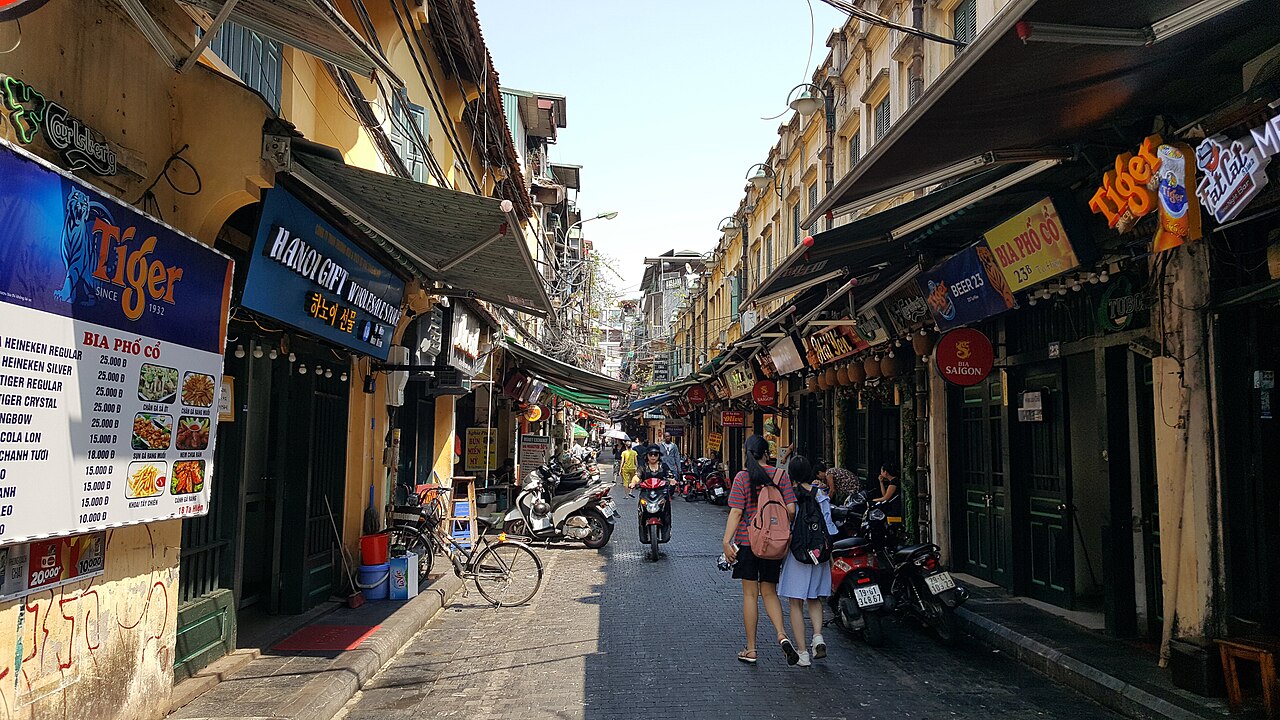
Ta Hien Street
- Must see
- Historic monument
Language · 11 published
Historic monument · Hanoi
Editorial responsibility: Elena Voss · Roavina Travel Editor

| Monday | 00:00 – 23:59 |
|---|---|
| Tuesday | 00:00 – 23:59 |
| Wednesday | 00:00 – 23:59 |
| Thursday | 00:00 – 23:59 |
| Friday | 00:00 – 23:59 |
| Saturday | 00:00 – 23:59 |
| Sunday | 00:00 – 23:59 |
Checked 2026-08-31 · Source
Read from the OpenStreetMap access tags; anything not listed has no tag recorded.
Set the group type to family in the planner and the day window contracts to about three quarters of a solo day.
This place is a Attraction.
Hanoi's Old Quarter is the historic commercial core north of Hoàn Kiếm Lake, commonly associated with 36 guild streets. Vietnam Tourism describes it as a walkable neighbourhood of Vietnamese architecture, old shops, green spaces and street food. It is a district experience rather than a single ticketed attraction: its streets, temples, cafés, shops and individual museums operate separately. Approach the Old Quarter as a place for a deliberately paced walk, not a checklist to be completed by vehicle. Its character comes from street-level activity and historic trade patterns rather than one monument or one operator-managed route.
Checked 2026-08-31 · Source
Vietnam Tourism explains that the 36 guild streets were named for crafts and trades that supplied the royal centre, although only some streets retain their historic specialisation. Its guide identifies Hàng Bạc, Hàng Mã, Hàng Gai and Lãn Ông as examples of distinct street character. The same district contains lanes, pagodas, cafés, shops and nearby landmarks, so there is no single indoor circuit or mandatory sequence. Choose a few streets and one or two specific sites rather than assuming the whole quarter can be covered equally.
Checked 2026-08-31 · Source
Allow at least half a day for an unhurried Old Quarter walk, and reserve longer when you add a specific museum, temple, performance, meal or Hoàn Kiếm Lake circuit. This is editorial planning guidance, not an operator-issued duration. Vietnam Tourism presents the area as best explored on foot and notes that its narrow streets reward slower wandering. The quarter has no single entry gate or fixed visit length. Build in pauses for traffic crossings, heat, rain and the time needed to locate an individual destination inside the dense street network rather than judging the visit by a straight-line distance.
Checked 2026-08-31 · Source
Daily, 24 hours. The separate weekend pedestrian-street operation runs Friday–Sunday, 19:00–00:00 in summer and 18:00–00:00 in winter. The Old Quarter is an inhabited public-street district with no gates or weekly closure day. The listed evening hours apply only to vehicle restrictions and programmed activity in the pedestrian zone, not access to the district. The official tourism guide points to early morning and late afternoon around nearby Hoàn Kiếm Lake as active times, while describing the Old Quarter as continuously busy and frenetic. Choose your timing around the specific temple, museum, shop or food stop you want, because there is no district-wide schedule. Start earlier when you want a calmer street walk, but verify the individual venue's official terms before treating it as open.
Checked 2026-08-31 · Source
Free access to the Old Quarter’s public streets. Individual attractions charge separately; Hanoi’s fee rules specifically cover Bach Ma Temple, Kim Ngan Communal House, 28 Hang Buom and the Old Quarter Cultural Exchange Center. The Old Quarter itself is a public urban district and has no single admission ticket. Individual temples, museums, performances, guided rides, food venues and shops may set their own fees and conditions. Do not buy a generic package on the assumption that it grants access everywhere. Decide which specific paid stop matters, then use its own official page for current terms. Walking the streets does not replace the booking requirement of a separately managed attraction.
Checked 2026-08-31 · Source
Bus 01 serves Hàng Cót, Đường Thành and Phùng Hưng; bus 04 serves Nguyễn Hữu Huân, Lý Thái Tổ and Hàng Tre; bus 31 serves Hàng Cân, Hàng Lược, Lý Thái Tổ, Hàng Tre and Hàng Muối. Long Biên is the named northern interchange. Routes 04 and 31 use adjusted routing from 19:00 Friday through 00:00 Sunday under the low-emission-zone pilot introduced on 1 July 2026. Vietnam Tourism recommends experiencing the Old Quarter on foot and suggests a cyclo as one way to take in the streets before walking. Begin from a confirmed individual destination or a nearby landmark such as Hoàn Kiếm Lake, then continue on foot through a limited set of streets. Check current city transport information before departure, and do not expect a car to deliver you to every lane.
Checked 2026-08-31 · Source
This is an open historic street district rather than a controlled attraction with a single step-free entrance. Weekend pedestrian operation removes ordinary vehicle traffic from designated streets, offering the lowest-traffic time for wheelchair users. There is no continuous dedicated step-free circuit. Access depends on ordinary sidewalks and road crossings; Hanoi’s current urban-order programme includes ongoing work to clear, flatten and upgrade sidewalks. The official tourism guide describes shops spilling onto sidewalks and motorcycles moving through narrow streets. Treat traffic, crossings and uneven pedestrian space as part of the route, especially when looking at a map or taking photographs. The Old Quarter contains active religious and residential places, so appropriate dress and quiet conduct matter inside temples and private courtyards.
Checked 2026-08-31 · Source
The Old Quarter rewards photographs that show street activity, narrow façades, shop signs and the changing relationship between pedestrians and traffic. Vietnam Tourism specifically notes historic trade streets and the area's lively street scenes. Take photographs from a safe place rather than stopping in a motorbike path or blocking a shop entrance. Ask at individual venues, respect worshippers and residents, and avoid close images of people without consent. Early or quieter periods make careful composition easier.
Checked 2026-08-31 · Source
No. It is a living urban heritage district comprising 36 historic streets; the Ministry of Culture, Sports and Tourism recognized it as a National Historic Site in 2004.
Designated Old Quarter walking streets operate Friday, Saturday and Sunday evenings, from 19:00 to 00:00 in summer and 18:00 to 00:00 in winter.
The expansion includes Hàng Dầu, Cầu Gỗ, Hàng Bè, Hàng Bạc, Đinh Liệt, Gia Ngư, the Đào Duy Từ section from Chợ Gạo to Ô Quan Chưởng, Ô Quan Chưởng and the Cầu Gỗ, Trung Yên and Phất Lộc alleys.
No. Ordinary vehicles are excluded from the designated walking streets during their operating periods; the wider Old Quarter remains a working mixed-traffic neighbourhood.
“Hàng” refers to merchandise or shops. Guild streets were named for their traditional products: Hàng Đào sold silk and fabric, Hàng Bạc was associated with silver casting and jewellery, and Hàng Chĩnh with ceramics.
No. Public streets are free, but managed interiors have separate admission arrangements. Hanoi’s fee rules identify Bach Ma Temple, Kim Ngan Communal House, 28 Hang Buom and the Old Quarter Cultural Exchange Center as fee-collecting sites.
Loading the interactive map…
The interactive map could not be loaded.
Last updated:
Source: OpenStreetMap contributors ·