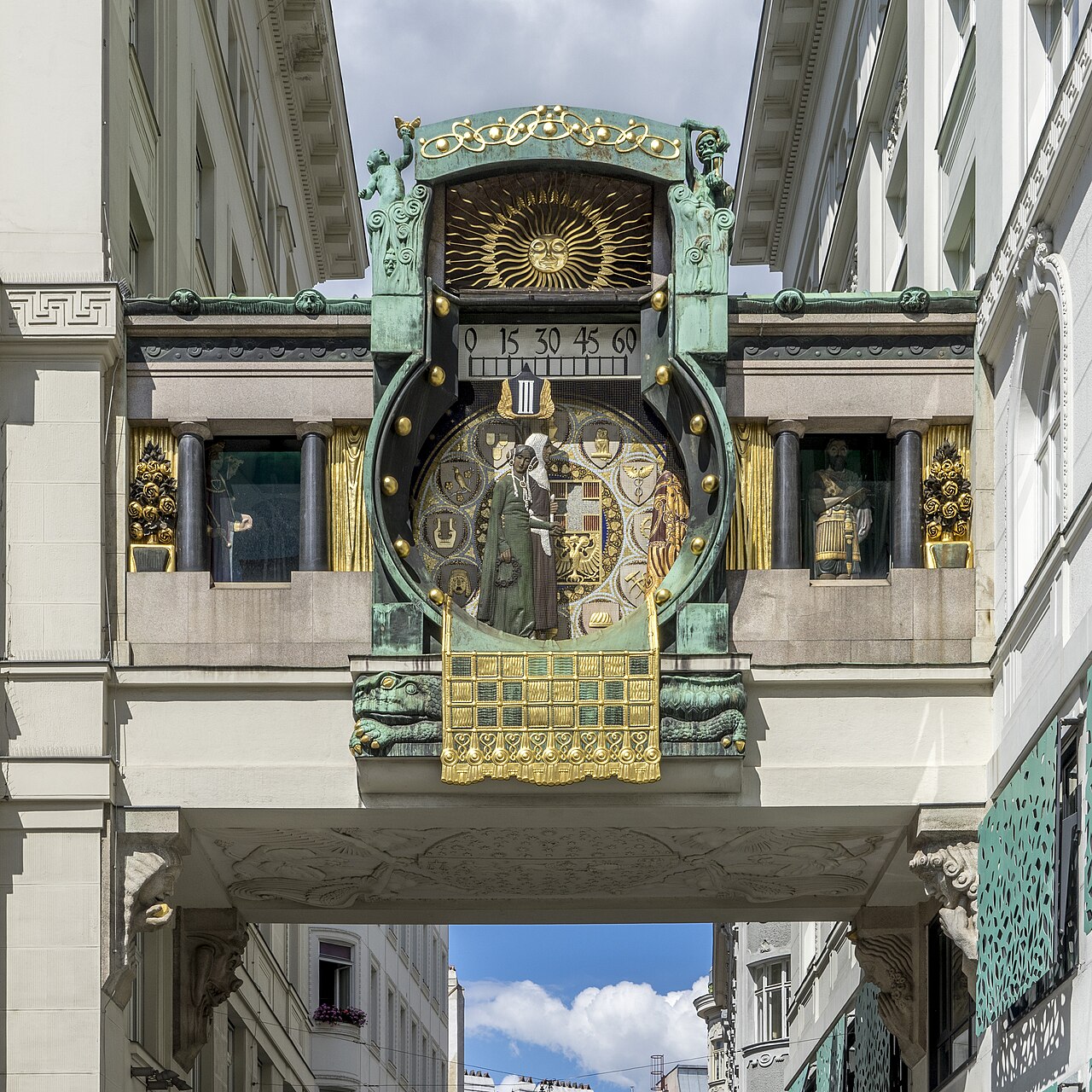
The Ankeruhr is Vienna’s Art Nouveau clock on Hoher Markt, built across the gap between two buildings associated with the Anker Insurance company. Franz von Matsch designed it between 1911 and 1917, giving a commercial commission an enduring place in the city’s historic streetscape. Its identity is architectural as much as mechanical: the bridge-like structure, mosaic surface, gilded ornament and figures make it a landmark to study from the square. Because the work is viewed outdoors, it fits naturally into a walking route through the Innere Stadt, especially for visitors interested in decorative arts, urban history and unusual public timepieces. The Ankeruhr, the Anker Clock, is an Art Nouveau clock built as a bridge between two buildings owned by the Anker Insurance company on Hoher Markt in Vienna's Innere Stadt.
The Ankeruhr has no visitor interior: the experience is the decorated clock bridge facing Hoher Markt. Twelve metal figures represent historical Viennese and imperial figures, ranging from Marcus Aurelius to Joseph Haydn, and move across the clock face on a track. Mosaic, sculptural ornament and gilded details frame the procession, while period music accompanies the figures as they pass. Look at the whole composition first, then examine the figures, costumes and decorative setting from a closer position in the square.
Allow about fifteen minutes for a focused stop: time to cross Hoher Markt, find a clear sightline and inspect the clock bridge, mosaic and figures. The movement itself is brief, while the decoration rewards a slower look. If you are following the historical procession, stay long enough to watch the figures pass across the dial and compare their costumes and poses. The Ankeruhr works best as a compact pause within a longer central-Vienna walking route, alongside nearby historic streets and squares.
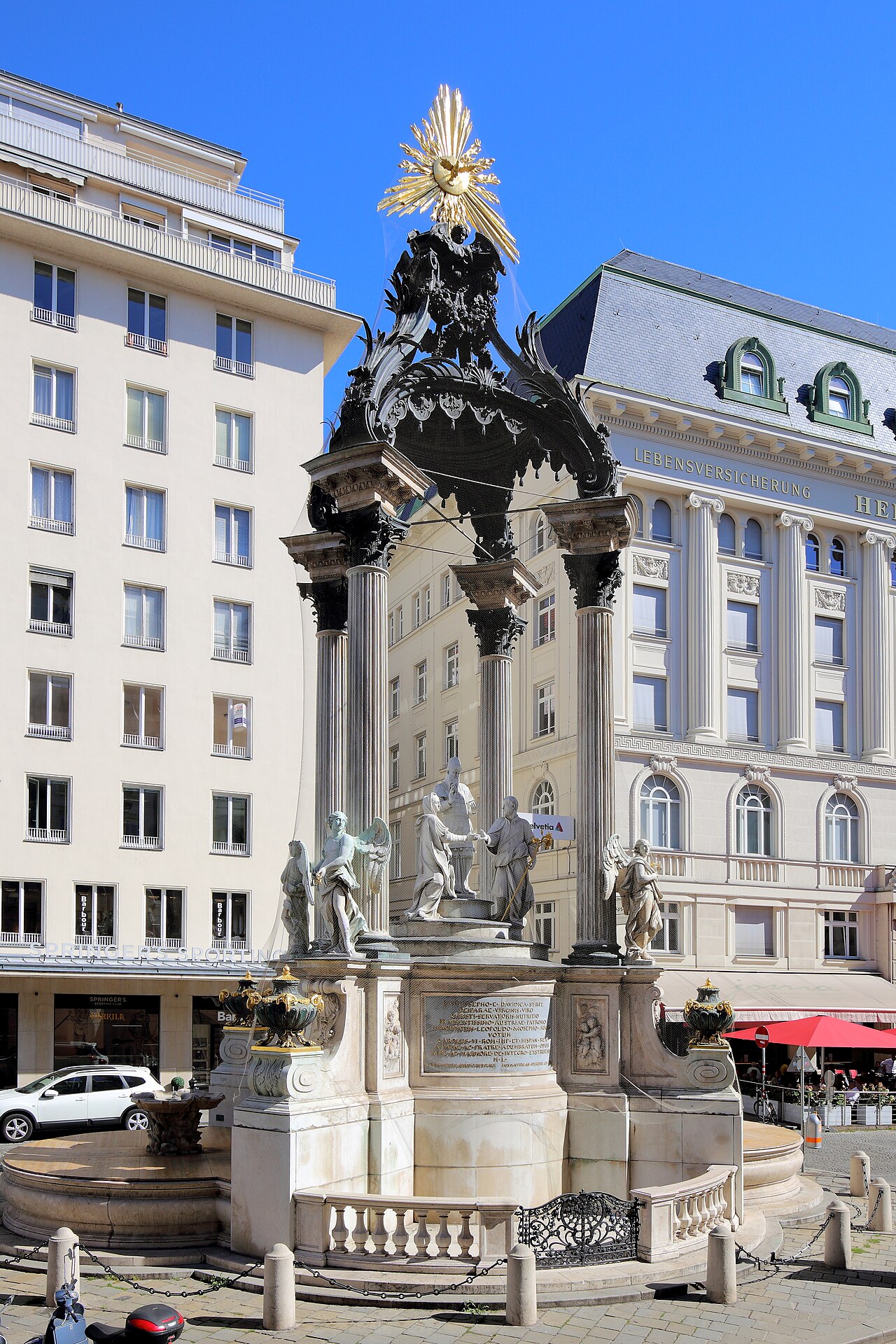
Plan the Ankeruhr as a daytime stop on a walk through Vienna’s historic centre, when the clock bridge and its surrounding decoration are easiest to examine. Hoher Markt adds context through its Roman ruins display and Baroque fountain, so the square works well as a short cluster of sights. The Innere Stadt streets lead naturally towards other central landmarks, making the clock a practical architectural pause rather than a separate half-day destination. Leave room in your route to watch the moving figures instead of treating the sight as only a quick photograph.
See the Ankeruhr from Hoher Markt as an exterior clock bridge between two buildings. The visit does not involve a museum interior or a conventional entrance sequence, so you can approach the square from different sides and choose a viewpoint that shows either the complete structure or its smaller details. Treat the clock as a public urban sight within a walking route: the bridge, figures and decoration are the focus, and the square provides the viewing space.
Hoher Markt is about a five-minute walk from Stephansplatz, served by the U1 and U3 underground lines, and a similar walk from Schwedenplatz, served by the U1 and U4. Bus route 2A stops on Hoher Markt, while central tram routes stop within a short walk of the clock. Once you reach the square, look across the open space for the bridge joining the two Anker buildings. Its central location makes it easy to combine with a walking tour of the Innere Stadt and nearby historic sights.
The Ankeruhr is an outdoor clock bridge, so your view depends on where you stand in Hoher Markt and how much space is available around the sightline. A position farther across the square gives a clearer sense of the complete design, while a closer position emphasizes individual figures and decoration. When the moving display draws a crowd, leave room for passing pedestrians and other viewers. The square is both a passage and a viewing place, so keep the main pedestrian flow clear while looking up or taking photographs.
Stand across Hoher Markt for a wide photograph that includes the complete clock bridge and both flanking buildings. Move closer for the mosaic, ornament and individual figures, or use a longer lens from farther back to isolate a figure against the decorated dial. A handheld camera is practical in the square, where pedestrians may pass between you and the clock. Photographing from several positions shows how the bridge spans the space and how the figures relate to the surrounding architecture; frame the clock before the display begins so you can watch as well as photograph.
It is an Art Nouveau clock bridge on Hoher Markt, designed by Franz von Matsch between 1911 and 1917 for the Anker Insurance company and decorated with mosaic, ornament and moving figures.
Who designed the Ankeruhr?
Franz von Matsch designed the clock between 1911 and 1917 for the Anker Insurance company.
What can I see on the clock?
The clock includes mosaic and ornamental decoration plus twelve metal figures representing historical Viennese and imperial figures, from Marcus Aurelius to Joseph Haydn.
Does the Ankeruhr have an interior?
No. The Ankeruhr is an exterior installation spanning the gap between two buildings and is viewed from Hoher Markt.
Where is the Ankeruhr located?
It stands on Hoher Markt in Vienna’s Innere Stadt, about a five-minute walk from Stephansplatz and also close to Schwedenplatz.
How should I photograph the Ankeruhr?
Stand across Hoher Markt for the complete clock bridge, then move closer for the mosaic, ornament and individual figures. A longer lens can isolate details from farther back.
Nothing non-essential is set before you choose, in regions where consent is required. If you decline, ads still appear and analytics is switched off entirely.