
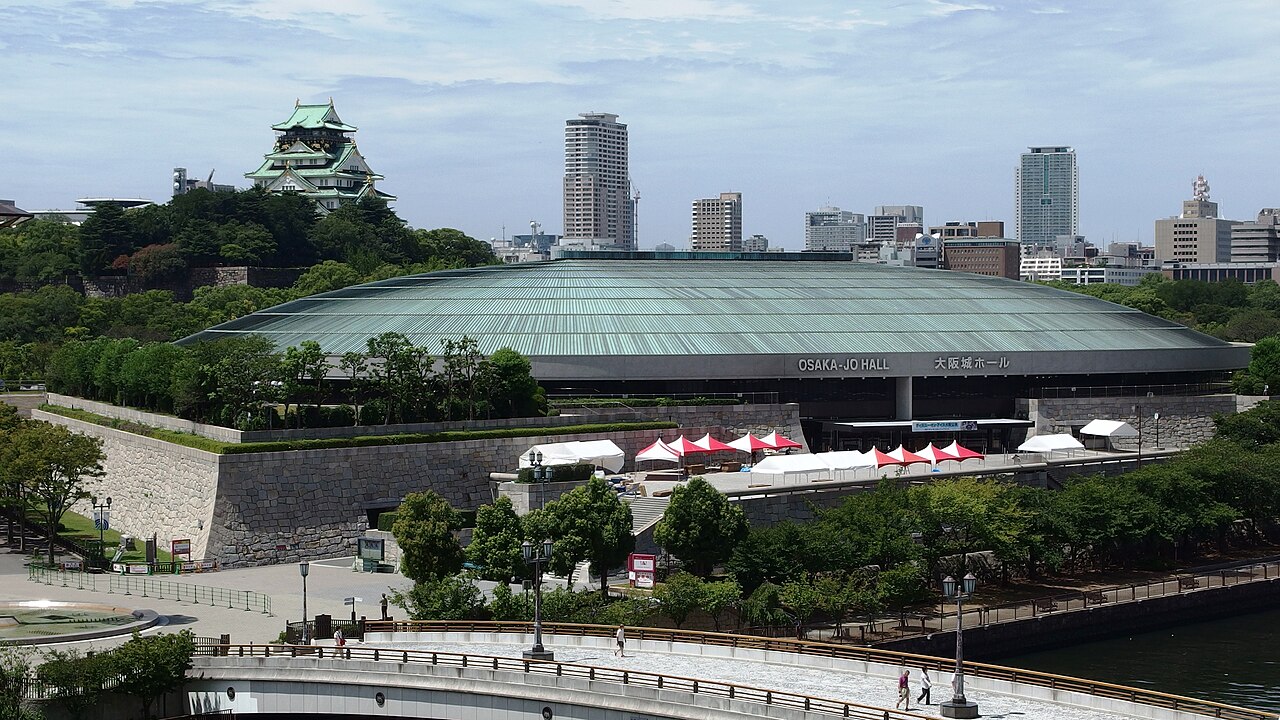
7 min walk
Osaka-jō Hall
- Must see
- Art and culture venue
Language · 11 published
Historic monument · Osaka
大阪城
Reviewed by Elena Voss · Roavina Travel Editor

| Monday | 09:00 – 18:00 |
|---|---|
| Tuesday | 09:00 – 18:00 |
| Wednesday | 09:00 – 18:00 |
| Thursday | 09:00 – 18:00 |
| Friday | 09:00 – 18:00 |
| Saturday | 09:00 – 18:00 |
| Sunday | 09:00 – 18:00 |
Checked 2026-08-31 · Source
Read from the OpenStreetMap access tags; anything not listed has no tag recorded.
Set the group type to family in the planner and the day window contracts to about three quarters of a solo day.
It was established in 1583. It is built of wood. It carries the Important Cultural Property of Japan heritage designation.
Osaka Castle is a historic fortress in Chūō-ku, Osaka, Japan. The present structure is a concrete reconstruction dating from 1931, with extensive modern renovations. It stands on the site of the original castle built by Toyotomi Hideyoshi in the late 16th century, which played a central role in the unification of Japan. The castle is surrounded by extensive parkland and moats. It serves as a museum and symbol of Osaka's historical significance. The main keep is visible from considerable distances and dominates the surrounding skyline.
Checked 2026-08-31 · Source
The main keep contains a museum spread across multiple floors. Exhibits focus on the castle's history, the life of Toyotomi Hideyoshi, and the Sengoku period. Visitors can view historical artifacts, documents, and dioramas depicting battles and castle life. The top floor offers panoramic views of Osaka city. The surrounding grounds include the Nishinomaru Garden, plum groves, and cherry blossom trees. Additional structures within the park include turrets, gates, and stone walls from earlier periods. The castle interior is accessible by elevator and stairs. Osaka Castle also earns time in a osaka itinerary because A primary visitor landmark supported by the three required source families and matched exactly to the production city pool.
Checked 2026-08-31 · Source
A thorough visit to Osaka Castle typically requires between two and three hours. This duration allows time to explore the main keep museum, ascend to the observation deck, and walk portions of the surrounding park grounds. Visitors with limited interest in museum exhibits may complete the main keep in approximately one hour. Those wishing to extensively explore the outer grounds, including Nishinomaru Garden, should allocate additional time. Seasonal factors such as cherry blossom viewing may extend typical visit durations due to crowd density and photographic stops.
Checked 2026-08-31 · Source
Open daily 09:00-18:00, last admission 17:30; closed 28 December-1 January. Events, ceremonies, maintenance and security measures can alter ordinary access. Osaka Castle can be visited throughout the year, with each season offering distinct atmospheric conditions. Spring brings cherry blossoms to the extensive grounds. Summer presents lush greenery though with high humidity. Autumn offers foliage coloration. Winter provides clearer atmospheric conditions for photography. The castle is illuminated during select evening periods seasonally. JR Osakajokoen or Morinomiya stations; Osaka Metro Tanimachi 4-chome serves the southwest. Weather considerations should include Japan's rainy season typically occurring in early summer. Crowd levels vary significantly during domestic holiday periods.
Checked 2026-08-31 · Source
Adult castle museum admission is JPY 1,200; Osaka Castle Park grounds are free. Premium experiences and event products cost separately. Admission to the main keep requires payment. The surrounding park grounds are generally accessible without charge, though specific garden areas may have separate admission requirements. Combination arrangements may exist for multiple facilities. Group rates, if available, would require direct inquiry. Any changes to admission policies since last documentation would not be reflected here.
Checked 2026-08-31 · Source
JR Osakajokoen or Morinomiya stations; Osaka Metro Tanimachi 4-chome serves the southwest. This is the named public-transport approach for an independent visit. Osaka Castle is accessible via multiple public transportation options. The nearest stations include Osakajōkōen Station on the JR Loop Line and various subway stations including Tanimachi 4-chome and Morinomiya. Walking distances from stations vary. The site is situated within Osaka's urban core with established pedestrian infrastructure. Cycling to the perimeter is feasible. Signage in Japanese and English assists navigation from major transit points. The castle's visibility assists orientation for approaching visitors.
Checked 2026-08-31 · Source
Step-free entrances or public approaches, lifts where required, and accessible toilets serve principal visitor areas. The access description applies to principal visitor areas rather than every historic or operational space. The main keep reconstruction dates from 1931 and is not the original structure, which may affect expectations of historical authenticity. Elevator access exists but may have queues during peak visitation. The observation deck involves exposure to weather conditions. Extensive walking on varied surfaces is required for full ground exploration. Summer conditions involve heat and humidity that may affect comfort. Crowding during cherry blossom season and holidays significantly impacts experience quality. Some exterior areas lack shade. The moat edges present standard water safety considerations. Standard urban visitor awareness regarding personal belongings applies throughout the grounds.
Checked 2026-08-31 · Source
Photography opportunities exist at multiple scales and perspectives. The castle exterior is photographable from numerous angles around the moat and grounds. The observation deck permits cityscape photography though glass barriers may affect quality. Interior museum photography may be restricted in specific exhibit areas; signage should be observed. Early morning and late afternoon light provide favorable conditions for exterior castle photography. Night illumination, when operational, creates alternative photographic conditions. Drone operation would be subject to standard Japanese aviation regulations and local prohibitions. Seasonal vegetation significantly alters compositional possibilities.
Checked 2026-08-31 · Source
Open daily 09:00-18:00, last admission 17:30; closed 28 December-1 January.
Adult castle museum admission is JPY 1,200; Osaka Castle Park grounds are free.
Step-free entrances or public approaches, lifts where required, and accessible toilets serve principal visitor areas.
JR Osakajokoen or Morinomiya stations; Osaka Metro Tanimachi 4-chome serves the southwest.
Yes. Events, maintenance, weather and ceremonies can change ordinary access.
No. Special tours, exhibitions and upgrades use separate tickets.
Loading the interactive map…
The interactive map could not be loaded.
Last updated:
Source: OpenStreetMap contributors, Wikidata ·