

9 min walk
Osaka Castle
- Must see
- Historic monument
Museum · Osaka
大阪歴史博物館
| Monday | 09:30 – 17:00 |
|---|---|
| Tuesday | Closed |
| Wednesday | 09:30 – 17:00 |
| Thursday | 09:30 – 17:00 |
| Friday | 09:30 – 17:00 |
| Saturday | 09:30 – 17:00 |
| Sunday | 09:30 – 17:00 |
Checked 2026-08-31 · Source
| Per person | ¥600 |
|---|
Checked 2026-08-31 · Source
Read from the OpenStreetMap access tags; anything not listed has no tag recorded.
Set the group type to family in the planner and the day window contracts to about three quarters of a solo day.
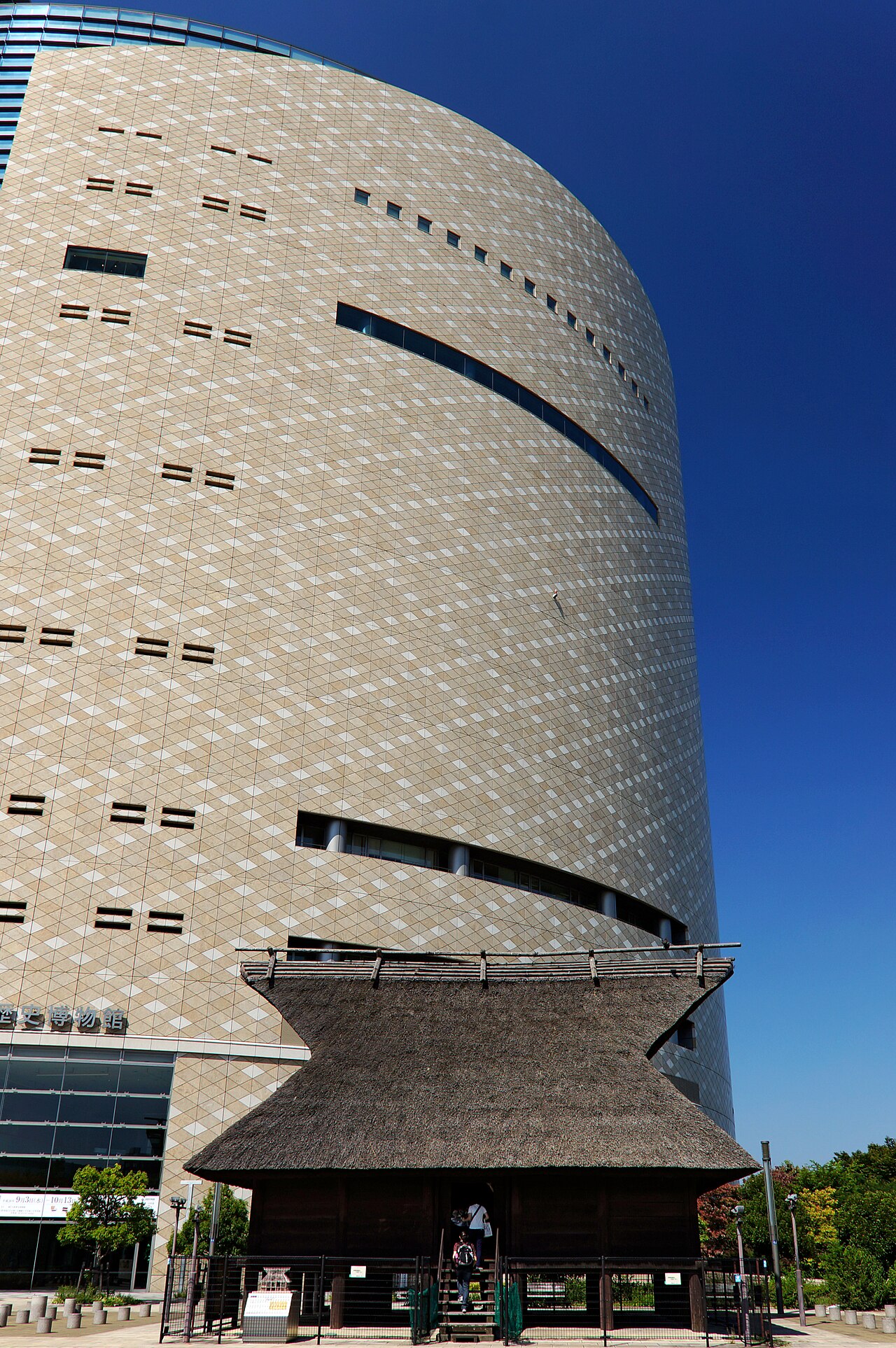
The Osaka Museum of History is the city's history museum, at 4-1-32 Otemae in Chuo-ku, immediately south-west of Osaka Castle Park. It opened on 3 November 2001 and is not a converted old building: Osaka City and NHK built it together as a single complex with the new NHK Osaka Broadcasting Station, on the site of the former municipal central gymnasium, as part of the city's plan to join the Naniwa Palace site to Osaka Castle Park. The ground under it decided what the museum would be.
Checked 2026-08-31 · Source
The permanent exhibition runs from the tenth floor down to the seventh, and the route is chronological: visitors take the lift to the top and work downwards. The tenth floor is the ancient city, built around a partial reconstruction of the Daikokuden of the Nara-period Naniwa Palace, with life-size vermilion-painted pillars seventy centimetres across, mannequins in court dress and video of court life. The ninth floor covers the age of Osaka Hongan-ji and the Edo-period water city, presented largely through townscape models at one-twentieth scale. The eighth floor is the Naniwa Archaeological Resource Centre, with a life-size replica excavation and real archaeological tools to handle.
Checked 2026-08-31 · Source
The museum publishes two routes through the permanent floors and says the shorter of them, the Highlight Course, takes in Osaka's history in about an hour by concentrating on the life-size reconstructions, the scale models and the key photographs and film. The Complete Course is the same four floors walked slowly, stopping at the individual cases. An hour is therefore the operator's own floor, not a target. Ninety minutes is the figure to plan on: it covers the Highlight Course at a comfortable pace, leaves time for the models on the ninth floor, which are the part visitors linger over longest, and absorbs the wait for a lift.
Checked 2026-08-31 · Source
Open Wednesday-Monday 09:30-17:00, last admission 16:30; closed Tuesday and year-end/New Year. Events, ceremonies, maintenance and security measures can alter ordinary access. The museum opens at 9:30 and closes at 17:00, with the last admission thirty minutes before closing, at 16:30. It is closed every Tuesday; when a Tuesday falls on a national holiday it opens that day and closes the following day instead. It also closes from 28 December to 4 January. Those two rules catch more visitors than anything else here, because a Tuesday in Osaka is easily filled with Osaka Castle and Osaka Castle Park next door and the museum quietly missed. The useful hour to arrive is between 9:30 and 11:00.
Checked 2026-08-31 · Source
Adult permanent-exhibition admission is JPY 600; special exhibitions use separate tickets. Premium experiences and event products cost separately. Admission to the permanent exhibition is 600 yen for adults and 400 yen for high school and university students, who are asked to show student identification. Junior high school pupils and younger children enter free. So do residents of Osaka City aged 65 or over on production of proof, such as a senior travel pass or a driving licence, and holders of a disability certificate together with one carer; the digital Mirairo ID certificate is accepted in place of the paper one.
Checked 2026-08-31 · Source
Osaka Metro Tanimachi 4-chome station, exits 2 or 9. This is the named public-transport approach for an independent visit. No car is needed and none is worth the trouble. The museum sits on top of a subway interchange: Tanimachi 4-chome station, served by the Osaka Metro Tanimachi and Chuo lines, has its exit 9 immediately beside the building, while exit 2 leaves a walk of roughly 300 metres east. Osaka City Bus stops at Banbacho, directly in front. From Kansai International Airport the museum is about seventy minutes by train, taking the airport line to JR Tennoji and changing to the Tanimachi line, or fifty minutes by car.
Checked 2026-08-31 · Source
Step-free entrances or public approaches, lifts where required, and accessible toilets serve principal visitor areas. The access description applies to principal visitor areas rather than every historic or operational space. Umbrellas cannot be carried into the galleries: long objects are refused because of the risk to the displays, so a wet day means leaving one downstairs. Only pencils may be used for notes and sketches; pens and mechanical pencils are barred because ink and broken leads damage the cases. Eating and drinking are confined to the first-floor restaurant, Lunch Japonica, whose last order is at 16:30; a packed lunch has to be eaten outside the building, and the second floor rest corner has only vending machines.
Checked 2026-08-31 · Source
Photography is allowed in the permanent exhibition for personal use, with clear limits. Anything carrying a "Do Not Photograph" sign is off limits. Cameras and phones must be hand-held: no flash, no additional lighting, no monopods, no tripods and no selfie sticks, the last three because they hit the cases and the other visitors. The film playing inside the galleries is not to be recorded. Other visitors and members of staff should be kept out of the frame, and photographing while walking, or standing over one exhibit for a long time, is asked against. Nothing shot inside may be reproduced, distributed or used commercially.
Checked 2026-08-31 · Source
Open Wednesday-Monday 09:30-17:00, last admission 16:30; closed Tuesday and year-end/New Year.
Adult permanent-exhibition admission is JPY 600; special exhibitions use separate tickets.
Step-free entrances or public approaches, lifts where required, and accessible toilets serve principal visitor areas.
Osaka Metro Tanimachi 4-chome station, exits 2 or 9.
Yes. Events, maintenance, weather and ceremonies can change ordinary access.
No. Special tours, exhibitions and upgrades use separate tickets.
Loading the interactive map…
The interactive map could not be loaded.
Last updated:
Source: OpenStreetMap contributors, Wikidata ·