
2 min walk
Sumiyoshi Taisha
- Must see · Heritage site
- Place of worship
Historic site · Osaka
| Monday | 06:00 – 17:00 |
|---|---|
| Tuesday | 06:00 – 17:00 |
| Wednesday | 06:00 – 17:00 |
| Thursday | 06:00 – 17:00 |
| Friday | 06:00 – 17:00 |
| Saturday | 06:00 – 17:00 |
| Sunday | 06:00 – 17:00 |
| Monday | 06:30 – 17:00 |
|---|---|
| Tuesday | 06:30 – 17:00 |
| Wednesday | 06:30 – 17:00 |
| Thursday | 06:30 – 17:00 |
| Friday | 06:30 – 17:00 |
| Saturday | 06:30 – 17:00 |
| Sunday | 06:30 – 17:00 |
Checked 2026-08-26 · Source
| Per person | Free entry |
|---|
Checked 2026-08-26 · Source
Sumiyoshi Taisha is the head shrine of approximately 2,300 Sumiyoshi shrines throughout Japan and the ichi-no-miya, or first-ranked shrine, of the former Settsu Province. The shrine’s official English account dates its founding to 211 and attributes it to empress-regent Jingū. Four deities are enshrined: sea gods Sokotsutsuno-o, Nakatsutsuno-o and Uwatsutsuno-o, collectively the Sumiyoshi Sanjin, and Jingū herself, enshrined after her death as Okinagatarashihime. The shrine is associated with maritime protection; people working in fishing and shipping still pray here for safe voyages. The official history places Naniwa harbor near the shrine as a departure point for diplomatic missions to mainland Asia between the seventh and ninth centuries. About two million visitors come each January for hatsumōde, the traditional first shrine visit of the year. (English brochure, checked 2026-10-06; official overview and history, checked 2026-10-06)
Checked 2026-10-06 · Source
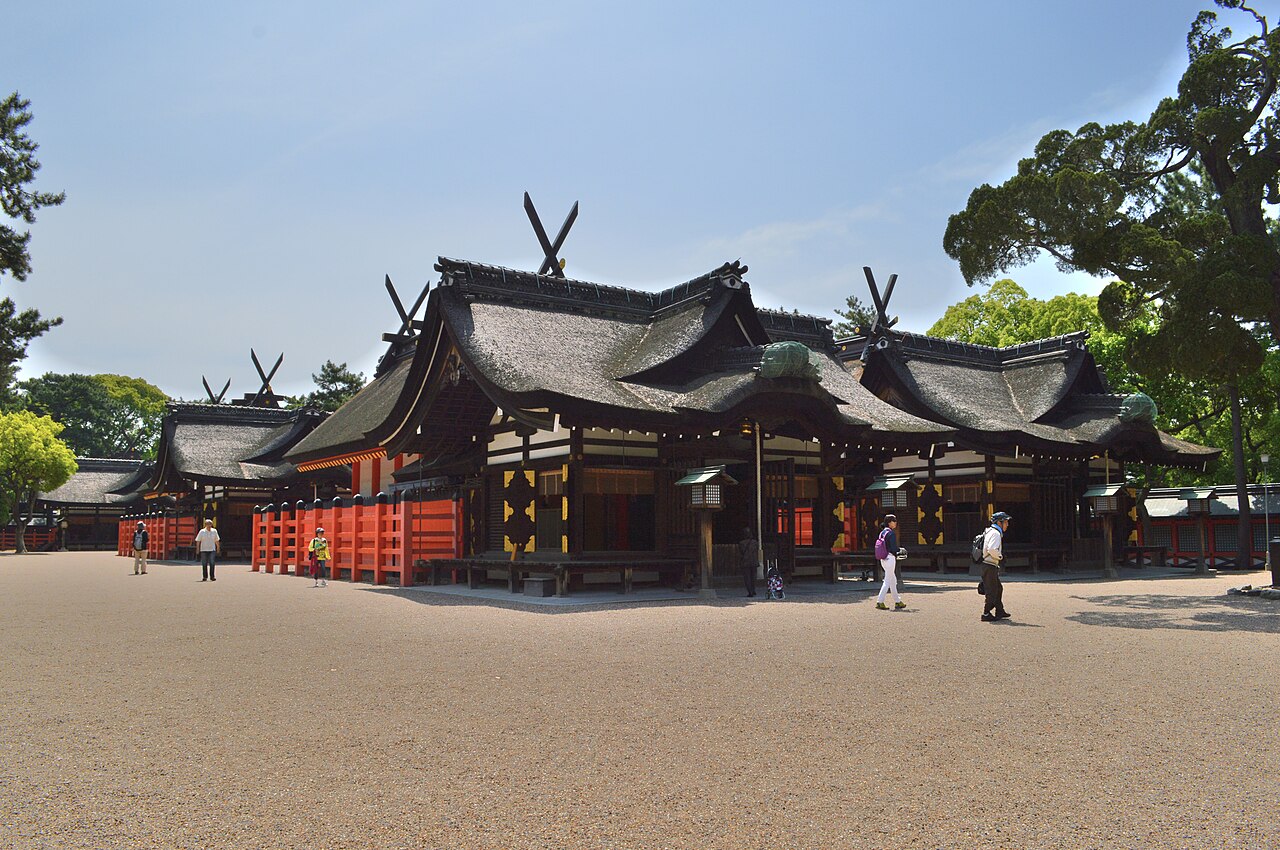
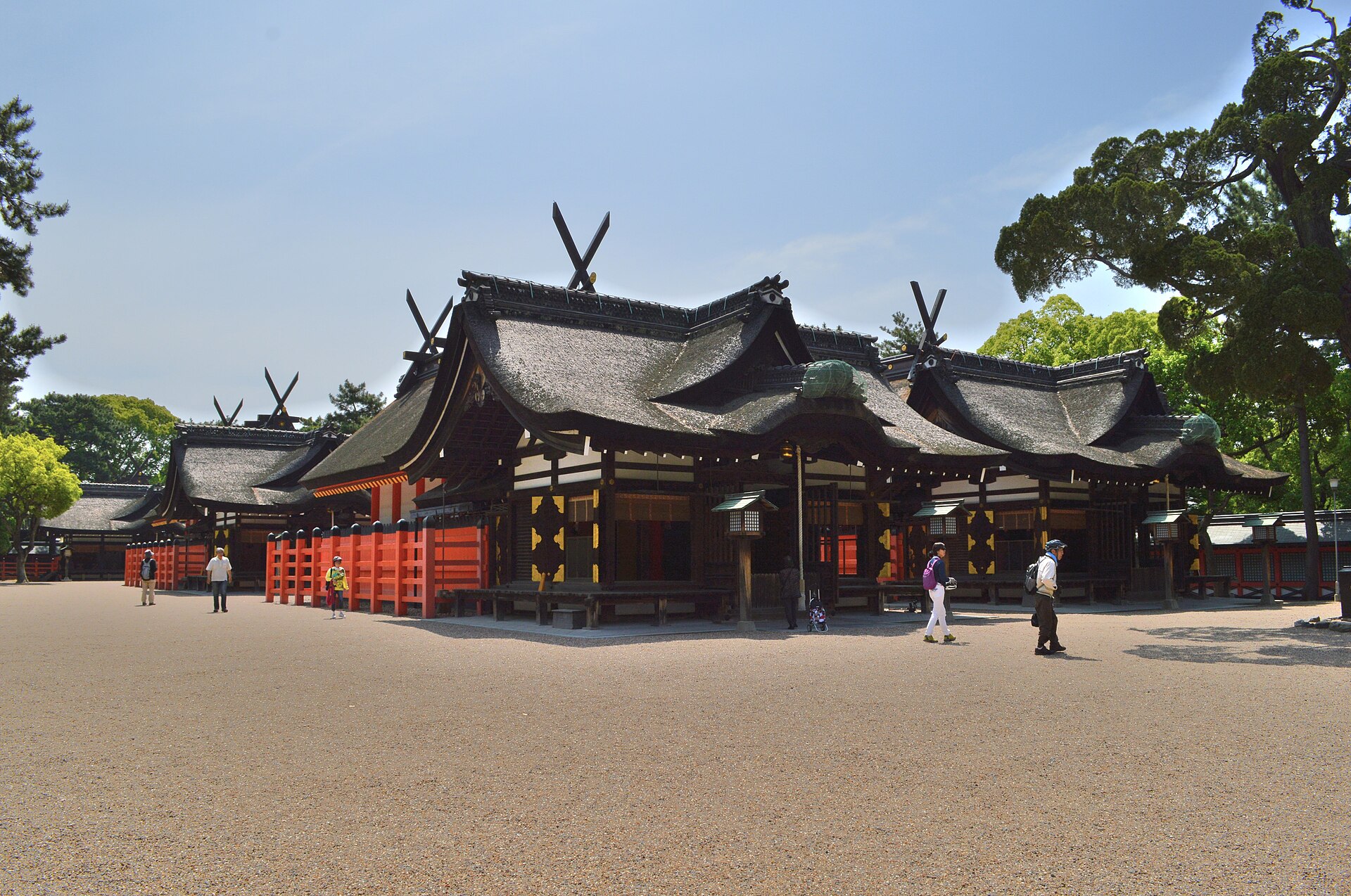
The precinct covers about thirty thousand tsubo and holds four main halls and twenty-seven auxiliary shrines. The four honden were built in 1810 and are National Treasures. They are built in the sumiyoshi-zukuri style, which predates the architectural influence that arrived from the Asian mainland: straight-cut gable roofs shingled in cypress bark, beams painted vermilion with mercury pigment, walls whitewashed with crushed seashell, and an interior divided into an outer and an inner room. Three of them stand in a single line running east to west rather than facing south, an arrangement one theory links to the three stars of Orion's belt that navigators steered by. The fourth, Jingu's, sits beside the westernmost, identical except that the crossed timbers on its roof ridge are cut horizontally rather than vertically. In front of them stands the Ishibutai, a stone stage built in 1607 at the request of Toyotomi Hideyori, flanked by the South Gate and two musicians' galleries; all are Important Cultural Properties. The Sorihashi, the steep arched bridge over the pond at the western entrance, is about twenty metres long, 3.6 metres high and 5.5 metres wide. Smaller things reward a slow walk: the Goshogozen stones, the bronze rabbit before the fourth hall, the Tanjoseki, and the bowl of Issun-boshi at Tanekashi-sha.
Checked 2026-08-26 · Source
The shrine publishes its own model routes with times attached, which makes this one of the rare places where the visit length does not have to be guessed. The formal worship route — across the Sorihashi, a stop at the water basin, then the four main halls in any order, since the shrine states there is no prescribed sequence — is given as about twenty minutes. Each of the themed routes then adds to it: the business prosperity circuit of the four subsidiary shrines is about forty minutes, the wish-fulfilment route by way of Goshogozen and the Omokaru-ishi about forty, the matchmaking route about twenty, and the safe-childbirth route about thirty. An hour is the sensible planning figure for a first visit: the twenty-minute core plus one of the longer circuits, with time for the amulet office. Two things stretch it. The Omokaru-ishi sits inside Otoshi-sha, a two-minute walk southeast of the main precinct, and at weekends and on hatsu-tatsu days it draws a queue long enough to be worth seeing before joining. Anyone intending to have a prayer performed should add the wait at the prayer reception on top.
Checked 2026-08-26 · Source
Sumiyoshi Taisha has seasonal opening hours. The gates open at 6:00 from April through September and at 6:30 from October through March; on the first day of each month and on hatsu-tatsu days they open at 6:00. The outer gates close at 16:00, while the inner fenced precinct remains open until 17:00 year-round. Other sites within the grounds, including Nankun-sha, Tanekashi-sha and the Omokaru-ishi, close at 16:00. During the New Year period and Sumiyoshi Matsuri, opening and closing times differ; the shrine asks visitors to inquire about those dates. The Japanese access page does not list a regular weekly closing day. (Official access and hours, checked 2026-10-06)
Checked 2026-10-06 · Source
Admission to the shrine grounds is free, as stated in the official FAQ. Parking and shrine services are separate charges, not an entrance fee. The FAQ lists parking at 200 yen per 30 minutes for passenger cars, with possible peak-season changes, and 2,000 yen per hour for large vehicles. Prayer rites and protective charms are separate services or purchases. The FAQ also says credit cards are not accepted for purchases at the souvenir shop and Nankunsha Shrine. (Official FAQ, checked 2026-10-06; prayer service information, checked 2026-10-06)
Checked 2026-10-06 · Source
No car is needed, and three separate railways stop within five minutes' walk. The Nankai Main Line has a station named Sumiyoshitaisha, and the shrine gives it as a three-minute walk east. The Nankai Koya Line stops at Sumiyoshihigashi, five minutes to the west. The Hankai tramway — a street tram rather than a railway — stops at Sumiyoshi-toriimae, which the shrine describes as immediately at the gate; the tram crosses the main road right in front of the western entrance, and it is the approach that puts the Sorihashi in front of a visitor first. The address is 2-9-89 Sumiyoshi, Sumiyoshi-ku, Osaka 558-0045, telephone +81-6-6672-0753. Drivers coming from the north are directed onto Hanshin Expressway Route 15, the Sakai line, off at the Tamade exit, left at the Shinkaiseibashi crossing, right at Tsukanishi, then about three minutes along the tramline. From the south the route is Hanshin Expressway Route 4, the bay line, off at Ohama, north on Route 26, right at Hamaguchi, east along Nagai-koen-dori, left at Anryu 1 and on to the tramline; the shrine warns that large vehicles cannot use this approach.
Checked 2026-08-26 · Source
The two closing times catch people out. The outer perimeter gates shut at four in the afternoon while the inner precinct stays open until five, and the subsidiary shrines, the Goshogozen stones and the Omokaru-ishi all stop at four; the amulet office runs to five and the prayer reception closes at ten to four. A visitor arriving at half past four still gets the four main halls and very little else. The New Year period is a different place altogether. Traffic restrictions run from eleven at night on 31 December until about seven the following evening, and from ten in the morning to about seven in the evening on 2 and 3 January; the car park is closed from 31 December to 3 January and its rates change again from 4 January to early February, when prayers are also moved into the National Treasure halls rather than the prayer hall. During the midsummer Sumiyoshi Matsuri the portable shrine procession brings temporary restrictions, though the car park works normally. The Sorihashi is steep — its maximum gradient is about 48 degrees, and Kawabata Yasunari wrote that coming down it frightens more than going up. The Kisshoden hall and its café close on Wednesdays.
Checked 2026-08-26 · Source
One rule is published and it is worth knowing before the camera comes out: the shrine asks that no photographs be taken during prayer rites. Rites run through the day from nine in the morning, so anyone framing the prayer hall should check first whether a ceremony is under way inside. Elsewhere the shrine is welcoming about photography, and its own pages invite visitors to be photographed sitting in the bowl of Issun-boshi at Tanekashi-sha. The Sorihashi is the picture most people come for, and it works best from the western bank of the pond, where the whole arch and its reflection close into a circle; early morning gives it flat water and no queue on the steps. The four honden are harder than they look. They stand in a line running east to west behind fences, so a clean elevation is rarely available; the rewarding frame is the vermilion beams against the white shell-lime walls and the cypress shingles, taken close. Look at the lower edge of the first hall's roof, where coins thrown by New Year crowds who could not reach the offering box have lodged in the shingles. On performance days a vermilion fence is set along the stone stage.
Checked 2026-08-26 · Source
The official Japanese access page lists seasonal hours: the gates open at 6:00 from April through September and at 6:30 from October through March, with a 6:00 opening on the first day of each month and on hatsu-tatsu days. The outer gates close at 16:00; the inner fenced precinct remains open until 17:00. The page does not list a regular weekly closing day. Opening and closing times differ during the New Year period and Sumiyoshi Matsuri; contact the shrine about those dates.
No. The shrine’s official FAQ states that admission is free. Parking is charged separately: 200 yen per 30 minutes for passenger cars, with possible peak-season changes, and 2,000 yen per hour for large vehicles. Prayer rites and protective charms are separate services or purchases, not entrance fees; the shrine publishes prayer fees on its prayer information page. ([Prayer information](https://www.sumiyoshitaisha.net/worship/info.html), checked 2026-10-06)
Three lines stop within five minutes' walk. The Nankai Main Line station is called Sumiyoshitaisha and the shrine gives it as three minutes' walk east. The Nankai Koya Line stops at Sumiyoshihigashi, five minutes west. The Hankai tramway stops at Sumiyoshi-toriimae, which the shrine describes as being right at the entrance; this is a street tram, not a railway. No car is needed to reach the shrine.
There is a visitors' car park with room for about 200 cars and five coaches. The shrine gives 200 yen per 30 minutes for an ordinary car and 2,000 yen per hour for a coach, with two hours free for anyone receiving a prayer. Coaches must be booked in advance. The car park closes at night, closes entirely from 31 December to 3 January, and charges different rates during the busy period from 4 January to early February.
About an hour. The shrine's own formal worship route — the arched bridge, the water basin and the four main halls — is given as roughly 20 minutes, and each themed circuit adds to that: about 40 minutes for the business prosperity route through the four subsidiary shrines, about 40 for the wish-fulfilment route, about 30 for the safe-childbirth route and about 20 for the matchmaking route. Add waiting time if you want a prayer performed or intend to queue for the Omokaru-ishi.
No booking is taken or needed. The shrine states that prayers are received at any time within the opening window and performed as visitors arrive; reception is beside the main halls, on their left as you face them, and is open daily from 9:00 to 15:50. From 1 January to early February prayers are held in the National Treasure main halls instead of the prayer hall. Only off-site rites, such as a ground-breaking ceremony, must be arranged in advance by telephone.
Loading the interactive map…
The interactive map could not be loaded.
Last updated:
Source: OpenStreetMap contributors ·